Intel Core Ultra 7 265K
vs
Intel Core i5-14600K


CPU Comparison Result
Intel Core Ultra 7 265K vs Intel Core i5-14600K: New Platform vs Cost-Effective i5
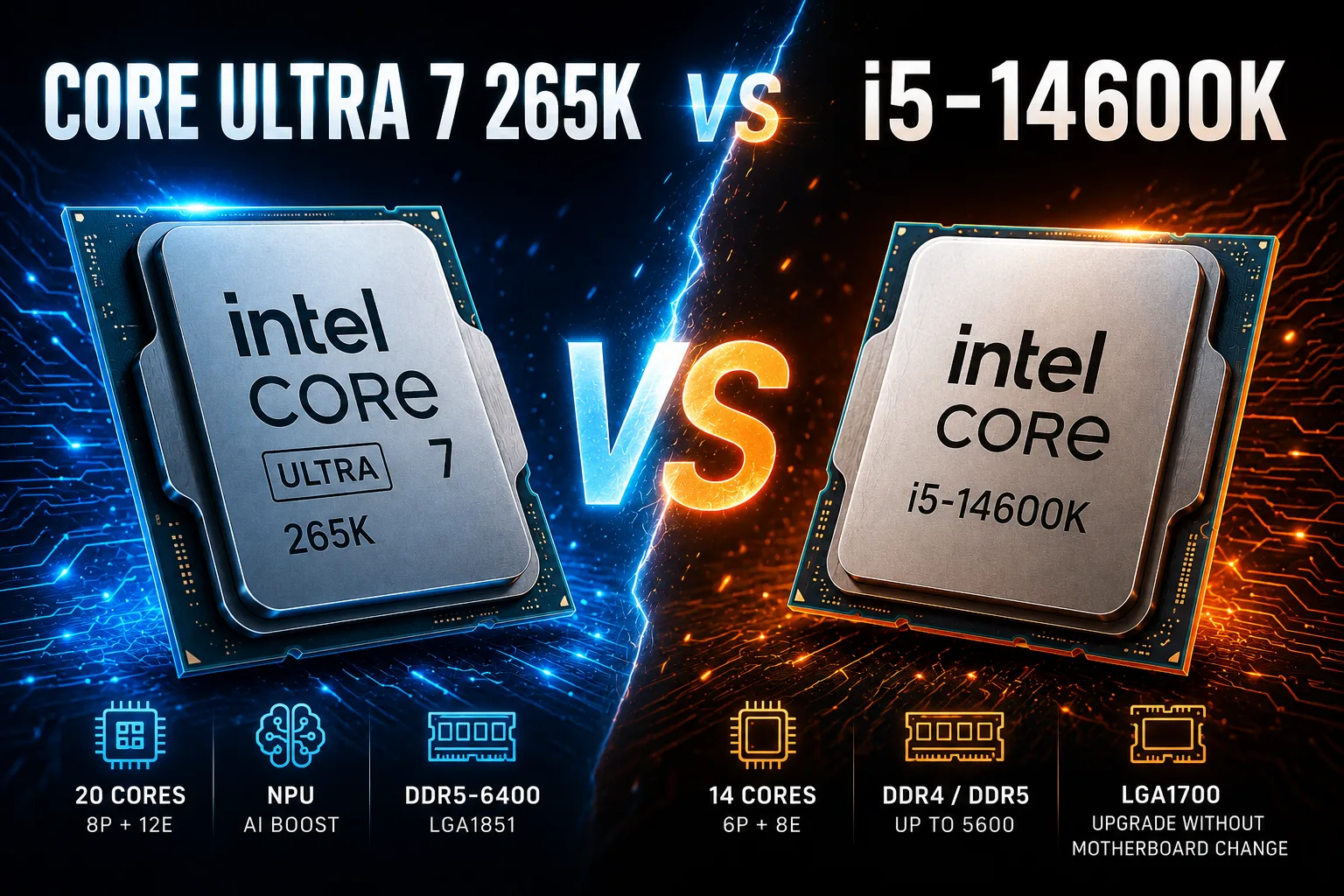
Intel Core Ultra 7 265K and Intel Core i5-14600K represent a comparison not only of two processors but of two platforms as well. The Core Ultra 7 265K is newer, faster in multithreaded tasks, and designed for LGA1851. The Core i5-14600K is older but still strong in gaming, supports LGA1700, and can work with DDR4.
In brief: Core Ultra 7 265K is better for a new work build, while Core i5-14600K is more cost-effective for a gaming PC and upgrading an old platform.
Key Difference
Both processors feature 20 threads, but they are designed differently.
Core Ultra 7 265K has 20 physical cores: 8 performance cores and 12 efficiency cores. There is no Hyper-Threading here.
Core i5-14600K has 14 physical cores: 6 performance cores and 8 efficiency cores. It reaches up to 20 threads through Hyper-Threading on the P-cores.
So, the Core Ultra 7 265K relies on the number of physical cores and new architecture, while the Core i5-14600K leverages high frequency, a mature platform, and good pricing.
Key Specifications
| Characteristic | Core Ultra 7 265K | Core i5-14600K |
|---|---|---|
| Architecture | Arrow Lake | Raptor Lake Refresh |
| Socket | LGA1851 | LGA1700 |
| Cores | 20: 8P + 12E | 14: 6P + 8E |
| Threads | 20 | 20 |
| Hyper-Threading | No | Yes on P-cores |
| Max Frequency | up to 5.5 GHz | up to 5.3 GHz |
| L3 Cache | 30 MB | 24 MB |
| L2 Cache | 36 MB | 20 MB |
| Memory | DDR5-6400 | DDR5-5600 / DDR4-3200 |
| Base Power | 125 W | 125 W |
| Max Turbo Power | 250 W | 181 W |
| Integrated Graphics | Intel Graphics, 4 Xe-cores | Intel UHD Graphics 770 |
| NPU | Yes | No |
Performance
In multithreaded tasks, the Core Ultra 7 265K is significantly faster. It has more physical cores, more L2 cache, and a new architecture. The advantage is particularly noticeable in rendering, video encoding, compiling, archiving, and heavy multitasking.
| Test | Core Ultra 7 265K | Core i5-14600K | Commentary |
|---|---|---|---|
| PassMark CPU Mark | ~58,700 | ~38,400 | 265K is noticeably faster |
| PassMark Single Thread | ~4,930 | ~4,270 | 265K is faster, but the gap is smaller |
| Multithreaded Tasks | Higher | Lower | Advantage for 265K |
| Gaming | close | close | often resolved by the GPU |
In everyday tasks, both processors are very fast. Browsing, office applications, launching programs, light photo editing, and daily multitasking do not create a significant load for them.
Gaming
In gaming, the Core i5-14600K still performs confidently. The Core Ultra 7 265K is newer and stronger in work tasks, but this doesn't always translate into a noticeable increase in FPS.
In many games, the graphics card, frequency, memory latency, and engine optimization are more important. If the focus is on the GPU, the difference between these processors may be minimal.
The Core Ultra 7 265K is better suited for mixed scenarios: gaming, streaming, video recording, browsing, Discord, and background tasks simultaneously. However, if a fast gaming processor is needed, the Core i5-14600K often proves to be more rational.
Work Tasks
The Core Ultra 7 265K excels in tasks that utilize all cores:
- rendering;
- video editing and encoding;
- compiling large projects;
- archiving;
- working with large volumes of files;
- virtual machines;
- heavy multitasking.
The Core i5-14600K also remains a strong processor, but under regular heavy loads, the Core Ultra 7 265K will provide a greater margin.
Platform and Build Price
The Core Ultra 7 265K requires an LGA1851 motherboard and DDR5 memory. This is more modern but also more expensive.
The Core i5-14600K works on LGA1700. This is a plus for upgrades: if there is already a Z690, Z790, B660, or B760 board with the appropriate BIOS, only the processor can be replaced. Support for DDR4 also helps reduce the cost of the build.
Therefore, the Core i5-14600K is particularly interesting not as the newest CPU, but as a cost-effective processor in terms of price-to-performance ratio.
Power Consumption and Cooling
Both processors have a base power consumption of 125 W. However, the maximum turbo limit for the Core Ultra 7 265K is higher-up to 250 W compared to 181 W for the Core i5-14600K.
For the Core Ultra 7 265K, good cooling is recommended: a powerful tower cooler or liquid cooling system. The Core i5-14600K can also get hot when limits are disabled, but it is easier to keep it within comfortable temperatures.
Integrated Graphics and NPU
The Core Ultra 7 265K features more modern integrated graphics with Intel Graphics that includes Xe-cores and a separate Intel AI Boost NPU. This is beneficial for media tasks, Quick Sync, output without a dedicated graphics card, and future AI features in applications.
The Core i5-14600K uses Intel UHD Graphics 770. This is sufficient for basic tasks and diagnostics, but it lacks additional capabilities.
What to Choose
| Scenario | Best Choice |
|---|---|
| New Work PC | Core Ultra 7 265K |
| Gaming PC with discrete GPU | Core i5-14600K |
| Upgrade from LGA1700 | Core i5-14600K |
| Rendering, editing, compiling | Core Ultra 7 265K |
| Use of DDR4 | Core i5-14600K |
| More modern platform | Core Ultra 7 265K |
| Maximum cost-effectiveness | Core i5-14600K |
Conclusion
Intel Core Ultra 7 265K is faster and more modern. It is better suited for a new build, heavy work, multitasking, rendering, editing, and compiling. It has more physical cores, more cache, a newer LGA1851 platform, DDR5-6400, an NPU, and more modern integrated graphics.
Intel Core i5-14600K is more cost-effective for gaming and upgrades. It has a lower platform cost, supports DDR4, operates on LGA1700, and still delivers excellent gaming performance.
If you need a new versatile PC with headroom for work, go for the Core Ultra 7 265K. If you need a fast and sensible gaming processor, the Core i5-14600K is the better choice.
Advantages
- More Total Cores: 20 (20 vs 14)
- Higher Performance-core Max Turbo Frequency: 5.5 GHz (5.5 GHz vs 5.3 GHz)
- Larger L3 Cache: 30 MB shared (30 MB shared vs 24MB)
- Higher Technology: 3 nm (3 nm vs Intel 7)
- Newer Launch Date: December 2024 (December 2024 vs October 2023)
Basic
CPU Specifications
Memory Specifications
GPU Specifications
Benchmarks
Related CPU Comparisons


Share in social media
Or Link To Us
<a href="https://cputronic.com/en/cpu/compare/intel-core-ultra-7-265k-vs-intel-core-i5-14600k" target="_blank">Intel Core Ultra 7 265K vs Intel Core i5-14600K</a>