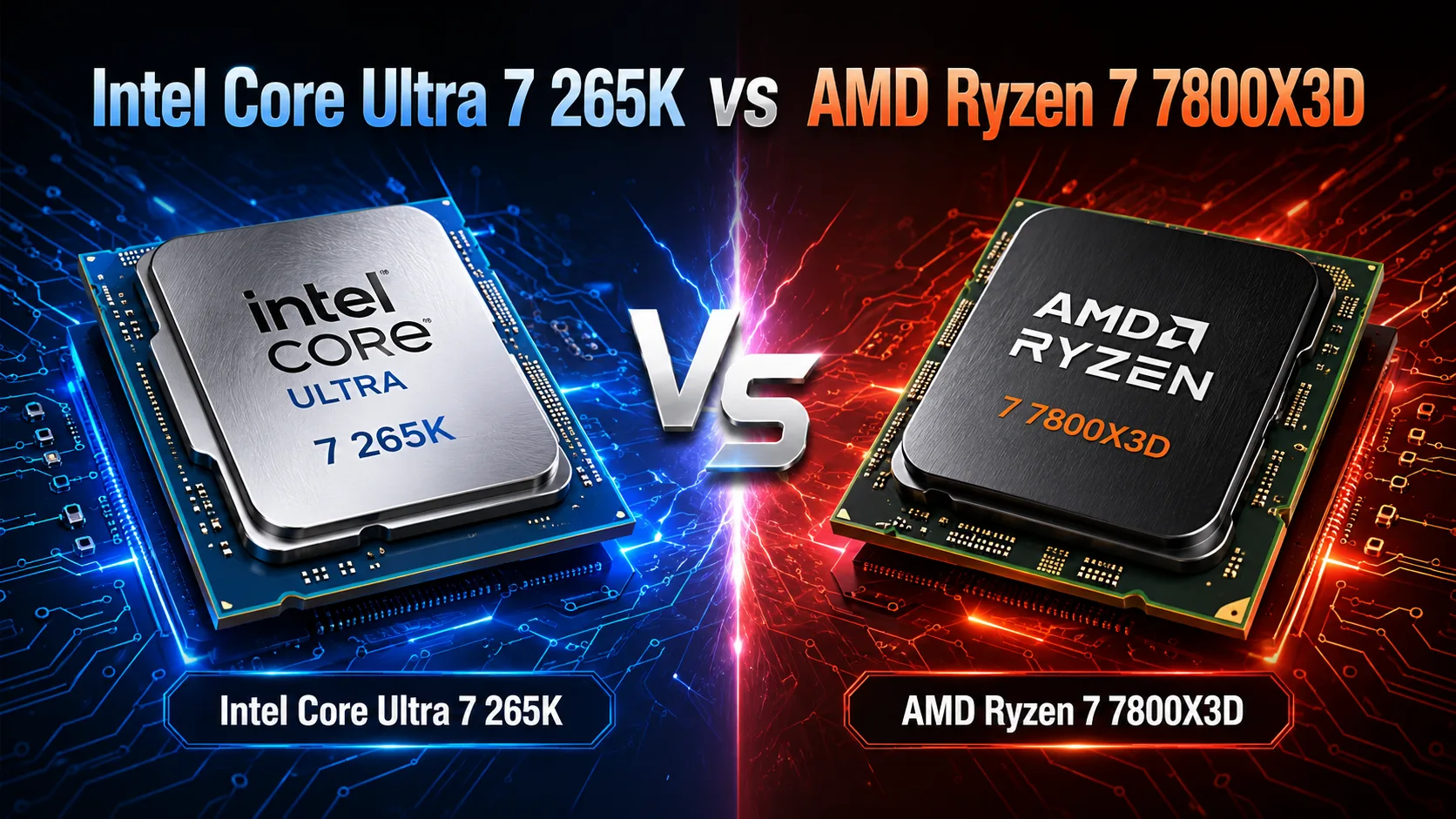
Intel Core Ultra 7 265K
vs
AMD Ryzen 7 7800X3D
CPU Comparison Result
Intel Core Ultra 7 265K vs Ryzen 7 7800X3D: Why 20 Cores Don't Guarantee Victory
The Intel Core Ultra 7 265K appears more powerful on almost all formal indicators: 20 cores, a frequency of up to 5.5 GHz, and a newer architecture. However, the Ryzen 7 7800X3D wins not with the number of computational blocks, but with its 96 MB of L3 cache. In gaming, this feature is often more critical than Intel's additional E-cores.
Therefore, there is no universal winner here. The Ryzen 7 7800X3D is better suited for a gaming PC, while the Core Ultra 7 265K is ideal for a system where gaming is combined with editing, rendering, compiling, and other heavy workloads.
Key Differences
| Characteristic | Intel Core Ultra 7 265K | AMD Ryzen 7 7800X3D |
|---|---|---|
| Architecture | Arrow Lake | Zen 4 |
| Cores and Threads | 20 / 20 | 8 / 16 |
| Configuration | 8 P-Core + 12 E-Core | 8 Zen 4 cores |
| Max Frequency | 5.5 GHz | 5.0 GHz |
| L3 Cache | 30 MB | 96 MB |
| Max Power | Up to 250 W | TDP 120 W |
| Socket | LGA 1851 | AM5 |
| Integrated Graphics | Intel Graphics | Radeon Graphics |
The Core Ultra 7 265K uses eight performant cores and twelve energy-efficient cores. Hyper-Threading is absent in Arrow Lake, so the processor handles 20 threads simultaneously.
The Ryzen 7 7800X3D has a simpler setup: eight identical Zen 4 cores and 16 threads. Its main advantage is the additional layer of 3D V-Cache, increasing the L3 cache to 96 MB.
Gaming: Advantage Ryzen 7 7800X3D
The large cache reduces the number of accesses to RAM and minimizes latency. This is particularly beneficial in strategy games, simulators, MMOs, large open-world games, and competitive titles where frame rates can exceed 200 FPS.
The Ryzen 7 7800X3D most noticeably outperforms Intel under three conditions:
- 1080p or 1440p resolution;
- A powerful graphics card;
- A monitor with a high refresh rate.
In such configurations, the load often bottlenecks at the processor, meaning AMD's extra cache provides real benefits not only to average FPS but also to rare frame rates.
After BIOS, microcode, and Windows updates, the Core Ultra 7 265K performs better than at the launch of Arrow Lake. However, in CPU-dependent games, it still frequently lags behind the 7800X3D.
At 4K resolution, the difference usually narrows since the main limiting factor becomes the graphics card. With a mid-range model, both processors often yield nearly identical results. However, in a system with GeForce RTX 5080 or RTX 5090, the potential of 7800X3D becomes more pronounced.
For a purely gaming PC, AMD remains the more rational choice: higher performance in suitable scenarios, lower power consumption, and less cooling requirement.
Work Tasks: Core Ultra 7 265K Significantly Faster
In multithreaded applications, the large cache no longer compensates for the difference between eight and twenty cores. Here, the Core Ultra 7 265K gains a convincing advantage.
Intel is better suited for:
- 3D rendering;
- Video encoding and re-encoding;
- Compiling large projects;
- Archiving;
- Batch photo processing;
- Simultaneously running several heavy applications.
The twelve E-cores are weaker than the P-cores in performance per core but significantly increase overall speed in well-parallelizable tasks. They can also handle background processes while the performant cores are busy with the primary load.
The Ryzen 7 7800X3D in such scenarios remains just the usual eight-core Zen 4. For infrequent editing, photo processing, and everyday tasks, its capabilities are sufficient, but for regular rendering or video encoding, the 265K will be significantly faster.
An additional advantage of Intel is Quick Sync and a more advanced media block. This is more useful than the integrated NPU, which in a desktop computer is still hard to consider a serious reason to buy: heavy AI tasks are typically handled by a discrete graphics card.
Power Consumption and Cooling
The Ryzen 7 7800X3D is noticeably more efficient in gaming. It can provide higher FPS at lower power consumption, making it easier to build a quiet gaming system based on it.
The Core Ultra 7 265K, under full multithreaded load, can approach its maximum power limit. It is advisable to use a large dual-tower cooler or a powerful liquid cooling system with it.
The 7800X3D's core temperatures can also be high, but this does not imply comparable power consumption to Intel. The additional layer of cache impairs heat transfer from the computation die to the processor cap.
Therefore, comparing these models solely based on temperature is not advisable. More important are the actual consumption, noise levels, and frequency stability under prolonged load.
Platform Cost and Upgrades
Both processors require DDR5 but use different sockets.
The Ryzen 7 7800X3D is installed in AM5 boards. The platform offers a wide range of models on B650, B850, X670, and X870 chipsets and allows future upgrades of the processor without necessitating a complete system replacement.
The Core Ultra 7 265K requires an LGA 1851 motherboard. If upgrading from previous Intel generations, the motherboard will need to be replaced. Additionally, it’s important to consider the higher cooling and power supply requirements.
When building from scratch, the price difference depends on specific boards and current processor prices. However, comparing only the price of the CPU is misleading; a build with the 265K may end up being more expensive due to the motherboard and cooling system.
What to Choose
| Scenario | Best Choice |
|---|---|
| Primarily gaming | Ryzen 7 7800X3D |
| Gaming with RTX 5080 or RTX 5090 | Ryzen 7 7800X3D |
| Quiet and energy-efficient build | Ryzen 7 7800X3D |
| Rendering and video encoding | Core Ultra 7 265K |
| Compilation and heavy multitasking | Core Ultra 7 265K |
| Universal workstation | Core Ultra 7 265K |
Conclusion
The Ryzen 7 7800X3D wins the most crucial comparison for a gaming processor: it more often delivers higher FPS, consumes less energy, and does not require expensive cooling. The twenty cores of the Core Ultra 7 265K do not change this outcome since most games do not utilize such a number of computational blocks effectively.
The Core Ultra 7 265K excels where all its cores are genuinely loaded. In rendering, compiling, video processing, and heavy multitasking, it is noticeably faster than the eight-core Ryzen.
For a gaming PC, it makes more sense to choose the Ryzen 7 7800X3D. The Core Ultra 7 265K is worth buying when gaming is just one of the tasks and not the primary purpose of the system.
Advantages
- More Total Cores: 20 (20 vs 8)
- Higher Technology: 3 nm (3 nm vs TSMC 5nm FinFET)
- Newer Launch Date: December 2024 (December 2024 vs April 2023)
- Larger L3 Cache: 96 MB (30 MB shared vs 96 MB)
Basic
CPU Specifications
Memory Specifications
GPU Specifications
Miscellaneous
Benchmarks
Related CPU Comparisons


Share in social media
Or Link To Us
<a href="https://cputronic.com/en/cpu/compare/intel-core-ultra-7-265k-vs-amd-ryzen-7-7800x3d" target="_blank">Intel Core Ultra 7 265K vs AMD Ryzen 7 7800X3D</a>