Intel Core Ultra 5 125H
vs
Intel Core i5-14450HX

CPU Comparison Result
Intel Core Ultra 5 125H vs Core i5-14450HX: Mobility or Maximum Performance
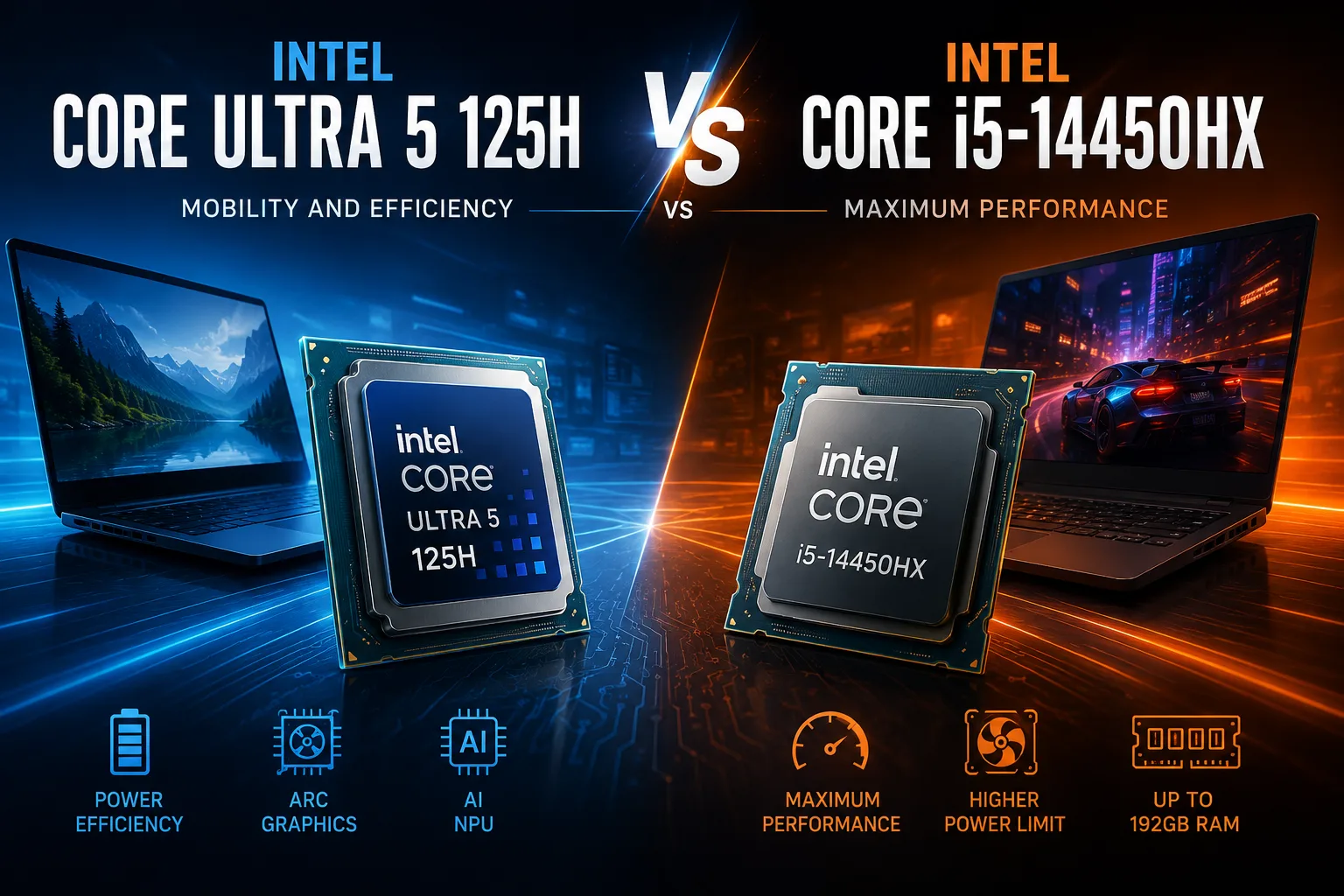
The Intel Core Ultra 5 125H and Core i5-14450HX belong to different classes of mobile processors. The former is designed for versatile and relatively thin laptops, while the latter is aimed at gaming models and mobile workstations equipped with powerful cooling systems. The Core Ultra focuses on energy efficiency, integrated graphics, and an NPU, whereas the Core i5 HX offers higher processing performance at the cost of increased power consumption.
Thus, it is pointless to compare them solely based on the number of cores. More important are the configuration of these cores, the permissible power, and the class of laptop in which the processor is installed.
Key Differences
| Characteristic | Intel Core Ultra 5 125H | Intel Core i5-14450HX |
|---|---|---|
| Core Configuration | 4 P + 8 E + 2 LP E | 6 P + 4 E |
| Cores / Threads | 14 / 18 | 10 / 16 |
| Base Power | 28 W | 55 W |
| Maximum Turbo Power | 115 W | 157 W |
| Integrated Graphics | Intel Arc, 7 Xe-cores | Intel UHD Graphics, 16 EU |
| NPU | Intel AI Boost | No |
| Max Memory Capacity | 96 GB | 192 GB |
The Core Ultra 5 125H appears stronger in terms of total core count, but two of them belong to the low-power LP E cluster. The Core i5-14450HX has six performance P-cores instead of four and can operate at significantly higher power limits. In heavy computational tasks, this is more important than the formal advantage of 14 versus 10 cores.
CPU Performance
The Core i5-14450HX is generally faster in rendering, compiling, processing large archives, and other prolonged workloads. The additional P-cores, higher clock speeds, and increased power headroom allow it to maintain high performance for longer periods.
The Core Ultra 5 125H utilizes four P-cores, eight E-cores, and two LP E-cores. The latter manage background processes with low workloads, reducing the need to engage the primary computational blocks. This configuration is better suited for everyday work and energy savings, but it does not substitute for the additional P-cores of the HX processor.
The advantage of the Core i5 is particularly noticeable in applications sensitive to individual core performance: games, engineering software, and some work programs. In a well-cooled laptop, it also performs more confidently under prolonged full load.
However, the processor name does not guarantee results. A poorly cooled model with the Core i5-14450HX may quickly throttle down frequencies, whereas a well-optimized laptop with the Core Ultra 5 125H can maintain stable speeds for longer. Therefore, when selecting a specific model, it is important to consider not only the CPU but also cooling tests and power limits.
Integrated Graphics: Clear Advantage of Core Ultra
The integrated Intel Arc in the Core Ultra 5 125H significantly outperforms the graphics core of the Core i5-14450HX. Seven Xe-cores are suitable for casual gaming, photo editing, video editing acceleration, and working with modern video codecs.
Intel UHD Graphics in the Core i5-14450HX is primarily designed for image output, office tasks, and video playback. It requires a discrete graphics card for gaming or serious graphics work.
Thus, the Core Ultra 5 125H is better suited for laptops without a separate GPU. It provides acceptable graphics performance without additional noise, heat, and power consumption.
The weak integrated graphics core of the Core i5-14450HX rarely becomes a significant drawback since most laptops with this processor come equipped with GeForce RTX. In such configurations, the reserve of CPU power is more important.
NPU and AI Hardware Acceleration
The Core Ultra 5 125H features a separate Intel AI Boost block for local processing of compatible AI functions. It can be used for noise reduction, background blurring, gaze tracking, and some image processing operations.
The Core i5-14450HX lacks a separate NPU. However, for most buyers, this remains a secondary difference: heavy AI tasks are performed faster on a discrete graphics card, and the practical utility of the NPU depends on the specific programs' support.
Power Consumption and Laptop Class
The base power of the Core Ultra 5 125H is 28 W, while the Core i5-14450HX has 55 W. Maximum turbo limits reach 115 W and 157 W, respectively.
The Core Ultra is easier to cool; therefore, it is better suited for relatively thin and quiet laptops. The Core i5 HX requires a more substantial cooling system, especially when paired with a powerful discrete graphics card.
Battery life is influenced not only by the processor but also by the screen, battery, graphics card, and manufacturer settings. Still, laptops with Core Ultra tend to be better equipped for prolonged battery operation. The performance of HX models is often significantly limited when running on battery.
Memory and Platform Capabilities
The Core i5-14450HX supports up to 192 GB of RAM and can work with both DDR5 and DDR4. This expands the choice of configurations and makes it more suitable for workstations, virtual machines, and tasks involving large data volumes.
The Core Ultra 5 125H is limited to 96 GB but supports fast LPDDR5X. This memory helps reduce the thickness of the chassis and lower power consumption, though it is usually soldered to the motherboard and not user-replaceable.
For most users, the practical difference is minimal: even 32-64 GB remains sufficient for gaming, work, and editing. The advantage of the Core i5 is important primarily for professional systems.
Which Processor to Choose
Intel Core Ultra 5 125H is better suited for:
- a versatile laptop for work and travel;
- models without a discrete graphics card;
- long battery life;
- photo, video, and casual gaming on integrated graphics;
- applications utilizing the NPU.
Intel Core i5-14450HX should be chosen for:
- a gaming laptop with a discrete graphics card;
- rendering, compiling, and heavy computational tasks;
- tasks requiring high P-core performance;
- systems with a large amount of RAM;
- operation primarily from the power grid.
Conclusion
The Core i5-14450HX is faster under heavy CPU loads. Six P-cores, higher frequencies, and a high power limit make it more suitable for gaming laptops and mobile workstations. However, this advantage can only be realized in a system with quality cooling.
The Core Ultra 5 125H offers a more balanced platform. It features significantly more powerful integrated graphics, lower power consumption, and a separate NPU. This is a more logical choice for a versatile laptop that should remain relatively lightweight, quiet, and capable without a discrete graphics card.
The Core i5-14450HX is chosen for maximum CPU performance, while the Core Ultra 5 125H is selected for a better combination of speed, graphics capability, and mobility.
Advantages
- More Total Cores: 14 (14 vs 10)
- Higher Technology: 7 nm (7 nm vs 10 nm)
- Higher Performance-core Max Turbo Frequency: up to 4.8 GHz (4.5 GHz vs up to 4.8 GHz)
- Larger L3 Cache: 20 MB (shared) (18 MB vs 20 MB (shared))
- Newer Launch Date: January 2024 (December 2023 vs January 2024)
Basic
CPU Specifications
Memory Specifications
GPU Specifications
Benchmarks
Related CPU Comparisons


Share in social media
Or Link To Us
<a href="https://cputronic.com/en/cpu/compare/intel-core-ultra-5-125h-vs-intel-core-i5-14450hx" target="_blank">Intel Core Ultra 5 125H vs Intel Core i5-14450HX</a>