Intel Core i5-14450HX
vs
AMD Ryzen 7 260
CPU Comparison Result
Intel Core i5-14450HX vs AMD Ryzen 7 260: Gaming Laptop Power vs Versatility
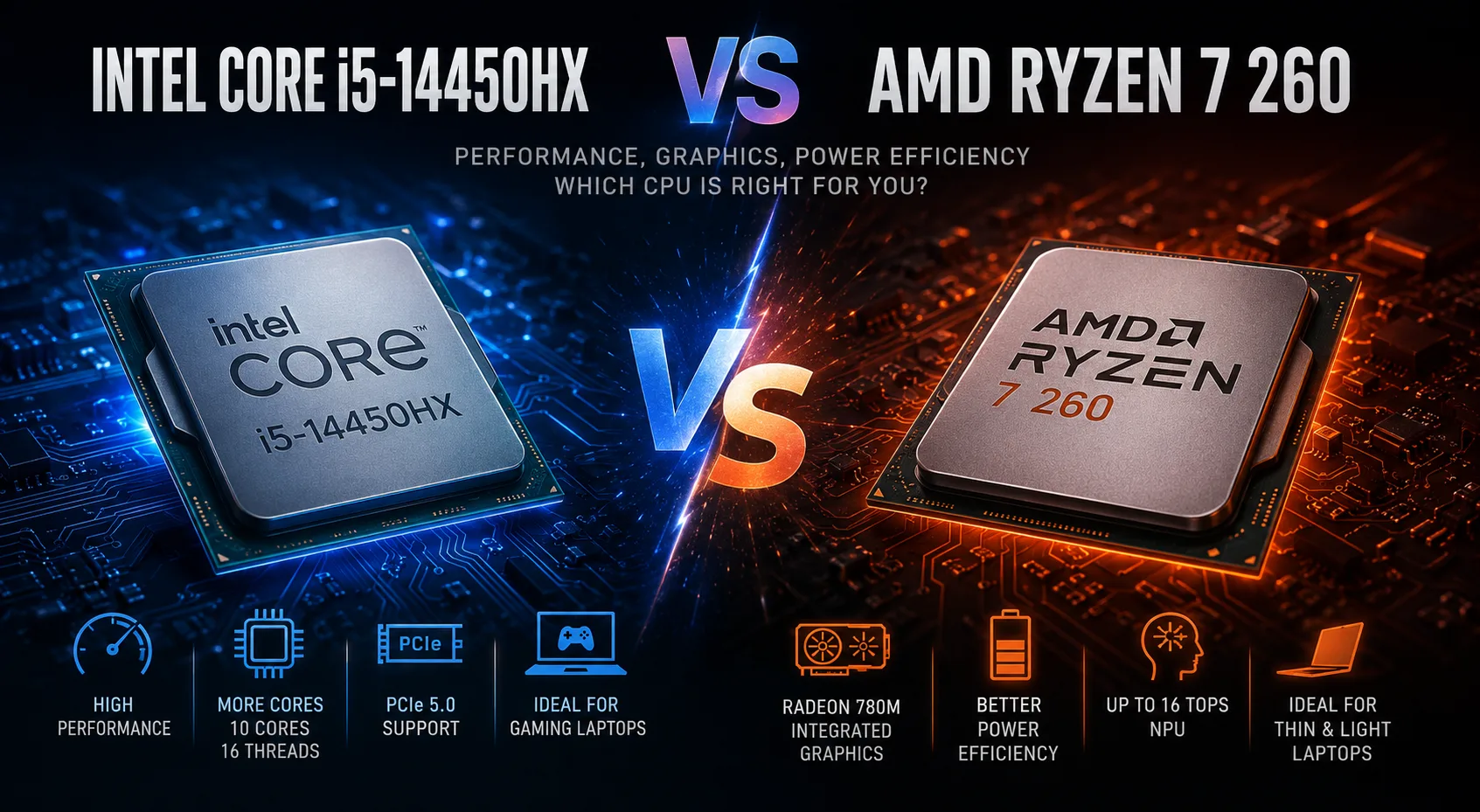
The Intel Core i5-14450HX and the AMD Ryzen 7 260 can be installed in laptops of similar price ranges, but they are designed for different scenarios. Intel’s processor is an HX model intended for larger gaming laptops with discrete graphics cards and efficient cooling systems. AMD is better suited for versatile laptops where integrated graphics, battery life, and moderate heating are important.
Therefore, choosing between them solely based on the number of cores or maximum frequency is not correct. The Core i5-14450HX performs best at a high power limit, while the Ryzen 7 260 offers a more balanced performance without stringent requirements for the laptop design.
Key Differences
| Intel Core i5-14450HX | AMD Ryzen 7 260 | |
|---|---|---|
| CPU Configuration | 6 P-cores + 4 E-cores, 16 threads | 8 Zen 4 cores, 16 threads |
| Power Range | 55W, up to 157W in turbo mode | 35-54W |
| Integrated Graphics | Intel UHD, 16 EU | Radeon 780M, 12 CU |
| NPU | No | Up to 16 TOPS |
| Main Device Class | Gaming and performance laptops | Versatile and relatively compact models |
Intel has more physical cores, but they are divided into performance and efficiency cores. AMD uses eight identical Zen 4 cores with support for 16 threads.
CPU Performance
The Core i5-14450HX is designed for high power consumption. With powerful cooling, it can maintain elevated frequencies for extended periods, showing strong results in rendering, compiling, video encoding, and other prolonged workloads.
At a high and stable power limit, Intel is generally faster in demanding multi-threaded tasks. However, its advantage is directly dependent on the laptop’s design. In a model with weak cooling, the processor will quickly reach temperature or power limits.
The Ryzen 7 260 operates within a range of 35-54W. Its eight full Zen 4 cores provide high-speed performance in work applications, web browsing, photo processing, and software development. Moreover, AMD does not require as aggressive power demands, making it easier to use in thinner designs.
In short bursts, the difference between the processors is often minimal. Both handle everyday applications quickly. The main advantage of the Core i5-14450HX becomes evident not in opening a browser or launching an editor but in long workloads that engage all cores.
Gaming with a Discrete Graphics Card
The Core i5-14450HX logically pairs well with GeForce RTX. Its high permissible power and performance-focused P-cores are suited to the design of large gaming laptops, which mainly operate from the wall outlet.
However, the processor itself does not define gaming performance. When comparing two laptops, it’s more critical to check:
- The model of the discrete graphics card;
- Its actual TGP;
- Cooling quality;
- Memory capacity and operating mode;
- Screen resolution.
A laptop with a Ryzen 7 260 and a more powerful graphics card will likely outperform one with the Core i5-14450HX and a weak GPU. The difference between graphics cards and their power limits is typically more noticeable than the difference between these processors.
Support for PCIe 5.0 gives Intel a technical edge, but in modern laptops, it rarely becomes a deciding advantage. In gaming and daily tasks, users are unlikely to notice a difference between PCIe 5.0 and PCIe 4.0.
Integrated Graphics: A Major Advantage for AMD
The main limitation of the Core i5-14450HX remains its graphics capabilities. The Intel UHD with 16 execution units is designed primarily for image output, video playback, and simple office tasks. For modern gaming and serious 3D work, a discrete graphics card is required.
The Ryzen 7 260 features the Radeon 780M with 12 compute units. This allows it to run popular online games, older AAA titles, and some modern games at reduced settings without a separate GPU.
This fundamentally changes the comparison. In a laptop without a discrete graphics card, the Ryzen 7 260 falls into a different performance category. The Core i5-14450HX makes sense primarily where the graphics load is handled by a GeForce RTX or another discrete accelerator.
The Radeon 780M also allows the discrete graphics card to be turned off when running on battery, without turning the laptop into a strictly office system.
Power Consumption, Noise, and Battery Life
The high power limit of the Core i5-14450HX requires a robust cooling system. Laptops with this processor are usually heavier, come with a substantial power supply, and produce more noise under load.
The Ryzen 7 260 is easier to keep within moderate temperature limits. Its 35-54W range allows manufacturers to use it in both powerful and relatively thin designs.
Battery life depends not only on the processor. It is influenced by the screen, battery capacity, firmware settings, and the presence of a discrete graphics card. Nevertheless, the AMD platform is better suited for prolonged use without a power outlet.
Memory, Interfaces, and NPU
Intel supports DDR5-5600 and DDR4-3200. Compatibility with DDR4 allows manufacturers to produce more affordable laptops, although such configurations usually fall short in memory bandwidth compared to DDR5 models.
The Ryzen 7 260 supports DDR5-5600 and LPDDR5X-7500. Fast LPDDR5X is particularly beneficial for the integrated Radeon 780M, as it utilizes system memory instead of its own video memory.
The processor also includes an NPU with a performance of up to 16 TOPS. It can accelerate specific camera functions, noise cancellation, and compatible local AI tasks. However, this is a supplementary feature and not a reason to choose the Ryzen 7 260 outright. The NPU performance is insufficient to meet the requirements of Copilot+ PC.
Intel Core i5-14450HX or Ryzen 7 260: Which is Better?
Choose the Core i5-14450HX if:
- You need a gaming laptop with a powerful discrete graphics card;
- Long multi-threaded computing speed is essential;
- The device will predominantly operate on AC power;
- Size, noise, and weight are not priorities.
The Ryzen 7 260 is preferable if:
- The laptop is used without a discrete graphics card;
- You require a powerful Radeon 780M;
- Battery life and moderate noise are important;
- You need a more compact and versatile device.
Conclusion
The Intel Core i5-14450HX is a specialized processor for large gaming and performance laptops. With a high power limit and effective cooling, it is typically faster in prolonged computational workloads. However, its benefits are hard to realize without a discrete graphics card.
The AMD Ryzen 7 260 is better balanced. It offers eight Zen 4 cores, significantly more powerful integrated graphics, and moderate power consumption. For a versatile laptop that should function even without a separate GPU, this is a more rational platform.
In the gaming segment, it’s essential to choose not just the processor but the entire laptop: graphics card, its TGP, cooling system, and price. In a compact system without discrete graphics, the advantages of the Ryzen 7 260 are much clearer.
Advantages
- More Total Cores: 10 (10 vs 8)
- Larger L3 Cache: 20 MB (shared) (20 MB (shared) vs 16 MB)
- Newer PCI Express Version: Gen 5, 16 Lanes (CPU only) (Gen 5, 16 Lanes (CPU only) vs PCIe® 4.0)
- Higher Technology: TSMC 4nm FinFET (10 nm vs TSMC 4nm FinFET)
- Newer Launch Date: February 2025 (January 2024 vs February 2025)
Basic
CPU Specifications
Memory Specifications
GPU Specifications
Miscellaneous
Benchmarks
Related CPU Comparisons



Share in social media
Or Link To Us
<a href="https://cputronic.com/en/cpu/compare/intel-core-i5-14450hx-vs-amd-ryzen-7-260" target="_blank">Intel Core i5-14450HX vs AMD Ryzen 7 260</a>