Intel Core 5 320
vs
Intel Core Ultra 5 225H


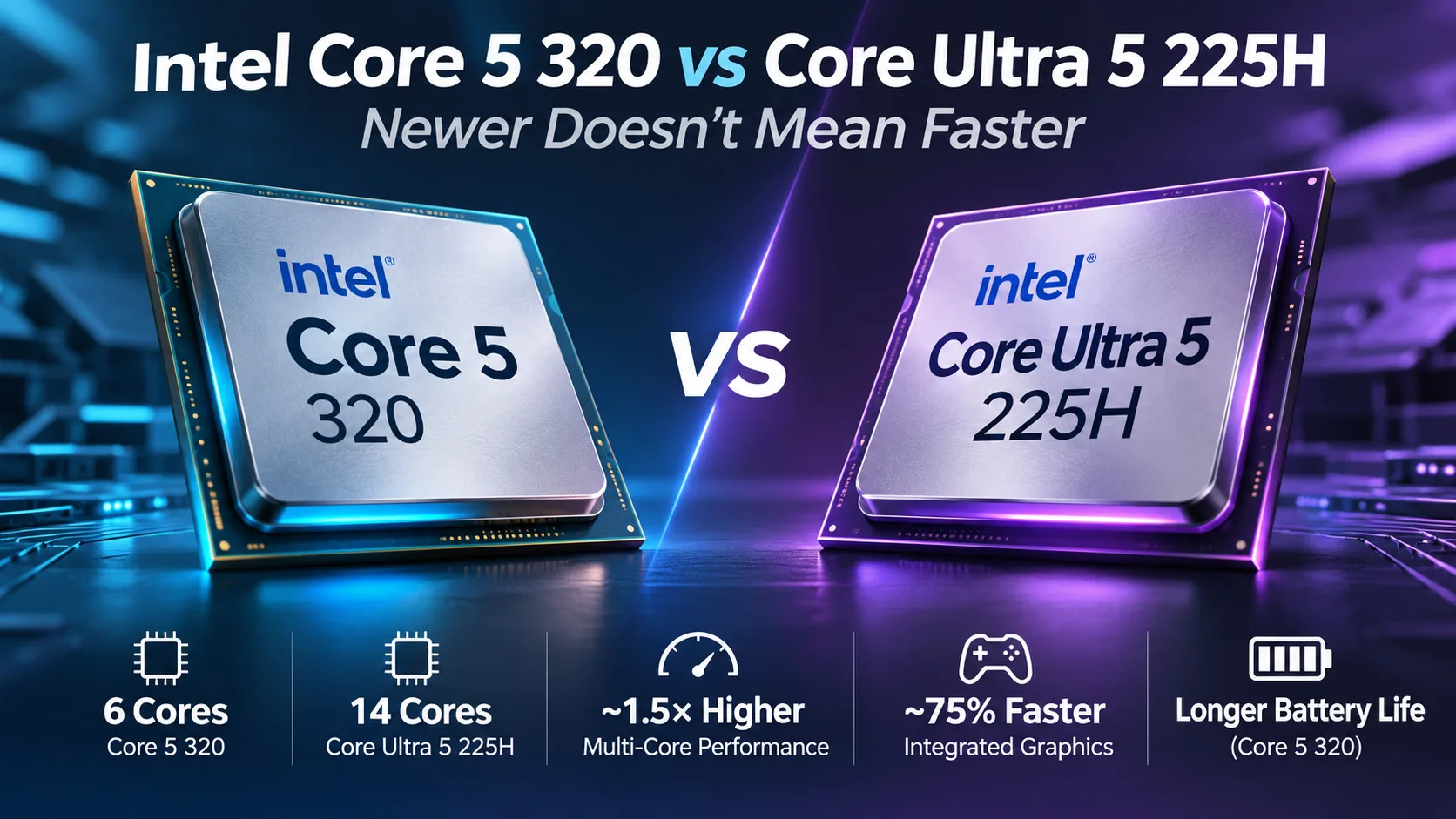
CPU Comparison Result
Intel Core 5 320 vs. Core Ultra 5 225H: Newer Doesn’t Mean Faster
The Intel Core 5 320 was released in April 2026, 15 months after the Core Ultra 5 225H. Despite its later release and Intel 18A process, it falls noticeably behind its rival in multithreaded tests and integrated graphics performance. The reason is their different configurations: the Core 5 320 has just six cores and lower power limits, while the Core Ultra 5 225H has fourteen cores and is designed for heavier workloads.
Key Differences Between the Processors
| Specification | Core 5 320 | Core Ultra 5 225H |
|---|---|---|
| Architecture | Wildcat Lake | Arrow Lake-H |
| Release | Q2 2026 | Q1 2025 |
| CPU process | Intel 18A | TSMC N3B |
| Cores / threads | 6 / 6 | 14 / 14 |
| Core configuration | 2P + 4 LP E | 4P + 8E + 2 LP E |
| P-core frequency | Up to 4.6 GHz | Up to 4.9 GHz |
| L3 cache | 6 MB | 18 MB |
| Base power | 15 W | 28 W |
| Maximum turbo power | 35 W | 115 W |
| Memory channels | 1 | 2 |
| Maximum memory capacity | 64 GB | 128 GB |
| Integrated graphics | Intel Graphics, 2 Xe cores | Intel Arc 130T, 7 Xe cores |
| NPU | 16 TOPS | 13 TOPS |
| PCIe | 4.0, 6 lanes | 5.0/4.0, 28 lanes |
The Core 5 320 has two high-performance Cougar Cove cores and four low-power Darkmont cores. It does not support Hyper-Threading, so its six cores handle six threads.
The Core Ultra 5 225H has four high-performance Lion Cove cores, eight Skymont E-cores, and two LP E-cores. Its L3 cache is three times larger: 18 MB versus 6 MB.
When browsing the web, working with documents, and making video calls, the difference between the processors may be barely noticeable. However, compiling large projects, rendering, and batch image processing require more computing resources. In these workloads, the additional cores of the Core Ultra 5 225H give it a significant advantage.
Geekbench 6: The Difference Is Especially Large in the Multithreaded Test
Results from specific laptops make it possible to evaluate processor performance while taking the characteristics of complete systems into account.
| Laptop | Processor | RAM | Geekbench 6 Single | Geekbench 6 Multi |
|---|---|---|---|---|
| HP OmniBook 5 14-kf0xxx | Core 5 320 | 16 GB | 2582 | 8069 |
| Dell XPS 13 DX13260 | Core 5 320 | 8 GB | 2575 | 7888 |
| Acer Aspire AG15-I51P | Core 5 320 | 16 GB | 2396 | 7421 |
| Dell 15 D15260 | Core Ultra 5 225H | 16 GB | 2733 | 11132 |
| ASUS ExpertBook B5 B5605CCA | Core Ultra 5 225H | 16 GB | 2770 | 12099 |
| LG 16Z90TP-GPV21KB | Core Ultra 5 225H | 64 GB | 2678 | 13434 |
These are individual published Geekbench 6 results. Scores are affected by the test version, memory configuration, cooling, and the laptop’s power settings.
In the single-core test, the Core Ultra 5 225H’s advantage is small. For example, the ASUS ExpertBook scores 2770 points, compared with 2582 for the HP OmniBook with the Core 5 320. The difference is approximately 7%.
When all cores are used, the gap widens. The ASUS ExpertBook scores 53% more points than the Dell XPS 13. The LG with the same Core Ultra 5 225H delivers an even higher result: 13434 points, 70% more than the Dell.
Core Ultra 5 225H results vary noticeably even between laptops with the same processor. Therefore, when choosing a model, it is worth considering cooling and power limits, not just the CPU’s name.
Integrated Graphics: The Arc 130T Is Faster in Games
The Core 5 320 is equipped with Intel Graphics featuring two Xe3 cores. The Core Ultra 5 225H has an Arc 130T with seven Xe cores from the previous generation. The newer graphics architecture of the Core 5 320 does not make up for the difference in the number of compute units.
| Laptop | Integrated graphics | 3DMark Time Spy Graphics |
|---|---|---|
| Dell XPS 13 DX13260 | Intel Graphics 2 Xe3 | 1343 |
| Dell 15 D15260 | Intel Arc 130T | 2354 |
| ASUS ExpertBook B5 B5605CCA | Intel Arc 130T | 2402 |
In the tests shown, the Arc 130T scores 75-79% more points.
Some of the difference is related to memory. The Dell XPS 13 has 8 GB of RAM, while the laptops with the Arc 130T each have 16 GB. In addition, the Core 5 320 supports only one memory channel, compared with two on the Core Ultra 5 225H. Memory bandwidth is particularly important for integrated graphics.
The Arc 130T’s advantage remains in gaming tests.
| Game, 1080p, low settings | Core 5 320, Dell XPS 13 | Core Ultra 5 225H, ASUS ExpertBook |
|---|---|---|
| Cyberpunk 2077 | 18.7 FPS | 25.9 FPS |
| Baldur's Gate 3 | 15.4 FPS | 25.7 FPS |
Even the Arc 130T does not provide a comfortable frame rate in these games at 1080p. However, lowering the resolution and using upscaling can produce a more acceptable result.
The Core 5 320 is suitable for less demanding games. If the laptop is also being purchased for modern games without a discrete graphics card, the Core Ultra 5 225H is preferable.
Power Consumption and Battery Life
The Core 5 320’s main advantage is its lower power limits. Its base power is 15 W, while its maximum turbo power is limited to 35 W. For the Core Ultra 5 225H, these figures reach 28 and 115 W, respectively.
The Dell XPS 13 with the Core 5 320 is a good example. In a Notebookcheck test, the laptop’s 52 Wh battery lasted 18 hours and 26 minutes during web browsing.
Under a sustained Prime95 workload, processor power consumption initially reached 35 W and then dropped to approximately 18 W. The temperature was around 89°C.
Thus, the Core 5 320 can provide long battery life without a large cooling system. However, the Dell XPS 13’s result cannot be applied to all laptops with this processor. Battery life also depends on the display, battery, and power settings.
The Core Ultra 5 225H consumes more power under heavy loads, but it handles multithreaded workloads faster. The size of its advantage will depend on the cooling system and the power limits set by the manufacturer.
NPU: A Small Advantage for the Core 5 320
The Core 5 320’s neural processing unit delivers up to 16 TOPS, compared with 13 TOPS for the Core Ultra 5 225H. This gives the lower-end model an advantage of approximately 23%.
However, NPU performance does not determine the speed of all artificial intelligence workloads. Many applications use the GPU, while some computations run on the CPU. In these areas, the Core Ultra 5 225H has more powerful graphics and a larger number of processor cores.
Therefore, the Core 5 320’s NPU advantage alone is not a compelling reason to choose it.
Which Processor Should You Choose?
- The Intel Core 5 320 is suitable for a compact laptop used primarily for web browsing, documents, video calls, and multimedia. When choosing one, pay attention to the battery life of the specific model.
- The Intel Core Ultra 5 225H is preferable for programming, photo processing, video editing, and other tasks capable of loading many cores.
- For gaming without a discrete graphics card, it is better to choose the Core Ultra 5 225H with the Arc 130T. It is faster, although it is also not powerful enough for demanding games.
Conclusion
The Core 5 320 is newer and more economical according to its stated power limits, but it falls behind the Core Ultra 5 225H in multithreaded tests and integrated graphics performance. Its six cores, small L3 cache, and single-channel memory limit its capabilities.
The Core Ultra 5 225H is faster in resource-intensive workloads and better suited to gaming without a discrete graphics card. If the laptops are similarly priced and their other specifications are comparable, the choice in its favor is obvious.
The Core 5 320 should primarily be considered for compact models with good battery life. Its advantage is not computing speed, but the ability to operate with lower power consumption.
Advantages
- Newer Launch Date: April 2026 (April 2026 vs January 2025)
- More Total Cores: 14 (6 vs 14)
- Higher Performance-core Max Turbo Frequency: 4.9 GHz (4.6 GHz vs 4.9 GHz)
- Higher Technology: 3 nm (Intel 18A vs 3 nm)
Basic
CPU Specifications
Memory Specifications
Up to DDR5 6400 MT/s
GPU Specifications
AI Specifications
Interfaces and Ports
Miscellaneous
Benchmarks
Related CPU Comparisons


Share in social media
Or Link To Us
<a href="https://cputronic.com/en/cpu/compare/intel-core-5-320-vs-intel-core-ultra-5-225h" target="_blank">Intel Core 5 320 vs Intel Core Ultra 5 225H</a>