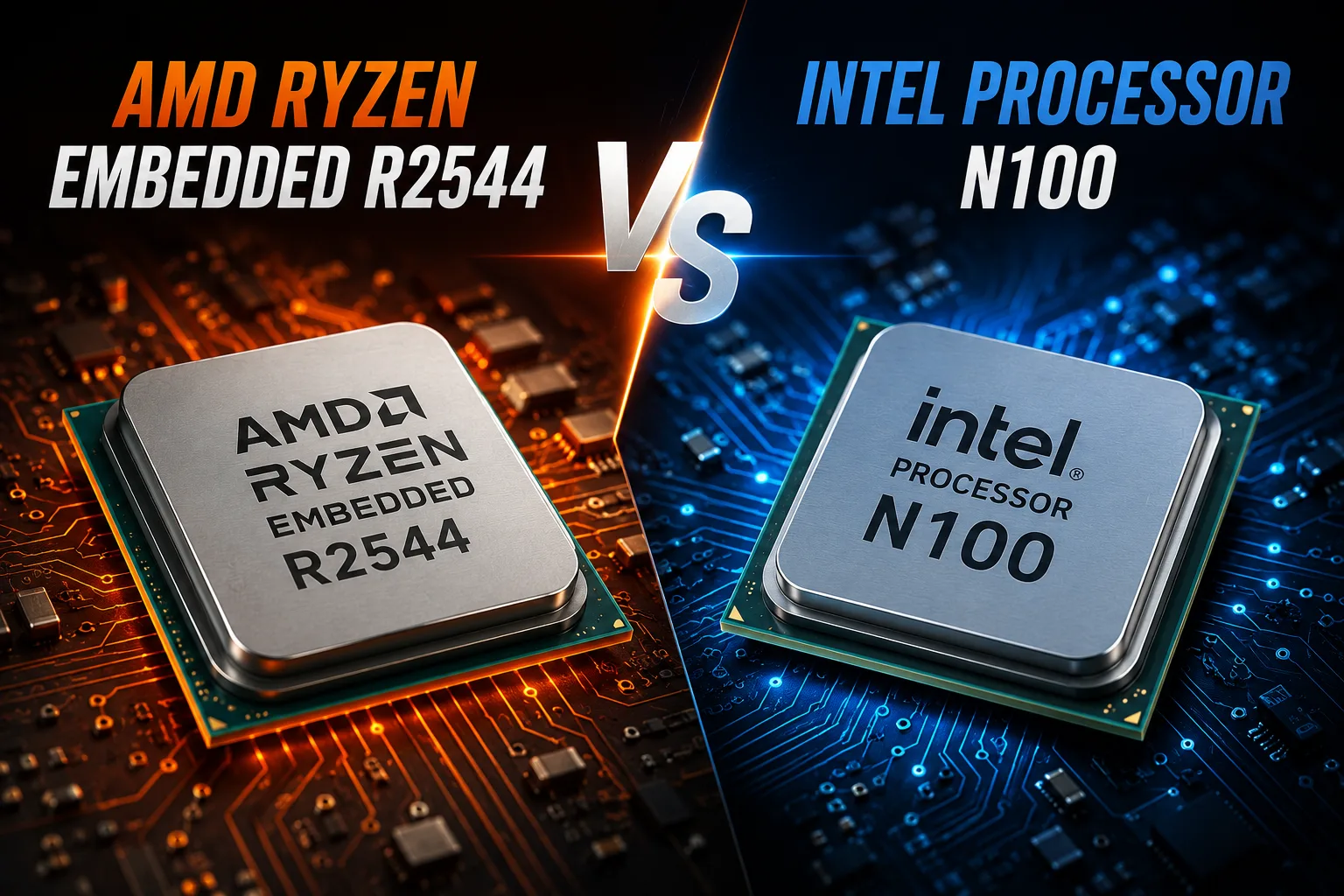
AMD Ryzen Embedded R2544
vs
Intel Processor N100

CPU Comparison Result
AMD Ryzen Embedded R2544 vs Intel N100: Eight Threads vs 6-Watt Platform
The AMD Ryzen Embedded R2544 and Intel Processor N100 both feature four cores, but that's where the similarities end. The R2544 supports eight threads, dual-channel memory, and a more powerful integrated graphics configuration, albeit with a nominal TDP of 45 watts. The N100 is limited to four threads and a single memory channel, but it consumes significantly less power and is suitable for compact systems with simple cooling solutions.
Thus, the R2544 should be considered for prolonged multi-threaded workloads, NAS, networking equipment, and specialized computers. The N100 is primarily geared towards budget mini-PCs, office terminals, media systems, and lightweight home servers.
Key Differences
| Specification | AMD Ryzen Embedded R2544 | Intel Processor N100 |
|---|---|---|
| Architecture | Zen+ | Alder Lake-N |
| Cores / Threads | 4 / 8 | 4 / 4 |
| Max Frequency | 3.7 GHz | 3.4 GHz |
| L3 Cache | 4 MB | 6 MB |
| Nominal TDP | 45 W | 6 W |
| Configurable TDP | 35-54 W | Not specified |
| Supported Memory | DDR4-3200 | DDR4-3200, DDR5-4800, LPDDR5-4800 |
| Memory Channels | 2 | 1 |
| Integrated Graphics | Radeon Vega, 8 CU | Intel UHD Graphics, 24 EU |
| Max GPU Frequency | 1.3 GHz | 750 MHz |
| Display Support | Up to 4 | Up to 3 |
| PCI Express 3.0 Lines | Up to 16 | Up to 9 |
| Main Segment | Embedded systems, NAS, and industrial PCs | Budget mini-PCs and compact systems |
The main advantages of the R2544 are its eight threads, dual memory channels, and broader peripheral connectivity options. The N100 is significantly simpler but is designed from the ground up for low power consumption, compact size, and low device cost.
CPU Performance
In average PassMark results, the Ryzen Embedded R2544 scores around 7760 CPU Mark points, while the Intel N100 scores about 5320 points. AMD’s advantage in multi-threaded tests reaches 46%.
| Test | Ryzen Embedded R2544 | Intel Processor N100 | Difference |
|---|---|---|---|
| PassMark CPU Mark | 7762 | 5320 | R2544 is 46% faster |
| PassMark Single Thread | 2090 | 1883 | R2544 is 11% faster |
The eight-threaded R2544 handles tasks that can load all cores simultaneously well: archiving, compiling, running virtual machines, and multiple background services.
In single-threaded mode, the gap is significantly smaller. The newer architecture of the N100 provides sufficient speed for browsing, office applications, and the operating system interface, despite the low power limit.
Geekbench 6 on Specific Devices
The results from ready-made systems are less definitive than the average PassMark scores.
| Processor and Device | Operating System | Single Core | Multi Core |
|---|---|---|---|
| Ryzen Embedded R2544 - HC Technology HCAR357-NR2 | Linux | 1154 | 3207 |
| Intel N100 - Beelink Mini S12 Pro | Debian Linux | 1281 | 3270 |
| Intel N100 - ASUS Mini PC PN42 | Linux | 1261 | 2901 |
| Intel N100 - MSI Cubi N ADL | Ubuntu Linux | 1253 | 3144 |
In the Geekbench 6 runs found, the N100 systems are faster in single-threaded mode, while multi-threaded results are roughly on par. However, only one suitable result is available for the R2544, so this table does not reflect the average processor performance.
In contrast, PassMark shows a significant advantage for the R2544 in multi-threaded testing. The discrepancy is related to different types of workloads, power limit settings, memory configurations, and a small sample of R2544 devices.
Therefore, the Geekbench results here are better considered as examples of specific mini-PC behavior rather than as a definitive ranking of the two processors.
Specific Devices
The Ryzen Embedded R2544 is found in mini-PCs like the KAMRUI P2 and ACEMAGIC K1, the ACEMAGIC N3A network storage, as well as in industrial boards and specialized computers.
The Intel N100 has seen much broader adoption. It is used in the Beelink Mini S12 Pro, ASUS Mini PC PN42, MSI Cubi N ADL, and dozens of similar compact systems.
The choice of devices on the N100 is significantly larger, making it easier to find, compare by price, and select based on the number of ports. R2544 models appear less frequently but typically offer more computational resources and expansion capabilities.
Integrated Graphics
The Ryzen Embedded R2544 features Radeon Vega graphics with eight compute units and a frequency of up to 1.3 GHz. An additional advantage is its dual-channel DDR4-3200, as the integrated GPU uses system memory rather than its own VRAM.
The Intel N100 has UHD Graphics with 24 execution units and a frequency of up to 750 MHz. The single-channel memory controller limits bandwidth, especially for graphics tasks.
In terms of GPU and memory configuration, the advantage should belong to the R2544, but the exact gap depends on the specific device's settings. For a reliable comparison of gaming performance, tests on two systems with the same amount of memory and similar cooling conditions are needed.
The N100 excels not in the number of graphics units but in the efficiency of its multimedia capabilities. Intel Quick Sync and hardware video decoding make it suitable for media players, streaming, and light transcoding.
Platform Features
The R2544 supports up to four external displays and provides up to 16 PCI Express 3.0 lanes. This allows manufacturers to install multiple network controllers, storage devices, expansion cards, or additional video outputs.
The N100 offers up to nine PCIe 3.0 lanes and support for up to three displays. This is sufficient for a typical mini-PC, but in NAS and networking devices, limited resources must be divided between NVMe, SATA, Ethernet, and wireless adapters.
Additional PCIe lanes, dual memory channels, and support for four displays make the R2544 a more flexible foundation for specialized computers. The N100 is better suited for simple configurations without many controllers and storage devices.
Power Consumption and Cooling
The nominal TDP of the Intel N100 is 6 watts. The Ryzen Embedded R2544 reaches 45 watts, with a configurable range between 35 and 54 watts.
TDP cannot be directly equated to the power consumption of the entire computer, but the difference between the platforms is still significant. In comparable configurations, systems on the N100 typically consume less power and require simpler cooling.
The R2544 needs a larger heatsink, and in most compact systems, active cooling is required as well. In return, the processor is able to sustain high performance longer when all threads are active.
The N100 is better suited for an always-on media server, office terminal, or home computer under light load. The R2544 is justified in systems with virtual machines, multiple network services, local data processing, or a large number of peripherals.
What to Choose
The Ryzen Embedded R2544 is preferable if you need:
- higher multi-threaded performance;
- eight threads for parallel tasks;
- dual-channel RAM;
- multiple storage devices or network controllers;
- support for three to four displays;
- an embedded platform with a long lifecycle.
The Intel Processor N100 is better suited for:
- a budget office mini-PC;
- browsing, documents, and video playback;
- compact form factor;
- quiet or passive cooling;
- an economical home server;
- 24/7 operation under light load.
Conclusion
The AMD Ryzen Embedded R2544 outperforms in averaged multi-threaded tests and offers a more functional platform. Eight threads, dual-channel memory, additional PCIe lanes, and support for four displays make it preferable for NAS, networking equipment, industrial computers, and mini-PCs under sustained load.
The Intel Processor N100 falls short in computational headroom and expansion capabilities but requires significantly less power. Its performance is sufficient for browsing, office applications, multimedia, and a lightweight home server, while its low thermal output simplifies cooling.
At a similar price and with comparable specifications, the R2544 offers more computational resources. However, devices based on the N100 are more widespread, making it easier to find an affordable, compact, and well-tested model.
Advantages
- Higher Max Turbo Frequency: up to 3.7 GHz (up to 3.7 GHz vs 3.40 GHz)
- Larger L3 Cache: 6 MB (4 MB (shared) vs 6 MB)
- Higher Technology: Intel 7 (12 nm vs Intel 7)
- Higher Memory Type: DDR4 3200 MT/s DDR5 4800 MT/s LPDDR5 4800 MT/s (DDR4 vs DDR4 3200 MT/s DDR5 4800 MT/s LPDDR5 4800 MT/s)
- Newer Launch Date: January 2023 (September 2022 vs January 2023)
Basic
CPU Specifications
Memory Specifications
GPU Specifications
AI Specifications
Miscellaneous
Related CPU Comparisons


Share in social media
Or Link To Us
<a href="https://cputronic.com/en/cpu/compare/amd-ryzen-embedded-r2544-vs-intel-processor-n100" target="_blank">AMD Ryzen Embedded R2544 vs Intel Processor N100</a>