AMD Ryzen AI Max+ 395
vs
AMD Ryzen AI 9 HX 470
CPU Comparison Result
AMD Ryzen AI Max+ 395 vs Ryzen AI 9 HX 470: Which One to Choose for Work, Gaming, and Local AI
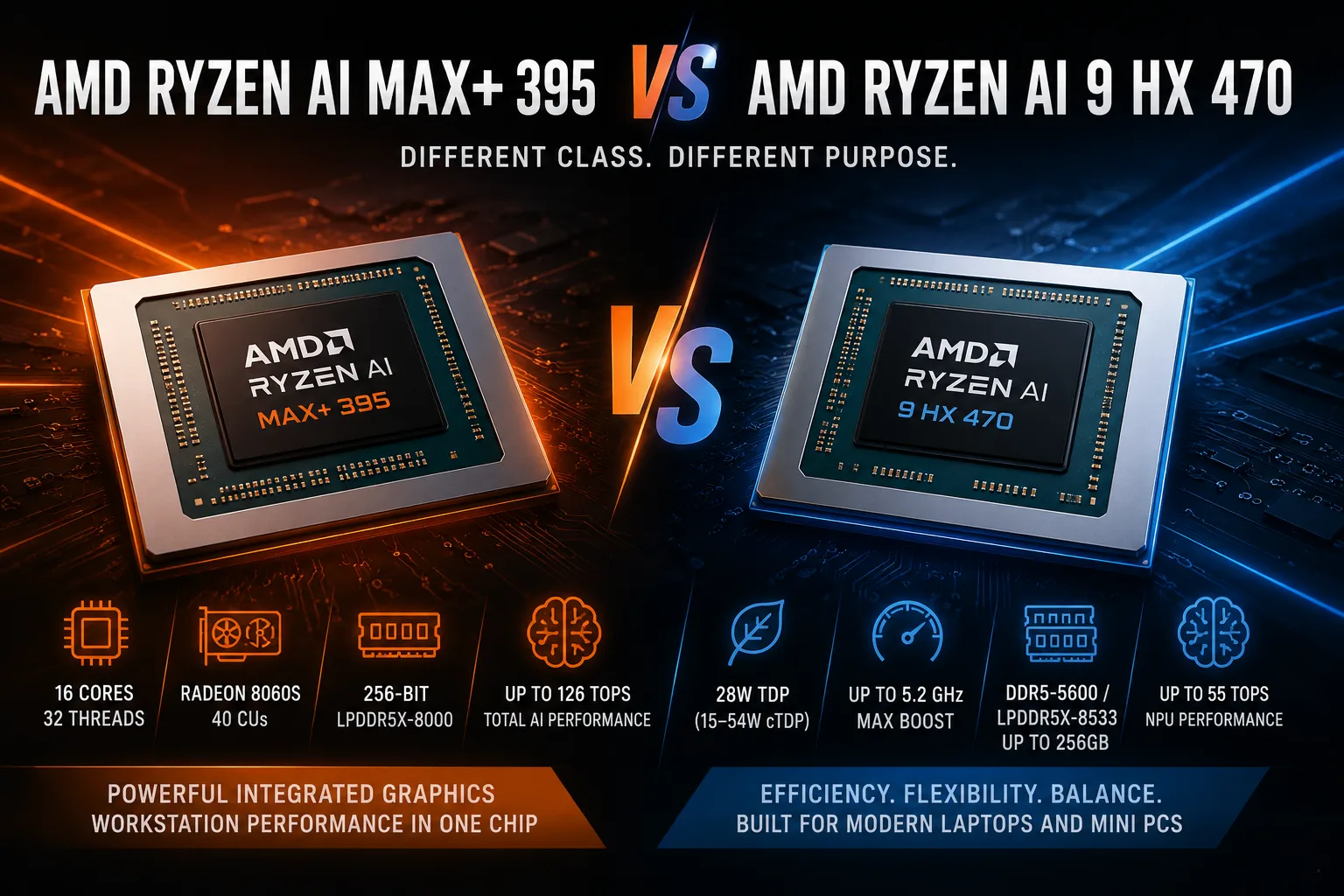
The Ryzen AI 9 HX 470 is newer, slightly faster in maximum frequency, and equipped with a more powerful NPU. However, in terms of overall computational power, it does not surpass the Ryzen AI Max+ 395.
These are processors of different classes. The HX 470 is designed for high-performance laptops with moderate power consumption, including models with discrete graphics cards. The Max+ 395 was created for compact workstations where a single processor must replace a powerful CPU and a separate GPU.
Main Differences
| Feature | Ryzen AI Max+ 395 | Ryzen AI 9 HX 470 |
|---|---|---|
| CPU Configuration | 16 × Zen 5 | 4 × Zen 5 + 8 × Zen 5c |
| Cores / Threads | 16 / 32 | 12 / 24 |
| Maximum Frequency | 5.1 GHz | 5.2 GHz |
| L3 Cache | 64 MB | 24 MB |
| Integrated Graphics | Radeon 8060S | Radeon 890M |
| GPU Compute Units | 40 | 16 |
| Supported Memory | 256-bit LPDDR5X-8000 | DDR5-5600 or LPDDR5X-8533 |
| Maximum Memory Volume | 128 GB | 256 GB |
| NPU Performance | up to 50 TOPS | up to 55 TOPS |
| Total AI Performance | up to 126 TOPS | up to 86 TOPS |
| Standard TDP | 55 W | 28 W |
| cTDP Range | 45-120 W | 15-54 W |
The Ryzen AI Max+ 395 features 16 full Zen 5 cores. The HX 470 has four Zen 5 cores supplemented by eight compact Zen 5c cores. This configuration helps reduce die size and power consumption but limits performance under sustained multithreaded loads.
CPU Performance
In everyday tasks, the difference between the models is minimal. The HX 470 boosts to 5.2 GHz compared to 5.1 GHz for the Max+ 395, so browsers, office applications, and most lightly parallelized applications perform similarly on both.
The advantage of the Max+ 395 becomes apparent under full core load. It has four more cores and eight more threads, and its L3 cache reaches 64 MB versus 24 MB for the HX 470.
In continuous multithreaded tests, the difference is usually measured in percentage points. The Max+ 395 is noticeably faster in rendering, compiling large projects, video encoding, engineering calculations, and running multiple virtual machines simultaneously.
However, the results depend not only on the CPU. The Max+ 395 can consume up to 120 W, while the HX 470's upper limit is 54 W. For the higher model to maintain advantages under long loads, it requires a massive cooling system.
The HX 470 is easier to install in a thinner laptop. It falls short in maximum performance but consumes less power and has more moderate cooling requirements.
Radeon 8060S vs. Radeon 890M
The main difference between the processors is the integrated graphics.
The Radeon 890M in the HX 470 features 16 RDNA 3.5 compute units and operates at frequencies of up to 3.1 GHz. Its capabilities are sufficient for multimedia, acceleration of work applications, and modern games with moderate quality settings.
The Radeon 8060S has 40 compute units-2.5 times more. Along with the 256-bit LPDDR5X, it provides significantly higher memory bandwidth and computational power.
Depending on the game, power limit, and memory configuration, the Radeon 8060S can outperform the Radeon 890M by more than double. It is better suited for gaming without a discrete graphics card, video editing, 3D modeling, and GPU-accelerated applications.
The HX 470 is more rational to use in a laptop with a separate GeForce or Radeon. In such a system, the integrated graphics mainly handle image output, video, and power savings, so the extra cost for the Radeon 8060S makes less sense.
Memory: Speed vs. Flexibility
The Ryzen AI Max+ 395 supports up to 128 GB of LPDDR5X-8000 connected via a 256-bit bus. The memory is soldered onto the motherboard, so the amount must be chosen at the time of purchase.
The CPU and Radeon 8060S share the same pool of memory. In higher configurations, a significant portion can be allocated to the integrated graphics. This allows working with projects and AI models that require more than 8-16 GB of video memory typically found in standard mobile graphics cards.
The HX 470 supports up to 256 GB of memory and can work with both LPDDR5X-8533 and DDR5-5600. The specific implementation depends on the laptop or mini-PC manufacturer: memory can be soldered or installed in SO-DIMM slots.
The advantage of the HX 470 is the possibility of upgrading and a larger maximum volume. The Max+ 395 provides significantly higher bandwidth, which is necessary for the Radeon 8060S.
Artificial Intelligence
The NPU in the Ryzen AI 9 HX 470 achieves 55 TOPS compared to 50 TOPS for the Max+ 395. Thus, the HX 470 is slightly faster in tasks performed directly by the neural processor: camera processing, noise suppression, and some Copilot+ PC functions.
However, for local language models and image generation, just the NPU is not the only important factor. Such workloads often utilize integrated graphics and require a large volume of available memory.
The total declared AI performance of the Max+ 395 reaches 126 TOPS compared to 86 TOPS for the HX 470. The Radeon 8060S and 256-bit memory make it a notably more suitable platform for heavy local AI tasks.
The additional 5 TOPS of the NPU in the HX 470 do not compensate for the difference in graphics. It makes little sense to overpay for them separately from the other specifications.
Ryzen AI Max+ 395 or Ryzen AI 9 HX 470
Choose the Ryzen AI Max+ 395 for:
- rendering and editing;
- compiling large projects;
- gaming without a discrete graphics card;
- 3D modeling and GPU computing;
- local deployment of large AI models;
- compact workstation with unified memory.
The Ryzen AI 9 HX 470 is more rational for:
- thinner and lighter laptops;
- prolonged battery life;
- systems with a discrete graphics card;
- mini-PCs with replaceable DDR5;
- configurations where memory size and upgradeability are important;
- everyday professional work without heavy rendering.
Conclusion
The Ryzen AI 9 HX 470 is chosen for a more compact form factor, moderate power consumption, and compatibility with standard DDR5. It is particularly logical in a laptop with a discrete graphics card, where powerful integrated graphics are not required.
The Ryzen AI Max+ 395 is needed for something else: maximum performance without a separate GPU. Its 16 cores, Radeon 8060S, and 256-bit memory are significantly stronger in rendering, gaming, and local AI.
The novelty of the HX 470 does not change the hierarchy. In terms of overall capabilities, the Ryzen AI Max+ 395 remains significantly more powerful, while the HX 470 mainly wins in energy efficiency and platform flexibility.
Advantages
- More Total Cores: 16 (16 vs 12)
- Larger L3 Cache: 64 MB (64 MB vs 24 MB)
- Higher Max Turbo Frequency: Up to 5.2 GHz (Up to 5.1 GHz vs Up to 5.2 GHz)
- Newer Launch Date: January 2026 (January 2025 vs January 2026)
Basic
CPU Specifications
Memory Specifications
GPU Specifications
Miscellaneous
Benchmarks
Related CPU Comparisons



Share in social media
Or Link To Us
<a href="https://cputronic.com/en/cpu/compare/amd-ryzen-ai-max-plus-395-vs-amd-ryzen-ai-9-hx-470" target="_blank">AMD Ryzen AI Max+ 395 vs AMD Ryzen AI 9 HX 470</a>