AMD Ryzen 7 H 255
vs
AMD Ryzen 5 7640HS
CPU Comparison Result
AMD Ryzen 7 H 255 vs AMD Ryzen 5 7640HS: How Much Faster Are Eight Zen 4 Cores?
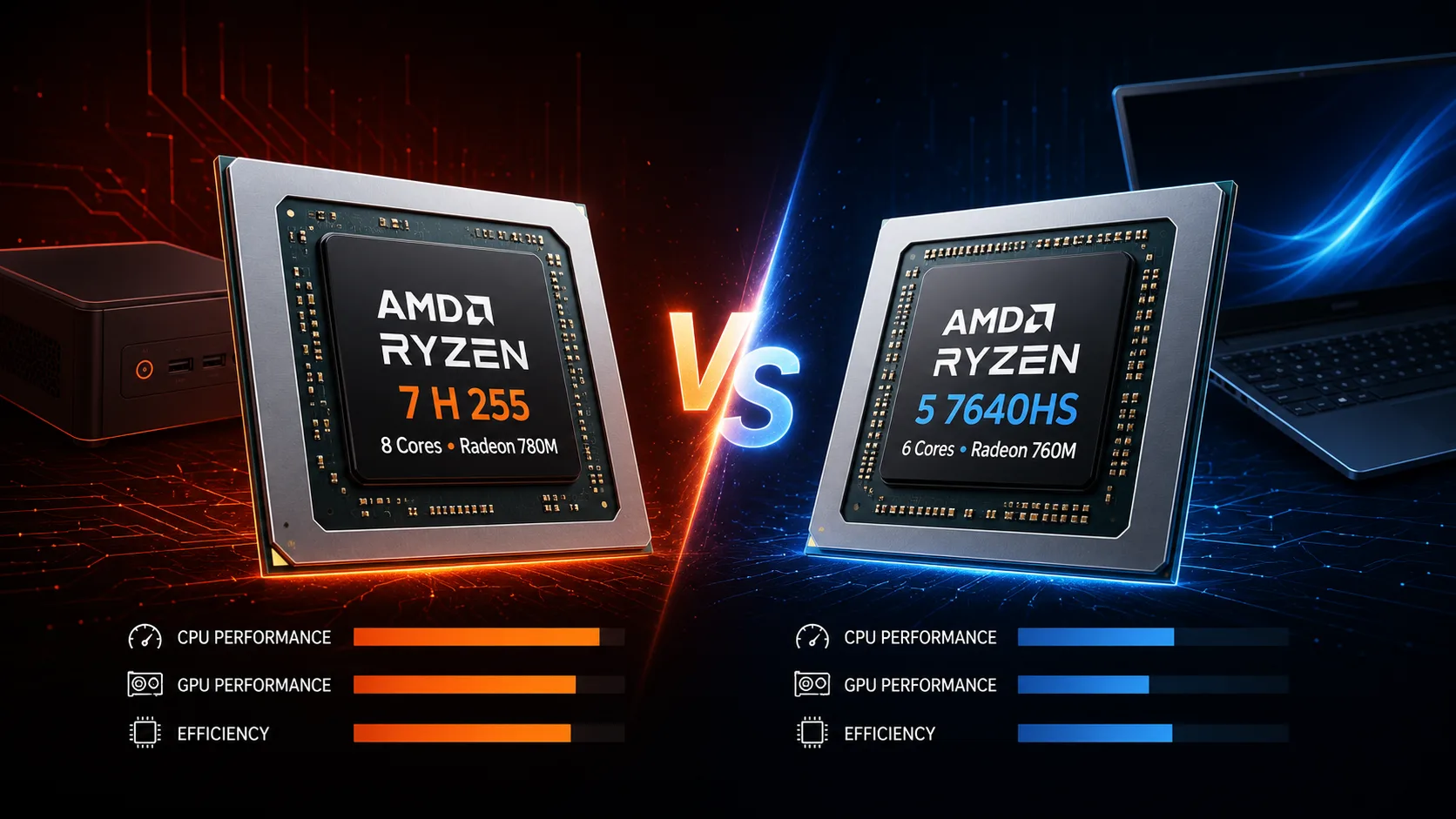
The AMD Ryzen 7 H 255 looks significantly newer than the Ryzen 5 7640HS; however, there is no architectural gap between the processors. Both models utilize Zen 4 cores and are manufactured using a 4nm process. The H 255 represents a larger configuration: eight cores instead of six and Radeon 780M instead of Radeon 760M.
As a result, the Ryzen 7 H 255 is better suited for multi-threaded tasks and systems without a discrete graphics card. The Ryzen 5 7640HS boasts a slightly higher maximum frequency and includes an NPU for Ryzen AI. At similar price points, the advantage remains with the H 255, but the implementation of a specific laptop or mini-PC can significantly influence the results.
Key Differences
| Characteristic | Ryzen 7 H 255 | Ryzen 5 7640HS |
|---|---|---|
| Codename | Hawk Point | Phoenix |
| Cores / Threads | 8 / 16 | 6 / 12 |
| Base Frequency | 3.8 GHz | 4.3 GHz |
| Maximum Frequency | 4.9 GHz | 5.0 GHz |
| L2 Cache | 8 MB | 6 MB |
| Integrated Graphics | Radeon 780M | Radeon 760M |
| Graphics Units | 12 CU | 8 CU |
| NPU | No | Ryzen AI, up to 10 TOPS |
| Regional Availability | China | Global Market |
The Ryzen 7 H 255 belongs to the Ryzen 200 series but uses the Zen 4 architecture and the Hawk Point die. AMD lists its availability in China, with an 8-core, 16-thread configuration, frequencies ranging from 3.8 to 4.9 GHz, and a configurable TDP of 35-54 Watts. The Ryzen 5 7640HS is based on the Phoenix architecture and offers 6 cores, 12 threads, and frequencies of 4.3 to 5.0 GHz with a similar power range.
Both processors support DDR5-5600, LPDDR5X-7500, PCI Express 4.0, and two USB4 interfaces. Therefore, the main differences lie in the number of cores, integrated graphics, and the presence of the NPU, rather than platform capabilities.
Which Devices Feature These Processors
The Ryzen 7 H 255 is particularly noticeable in the segment of Chinese mini-PCs. For instance, it's used in the GMKtec NucBox K12 with dual-channel DDR5 and Radeon 780M. The processor is also found in laptops, including the Lecoo N155A. The Ryzen 5 7640HS has wider availability: it can be found in both the compact GMKtec NucBox M6 Ultra and the HP Victus 16 gaming laptops.
This range of devices allows us to not only highlight the differences between the two processors but also to assess the impact of achieved frequency, power settings, and form factor.
Performance in Real Devices
For comparison, we will take several user results from Geekbench 6. This is not a uniform laboratory test: systems vary in memory, firmware, and power settings. Nonetheless, the table shows how the processors perform in actual commercially available mini-PCs and laptops.
| Device | Form Factor | Processor | Single-Core | Multi-Core | Recorded Peak Frequency |
|---|---|---|---|---|---|
| GMKtec NucBox K12 | Mini-PC | Ryzen 7 H 255 | 2551 | 12 667 | 4.94 GHz |
| Lecoo N155A | Laptop | Ryzen 7 H 255 | 2495 | 12 411 | 4.93 GHz |
| Lecoo N155A, launch at reduced frequency | Laptop | Ryzen 7 H 255 | 1938 | 10 006 | 2.45 GHz |
| GMKtec NucBox M6 Ultra | Mini-PC | Ryzen 5 7640HS | 2629 | 10 547 | 4.98 GHz |
| HP Victus 16 | Gaming Laptop | Ryzen 5 7640HS | 2496 | 10 319 | 4.84 GHz |
At a peak frequency of around 4.9 GHz, the Ryzen 7 H 255 demonstrates comparable results in the GMKtec K12 mini-PC and the Lecoo N155A laptop. The difference is approximately 2% in both Single-Core and Multi-Core performance. This indicates that the laptop form factor does not hinder the eight-core processor from approaching the performance of a high-performance mini-PC.
Another run of the Lecoo N155A shows the behavior of the same processor at a peak frequency of only 2.45 GHz. Single-Core dropped from 2495 to 1938 points, and Multi-Core from 12,411 to 10,006. The loss was about 22% and 19%, respectively.
At this frequency, the Ryzen 7 H 255 already falls behind the Ryzen 5 7640HS from the GMKtec M6 Ultra by approximately 26% in Single-Core and 5% in Multi-Core. The two additional cores do not compensate for the significant frequency drop: the advantage of the eight-core configuration completely disappears.
The Ryzen 5 7640HS in the GMKtec M6 Ultra scored 2629 and 10,547 points, while the HP Victus 16 showed 2496 and 10,319 points. The gaming laptop lagged behind the mini-PC by about 5% in Single-Core and only 2% in Multi-Core, maintaining a peak frequency of around 4.84 GHz.
In the provided runs, the Ryzen 7 H 255 at a frequency of around 4.9 GHz surpasses the Ryzen 5 7640HS by about 18-20% in Multi-Core. In Single-Core, the six-core model occasionally comes out slightly ahead due to its frequency reaching 5.0 GHz, but the difference between normally functioning systems remains small.
The peak frequency in the table represents the maximum value recorded by Geekbench during the test, not an average frequency of all cores under sustained load. Nonetheless, the example vividly demonstrates how significantly operating frequencies can alter a processor's standing in comparison.
Performance in Everyday and Work Tasks
In web browsers, office applications, and most everyday software, the difference between the processors will be minimal. Both models utilize the same Zen 4 architecture, and the Ryzen 5 7640HS even has a 100 MHz higher maximum frequency.
The Ryzen 7 H 255 shines under full-core loads:
- rendering;
- video encoding;
- compiling;
- processing large archives;
- running multiple heavy applications simultaneously;
- gaming with concurrent recording or streaming.
At comparable frequencies, the eight cores and sixteen threads provide it with a noticeable edge over the six-core Ryzen 5 7640HS.
Radeon 780M vs. Radeon 760M
The Ryzen 7 H 255 is equipped with Radeon 780M featuring 12 compute units, whereas the Radeon 760M in the Ryzen 5 7640HS has 8 units. Both graphics systems operate at frequencies of up to 2.6 GHz.
The number of CUs in the Radeon 780M is 50% higher, but gaming performance does not increase proportionally. Both iGPUs utilize system memory and share a common power budget with processor cores. The overall speed depends on RAM bandwidth, dual-channel mode, and power limits.
The Radeon 780M is better suited for:
- online gaming at 1080p resolution;
- modern games at low settings;
- light editing;
- GPU-accelerated applications;
- mini-PCs without a dedicated graphics card.
The Radeon 760M can also handle undemanding games but often requires lowering settings or resolution. With a discrete graphics card, the difference between the integrated GPUs almost loses significance.
For both models, memory configuration is crucial. A single DDR5 module significantly limits integrated graphics; therefore, two modules or fast soldered LPDDR5X are preferred.
Is Ryzen AI Relevant?
The Ryzen 5 7640HS is equipped with a first-generation NPU with a performance of up to 10 TOPS. The Ryzen 7 H 255 does not have a dedicated Ryzen AI block.
The NPU can accelerate certain compatible camera functions, noise cancellation, and image processing, but its capabilities are limited by modern standards. Overpaying for the Ryzen 5 7640HS just for the early Ryzen AI does not make sense. In this comparison, the two additional cores and the Radeon 780M offer significantly more practical benefits.
Which Processor Should You Choose?
Choose the Ryzen 7 H 255 if:
- the computer will operate without a discrete graphics card;
- rendering, editing, or compiling is regularly used;
- a high-performance mini-PC is needed;
- multiple heavy applications are run simultaneously;
- the price difference between devices is minimal.
The Ryzen 5 7640HS is more reasonable if:
- the device is significantly cheaper;
- the laptop is equipped with a powerful discrete graphics card;
- primary tasks rarely load all cores;
- the specific model offers a better display, battery, or cooling;
- maximum multi-threaded performance is not required.
In a gaming laptop, the model of the discrete graphics card and its power limit should be prioritized. A system with a Ryzen 5 7640HS and a more powerful GPU can significantly outperform a device with an H 255 and weak or nonexistent discrete graphics.
Conclusion
The AMD Ryzen 7 H 255 and Ryzen 5 7640HS are based on the same Zen 4 architecture. The new H 255 name does not signify a transition to a new generation of cores: its advantages are provided by the configuration of 8 cores and 16 threads, as well as the Radeon 780M.
In the provided Geekbench 6 results, the Ryzen 7 H 255 at around 4.9 GHz is approximately 18-20% faster in Multi-Core. In Single-Core, the processors are close in performance, and the Ryzen 5 7640HS occasionally comes out slightly ahead due to its maximum frequency of 5.0 GHz.
The example of the Lecoo N155A highlights the downside of mobile platforms. When the peak frequency of the H 255 is reduced to 2.45 GHz, its score drops by 19-22%, after which the eight-core processor is outperformed by a well-tuned Ryzen 5 7640HS even in Multi-Core scenarios.
At a comparable price, the Ryzen 7 H 255 is the better choice. It excels in multi-threaded tasks and offers more powerful integrated graphics. If there is a significant price difference, it is essential to compare the devices as a whole: power limits, memory, cooling, graphics card, display, port selection, and upgrade possibilities.
Advantages
- More Total Cores: 8 (8 vs 6)
- Newer Launch Date: January 2025 (January 2025 vs April 2023)
Basic
CPU Specifications
Memory Specifications
GPU Specifications
Interfaces and Ports
Miscellaneous
Benchmarks
Related CPU Comparisons


Share in social media
Or Link To Us
<a href="https://cputronic.com/en/cpu/compare/amd-ryzen-7-h-255-vs-amd-ryzen-5-7640hs" target="_blank">AMD Ryzen 7 H 255 vs AMD Ryzen 5 7640HS</a>