AMD Ryzen 7 170
vs
AMD Ryzen 7 260
CPU Comparison Result
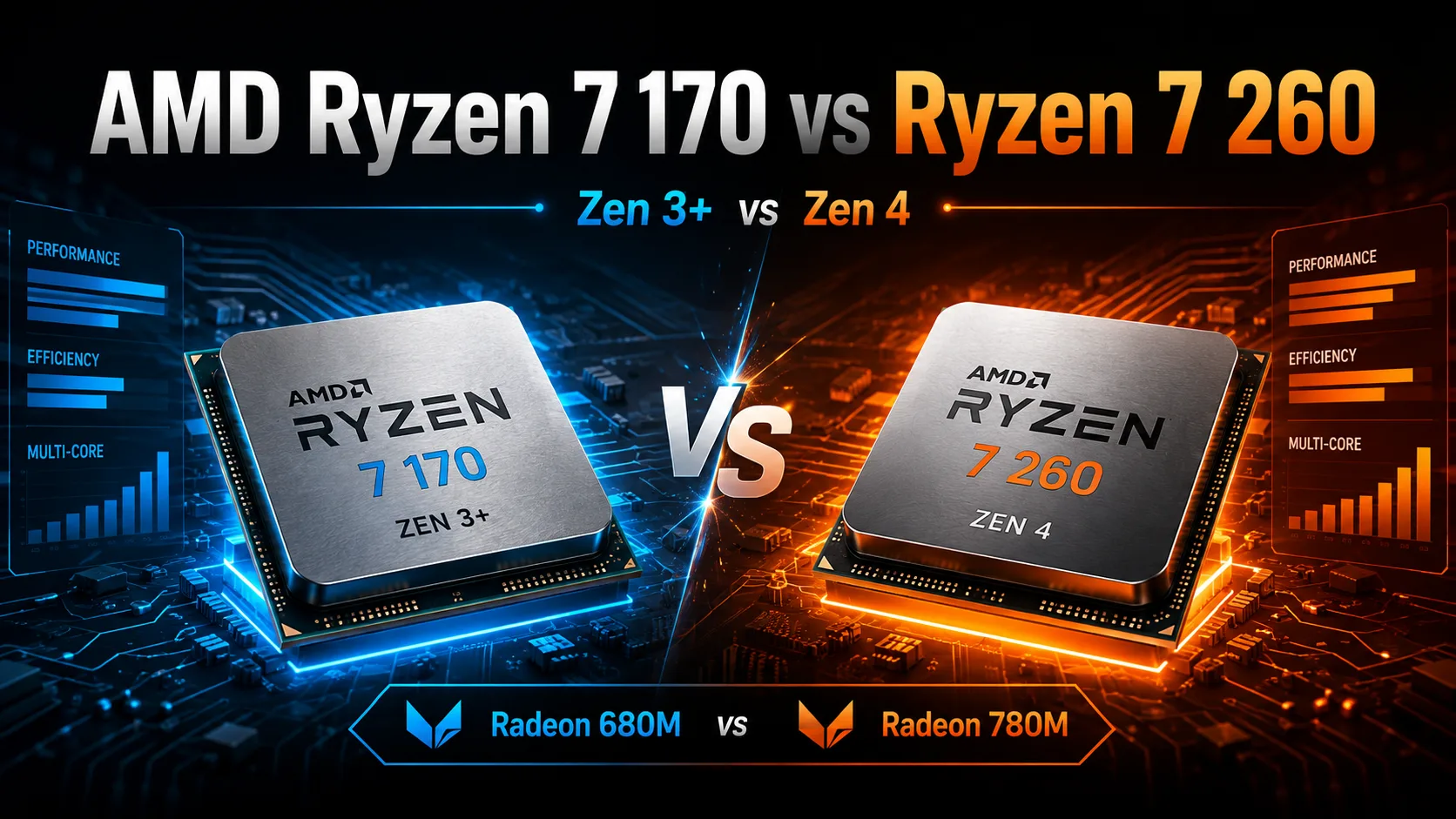
AMD Ryzen 7 170 vs Ryzen 7 260: What Similar Names Conceal
By their names, the Ryzen 7 170 and Ryzen 7 260 seem to be adjacent models from the same lineup. However, the Ryzen 7 170 is based on Zen 3+ and is nearly identical to the Ryzen 7 7735HS, while the Ryzen 7 260 is built on the newer Zen 4 platform, akin to the Ryzen 7 8845HS. The similar indices here can be misleading: technically, these are processors from different generations.
| Characteristic | Ryzen 7 170 | Ryzen 7 260 |
|---|---|---|
| CPU Architecture | Zen 3+ | Zen 4 |
| Codename | Rembrandt-R | Hawk Point |
| Cores / Threads | 8 / 16 | 8 / 16 |
| Base Frequency | 3.2 GHz | 3.8 GHz |
| Boost | up to 4.75 GHz | up to 5.1 GHz |
| L2 Cache | 4 MB | 8 MB |
| L3 Cache | 16 MB | 16 MB |
| Process Technology | TSMC 6 nm | TSMC 4 nm |
| TDP | 45 W | 45 W |
| cTDP | 35-54 W | 35-54 W |
| Integrated Graphics | Radeon 680M | Radeon 780M |
| GPU Architecture | RDNA 2 | RDNA 3 |
| GPU Compute Units | 12 | 12 |
| GPU Frequency | up to 2.2 GHz | up to 2.7 GHz |
| Memory | DDR5-4800, LPDDR5 | DDR5-5600, LPDDR5X-7500 |
| USB4 | No | Yes |
| NPU | No | up to 16 TOPS |
Ryzen 7 170 - The Familiar Ryzen 7 7735HS Under a New Name
The Ryzen 7 170 is difficult to classify as a new processor. Its specifications nearly mirror those of the Ryzen 7 7735HS: eight Zen 3+ cores, 16 threads, boost frequencies up to 4.75 GHz, 16 MB of L3 cache, and Radeon 680M.
The Ryzen 7 170 is based on a 2022 generation platform rather than a new architecture. Eight Zen 3+ cores are still adequate for office work, programming, multitasking, and many resource-intensive applications.
Therefore, the closeness of the names should not be misleading: in terms of hardware, the Ryzen 7 170 is significantly older than the Ryzen 7 260.
Ryzen 7 260: The Familiar Hawk Point on Zen 4
The Ryzen 7 260 has much in common with the Ryzen 7 8845HS. It features eight Zen 4 cores, higher frequencies, a Radeon 780M, and a dedicated NPU for Ryzen AI.
While it still has eight cores, the Zen 4 cores themselves are faster, and the set of features is considerably broader. The Ryzen 7 260 has twice the L2 cache, support for faster memory, and more powerful integrated graphics.
CPU Performance
The most noticeable advantage of the Ryzen 7 260 is its single-thread performance. In Geekbench 6, laptops with the Ryzen 7 170 usually score around 2000-2100 points, while those with the Ryzen 7 260 score approximately 2600-2700 points.
The approximately 25% difference primarily manifests in tasks sensitive to the speed of individual cores: certain compilation stages, browser performance, parts of professional applications, and gaming.
In multi-threaded tests, the results heavily depend on the specific laptop. Both processors have eight cores and 16 threads, so power limits and cooling systems play a significant role here.
Geekbench 6 in Specific Laptops
| Laptop | Processor | Single-Core | Multi-Core |
|---|---|---|---|
| Acer Nitro V 15 ANV15-A31 | Ryzen 7 170 | 2024 | 8291 |
| ASUS Vivobook 16 M1605NAQ | Ryzen 7 170 | 2119 | 10024 |
| ASUS Vivobook 18 M1807HA | Ryzen 7 260 | 2622 | 10180 |
| ASUS TUF Gaming A16 FA608UP | Ryzen 7 260 | 2673 | 13299 |
| Lenovo Legion 5 15AHP G10 | Ryzen 7 260 | 2683 | 13349 |
The multi-core performance of the Ryzen 7 260 varies by about 30% even among laptops with the same processor. The ASUS Vivobook 18 scores around 10,200 points, while the ASUS TUF Gaming A16 and Lenovo Legion 5 score around 13,300 points.
Thus, the CPU name alone is insufficient: results depend on the power limits and cooling efficiency imposed by the manufacturer.
The performance disparity among laptops with the Ryzen 7 170 is also notable: the ASUS Vivobook 16 significantly outperforms the Acer Nitro V 15 in multi-core tests.
Radeon 680M vs Radeon 780M
Both integrated graphics have 12 compute units, but they belong to different generations. The Radeon 680M is based on RDNA 2 and operates at frequencies up to 2.2 GHz, while the Radeon 780M utilizes RDNA 3 and can boost up to 2.7 GHz.
The Ryzen 7 260 also supports faster memory, which is particularly important for integrated graphics since it lacks its own video memory; thus, performance significantly depends on the RAM bandwidth.
The Radeon 780M is faster, but the difference is not sufficient to classify it into a different tier of gaming performance. The primary scenario for both is esports and less demanding games. In heavier AAA titles, adjustments to settings and scaling are usually necessary.
In a laptop with a discrete GPU, the difference between the Radeon 680M and Radeon 780M becomes nearly insignificant for gaming.
NPU is Only Present in Ryzen 7 260
The Ryzen 7 170 lacks a dedicated neural processor. The Ryzen 7 260 features Ryzen AI with NPU performance of up to 16 TOPS.
However, this 16 TOPS for the NPU is already a modest figure. For Copilot+ PC, a minimum of 40 TOPS is required; therefore, having Ryzen AI alone is unlikely to influence the choice between the two laptops.
Memory, USB4, and Video
The differences extend beyond just the CPU cores. The Ryzen 7 260 supports DDR5-5600 and LPDDR5X-7500, whereas the Ryzen 7 170 is limited to slower memory. The Ryzen 7 260 also supports USB4.
The Hawk Point features a newer multimedia block with hardware support for AV1. In office tasks, the difference is nearly imperceptible, but when working with video, the capabilities of the Ryzen 7 260 are broader.
Conclusion
At a similar price, the Ryzen 7 260 is the clear choice. It is significantly faster in CPU performance, has the Radeon 780M, supports faster memory, and includes USB4.
The Ryzen 7 170 is essentially the Ryzen 7 7735HS under a new name. Eight Zen 3+ cores are still sufficient for most work tasks, but it clearly lags behind the Hawk Point in capabilities.
The Ryzen 7 170 makes sense to consider only if there is a substantial discount on the laptop, especially if it comes with a discrete graphics card, as the difference between the Radeon 680M and 780M becomes almost irrelevant in that case.
Advantages
- Newer Launch Date: October 2025 (October 2025 vs February 2025)
- Higher Max Turbo Frequency: Up to 5.1 GHz (Up to 4.75 GHz vs Up to 5.1 GHz)
- Higher Technology: TSMC 4nm FinFET (TSMC 6nm FinFET vs TSMC 4nm FinFET)
Basic
CPU Specifications
Memory Specifications
GPU Specifications
Miscellaneous
Benchmarks
Related CPU Comparisons



Share in social media
Or Link To Us
<a href="https://cputronic.com/en/cpu/compare/amd-ryzen-7-170-vs-amd-ryzen-7-260" target="_blank">AMD Ryzen 7 170 vs AMD Ryzen 7 260</a>