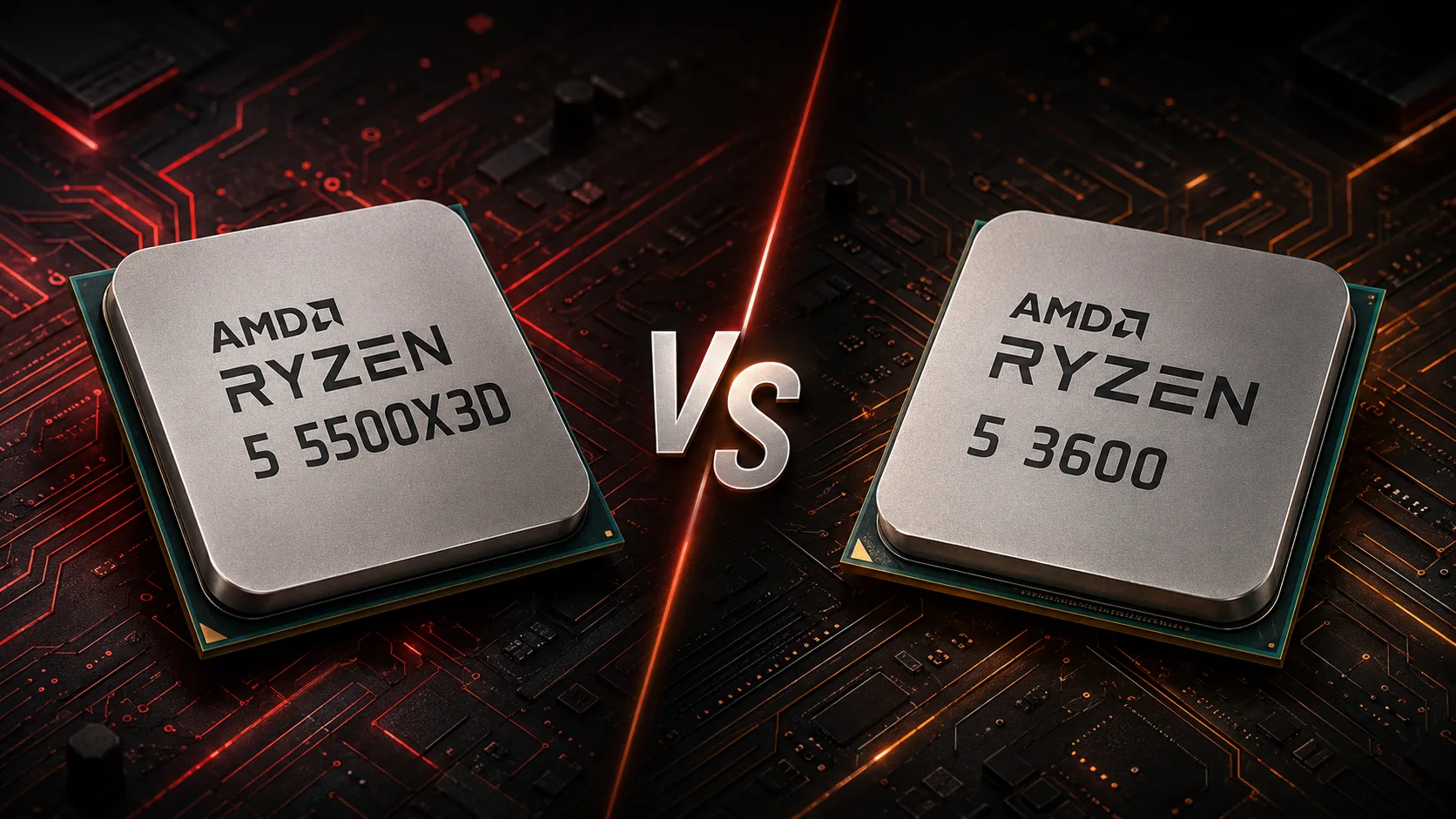
AMD Ryzen 5 5500X3D
vs
AMD Ryzen 5 3600
CPU Comparison Result
AMD Ryzen 5 5500X3D vs Ryzen 5 3600: A Major Gaming Upgrade for AM4
The Ryzen 5 3600 still handles most modern games, but its limitations become more apparent when paired with a powerful graphics card. This is particularly true at 1080p resolution, with high refresh rate monitors, and in projects sensitive to CPU speed. While the average FPS may remain acceptable, dips and unstable frame times increasingly reveal the age of the Zen 2 architecture.
The Ryzen 5 5500X3D addresses this issue without requiring a complete platform replacement. The core count remains unchanged-both processors offer 6 cores and 12 threads-but the new model features Zen 3 architecture and 96 MB of L3 cache. It’s the increased cache, rather than clock speed, that makes it a significantly stronger gaming solution.
Key Differences
| Feature | Ryzen 5 5500X3D | Ryzen 5 3600 |
|---|---|---|
| Architecture | Zen 3 | Zen 2 |
| Codename | Vermeer | Matisse |
| Cores / Threads | 6 / 12 | 6 / 12 |
| Base Clock | 3.0 GHz | 3.6 GHz |
| Max Clock | 4.0 GHz | 4.2 GHz |
| L3 Cache | 96 MB | 32 MB |
| TDP | 105 W | 65 W |
| Memory | DDR4-3200 | DDR4-3200 |
| PCI Express | PCIe 4.0 | PCIe 4.0 |
| Socket | AM4 | AM4 |
| Stock Cooler | No | Wraith Stealth |
| Integrated Graphics | No | No |
The main advantages of the Ryzen 5 5500X3D are the Zen 3 architecture and the threefold increase in L3 cache. The Ryzen 5 3600 operates at higher clock speeds, but the difference of 200-600 MHz does not compensate for the architectural gap in most modern games.
Why 96 MB of Cache Matters More Than Clock Speed
The Ryzen 5 5500X3D is effectively a lower-clocked version of the Ryzen 5 5600X3D. Both models have 6 cores, 12 threads, and 96 MB of L3 cache, but the maximum clock of the 5500X3D is reduced from 4.4 GHz to 4.0 GHz.
The large cache allows the CPU to access RAM less frequently. In games, this reduces latency for processing physics, character behavior, world geometry, and commands for the graphics card. As a result, the CPU prepares frames faster, leading to less downtime for powerful graphics cards waiting for data.
This effect is particularly noticeable in strategy games, simulators, MMOs, competitive shooters, and large open-world games. In projects that are less CPU-dependent, the advantage will be smaller.
Gaming Performance
There are currently fewer direct tests of the Ryzen 5 5500X3D against the Ryzen 5 3600 compared to comparisons with other AM4 processors, so it’s incorrect to state a uniform percentage increase for all games. However, existing reviews show a consistent pattern: the 5500X3D significantly outperforms Zen 2 processors and is typically about 7-10% lower than the higher-clocked Ryzen 5 5600X3D.
The most noticeable gains are expected when paired with a powerful graphics card, at 1080p or 1440p resolutions, and a target frame rate above 100-120 FPS. In such conditions, the Ryzen 5 3600 often becomes a bottleneck for the GPU.
Switching to the 5500X3D can improve not only the average FPS. The more significant result is often an increase in the minimum frame rate and a reduction in sharp drops during intense scenes. This is particularly evident when there are many characters, active world simulation, rapid location changes, and the operation of background applications.
At 1440p, the difference depends more on the graphics card and graphics settings. At 4K, the primary load usually falls on the GPU, so the average FPS may change only slightly. There is little sense in buying the 5500X3D solely for gaming at 4K with a mid-range graphics card.
Work Applications
In work scenarios, the advantage of the Ryzen 5 5500X3D is much less pronounced. Both processors have the same 6 cores and 12 threads, and the large cache rarely provides as much of a boost to video editing, rendering, or archiving as it does in gaming.
The Zen 3 architecture allows the new model to surpass the Ryzen 5 3600 in many tasks, but its lower clock speeds limit its potential. In Blender, video encoding, and other multi-threaded applications, the 5500X3D remains a typical six-core chip and may fall behind higher-clocked or multi-core AM4 processors.
Upgrading from the Ryzen 5 3600 to the 5500X3D for browsing, office tasks, Photoshop, or occasional video editing is not rational. For regular rendering and video processing, it’s better to consider an eight- or twelve-core model.
Power Consumption and Cooling
The Ryzen 5 3600 belongs to the 65W TDP class and comes with the Wraith Stealth cooler. It is relatively easy to cool, even in a budget case.
The Ryzen 5 5500X3D has a rated TDP of 105W, and a cooler is not included. Using the old Wraith Stealth is not recommended: a good tower cooler and adequate case ventilation are needed for stable and quiet operation. The maximum operating temperature of the new model is 90°C compared to 95°C for the Ryzen 5 3600.
Compatibility with Motherboards
Both processors use the AM4 socket, but the Ryzen 5 5500X3D will require a BIOS that supports the specific model. Simply having a compatible socket does not guarantee operation.
Before upgrading, it is necessary to:
- Check if the Ryzen 5 5500X3D is on the motherboard's supported processor list.
- Update the BIOS before removing the Ryzen 5 3600.
- Ensure that the motherboard’s power delivery system can handle a 105W class CPU.
- Prepare a more powerful cooler.
Support is possible on boards with X570, X470, X370, B550, B450, B350, and A520 chipsets, but the final decision depends on the manufacturer and specific model.
The Ryzen 5 5500X3D was originally intended for Latin American countries, so its availability and price vary significantly between regions.
Is It Worth Upgrading from Ryzen 5 3600?
The upgrade is justified if the Ryzen 5 3600 is already bottlenecking the graphics card, the computer is primarily used for gaming, and a complete transition to AM5 is not currently planned. The most noticeable results will be seen by owners of high-performance graphics cards and monitors with refresh rates of 120-240 Hz.
The Ryzen 5 3600 can be retained if the system is equipped with a low- or mid-range graphics card, games are primarily run at 4K, or the current frame rates are satisfactory.
The main criterion is the price. If the Ryzen 5 5500X3D is only marginally cheaper than the Ryzen 7 5700X3D, the eight-core model is preferable: it is faster in multi-threaded tasks and better suited for games that can utilize more than six cores. For a new build, it makes more sense to choose AM5, as the upgrade potential of AM4 is nearly exhausted.
Conclusion
The Ryzen 5 5500X3D significantly outperforms the Ryzen 5 3600 in modern CPU-dependent games, despite lower clock speeds. The Zen 3 architecture and 96 MB of L3 cache improve average FPS, minimum metrics, and stability of frame times-areas where the old Zen 2 increasingly bottlenecks powerful graphics cards.
This is a specialized gaming upgrade, not a universal processor for work applications or new builds. Its purchase makes sense when the Ryzen 5 3600 has become a bottleneck, the motherboard and DDR4 remain in the system, and the price is significantly lower than that of the Ryzen 7 5700X3D.
Advantages
- Larger L3 Cache: 96 MB (96 MB vs 32MB)
- Newer Launch Date: June 2025 (June 2025 vs July 2019)
- Higher Max Turbo Frequency: Up to 4.2GHz (Up to 4 GHz vs Up to 4.2GHz)
- Newer PCI Express Version: PCIe 4.0 x16 (PCIe® 4.0 vs PCIe 4.0 x16)
Basic
CPU Specifications
Memory Specifications
GPU Specifications
Miscellaneous
Benchmarks
Related CPU Comparisons


Share in social media
Or Link To Us
<a href="https://cputronic.com/en/cpu/compare/amd-ryzen-5-5500x3d-vs-amd-ryzen-5-3600" target="_blank">AMD Ryzen 5 5500X3D vs AMD Ryzen 5 3600</a>