AMD Ryzen 5 240
vs
AMD Ryzen 7 170


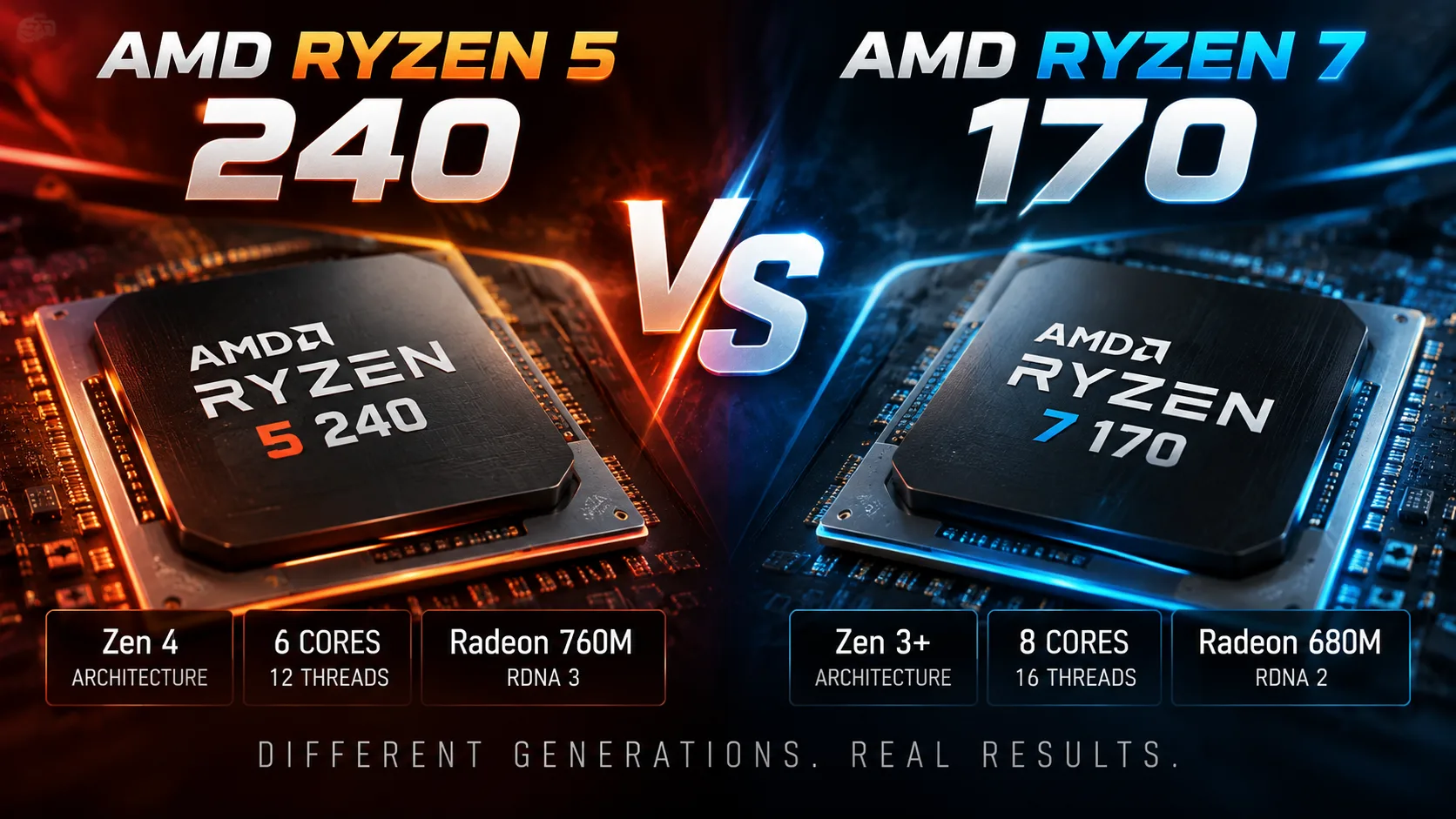
CPU Comparison Result
AMD Ryzen 5 240 vs. Ryzen 7 170: Six Zen 4 Cores vs. Eight Zen 3+ Cores
The Ryzen 5 240 and Ryzen 7 170 show that Ryzen 5 and Ryzen 7 branding does not always correspond to actual performance. The Ryzen 7 170 has eight cores but is based on the older Zen 3+ architecture. The Ryzen 5 240 uses six Zen 4 cores, operates at higher clock speeds, and is manufactured using a 4 nm process. As a result, the Ryzen 5 240 is noticeably faster in single-threaded tests and matches the eight-core model in many multithreaded workloads.
Key Differences
| Specification | AMD Ryzen 5 240 | AMD Ryzen 7 170 |
|---|---|---|
| Architecture | Zen 4, Hawk Point | Zen 3+, Rembrandt |
| Cores / threads | 6 / 12 | 8 / 16 |
| Base clock | 4.3 GHz | 3.2 GHz |
| Maximum clock | 5.0 GHz | 4.75 GHz |
| L2 | 6 MB | 4 MB |
| L3 | 16 MB | 16 MB |
| Process technology | TSMC 4 nm | TSMC 6 nm |
| TDP | 45 W | 45 W |
| cTDP | 35-54 W | 35-54 W |
| DDR5 memory | up to DDR5-5600 | up to DDR5-4800 |
| Integrated graphics | Radeon 760M | Radeon 680M |
| GPU compute units | 8 CU | 12 CU |
| GPU clock | up to 2600 MHz | up to 2200 MHz |
| NPU | Ryzen AI, up to 16 TOPS | None |
The Ryzen 5 240 is similar in configuration to the Ryzen 5 8645HS: both have six Zen 4 cores, Radeon 760M graphics, and a Ryzen AI engine. The Ryzen 7 170, in turn, uses the same basic CPU and GPU configuration as the Ryzen 7 7735HS: eight Zen 3+ cores and Radeon 680M graphics.
CPU Performance
The Ryzen 5 240’s main advantage appears in single-threaded performance. In Geekbench 6.7, laptops with this processor score around 2550-2615 points, while the ASUS Vivobook 16 with the Ryzen 7 170 scores around 2119 points. The difference exceeds 20%.
The gap is significantly smaller in multithreaded mode. The Ryzen 7 170 has eight cores and 16 threads versus the Ryzen 5 240’s 6/12, but the higher per-core performance of Zen 4 compensates for the Ryzen 7 170’s two additional cores. In Geekbench 6.7, systems with the Ryzen 5 240 score around 10,750-11,000 points, compared with approximately 10,000 for the Ryzen 7 170.
Geekbench 6 in Specific Devices
| Device | Processor | Geekbench 6 Single Core | Geekbench 6 Multi Core |
|---|---|---|---|
| Acer Nitro V 16 AI ANV16-42-R860 | Ryzen 5 240 | 2615 | 10754 |
| Acer Nitro ANV16S-61 | Ryzen 5 240 | 2550 | 10987 |
| ASUS Vivobook 16 M1605NAQ | Ryzen 7 170 | 2119 | 10024 |
Power limits, cooling, and memory configuration also affect the results. Both processors allow power settings in the 35-54 W range, so the same CPU can produce different results in different laptops.
Integrated Graphics
The Ryzen 5 240 does not have an unambiguous advantage in integrated graphics. It is equipped with Radeon 760M based on the RDNA 3 architecture, with 8 compute units and a clock speed of up to 2.6 GHz. The Ryzen 7 170 has Radeon 680M based on RDNA 2, with 12 compute units and a clock speed of up to 2.2 GHz.
The Radeon 680M has more execution units, while the Radeon 760M is based on the newer RDNA 3 architecture and operates at a higher clock speed. As a result, the two iGPUs deliver very similar performance.
3DMark
| Integrated graphics | 3DMark 11 Performance GPU | 3DMark Fire Strike Graphics | 3DMark Time Spy Graphics |
|---|---|---|---|
| Radeon 760M | 9899 | 6558 | 2281 |
| Radeon 680M | 10343 | 6848 | 2303 |
In these results, the Radeon 680M outperforms the Radeon 760M by approximately 4% in 3DMark 11 and Fire Strike, while the difference is around 1% in the newer Time Spy. This confirms that the two iGPUs are practically in the same performance class.
The Ryzen 5 240 supports DDR5-5600, while the Ryzen 7 170 supports DDR5-4800. The difference in memory bandwidth is particularly important for integrated graphics, since an iGPU uses system memory instead of dedicated video memory.
The Radeon 680M and Radeon 760M also deliver similar performance in games. The Radeon 680M may be faster in workloads that make effective use of its 12 CUs, while the Radeon 760M wins in other scenarios thanks to its newer RDNA 3 architecture and higher clock speed.
Power Consumption and Platform
Both processors have a 45 W TDP and a 35-54 W cTDP range. The Ryzen 5 240 is manufactured using TSMC’s 4 nm process, while the Ryzen 7 170 uses a 6 nm process.
The Ryzen 5 240 supports DDR5-5600 versus DDR5-4800 for the Ryzen 7 170. Memory speed has less impact on CPU performance than on integrated graphics, but the higher bandwidth still gives the newer platform an additional advantage.
Another difference is the Ryzen AI engine. The Ryzen 5 240 includes a separate NPU with performance of up to 16 TOPS. The Ryzen 7 170 does not have a hardware NPU. An NPU can be used in applications that support local execution of AI tasks.
Which One to Choose
The Ryzen 5 240 is faster in most CPU workloads. Zen 4 gives it a noticeable advantage in single-threaded tests and allows its six cores to compete successfully with the Ryzen 7 170’s eight cores in multithreaded workloads. In addition, the Ryzen 5 240 supports DDR5-5600, is manufactured using a 4 nm process, and includes an NPU.
The Ryzen 7 170 offers 8 cores instead of 6 and Radeon 680M with 12 CUs instead of the Radeon 760M’s 8 CUs. Its integrated graphics are slightly faster in 3DMark, but the difference between the two iGPUs is small.
At the same price and with comparable laptop specifications, the Ryzen 5 240 is the stronger option for CPU performance. The Ryzen 7 170 is worth considering if the specific laptop model is cheaper or if its Radeon 680M configuration delivers better gaming performance.
Conclusion
The newer Zen 4 architecture allows the Ryzen 5 240 to compensate for its lower core count. In terms of CPU performance, the Ryzen 5 240 is faster in most tests, while the Ryzen 7 170 counters with eight cores and a slightly faster Radeon 680M.
Advantages
- Higher Max Turbo Frequency: Up to 5 GHz (Up to 5 GHz vs Up to 4.75 GHz)
- Higher Technology: TSMC 4nm FinFET (TSMC 4nm FinFET vs TSMC 6nm FinFET)
- More Total Cores: 8 (6 vs 8)
- Newer Launch Date: October 2025 (February 2025 vs October 2025)
Basic
CPU Specifications
Memory Specifications
GPU Specifications
Miscellaneous
Benchmarks
Related CPU Comparisons


Share in social media
Or Link To Us
<a href="https://cputronic.com/en/cpu/compare/amd-ryzen-5-240-vs-amd-ryzen-7-170" target="_blank">AMD Ryzen 5 240 vs AMD Ryzen 7 170</a>