AMD Ryzen Embedded PRO 9645

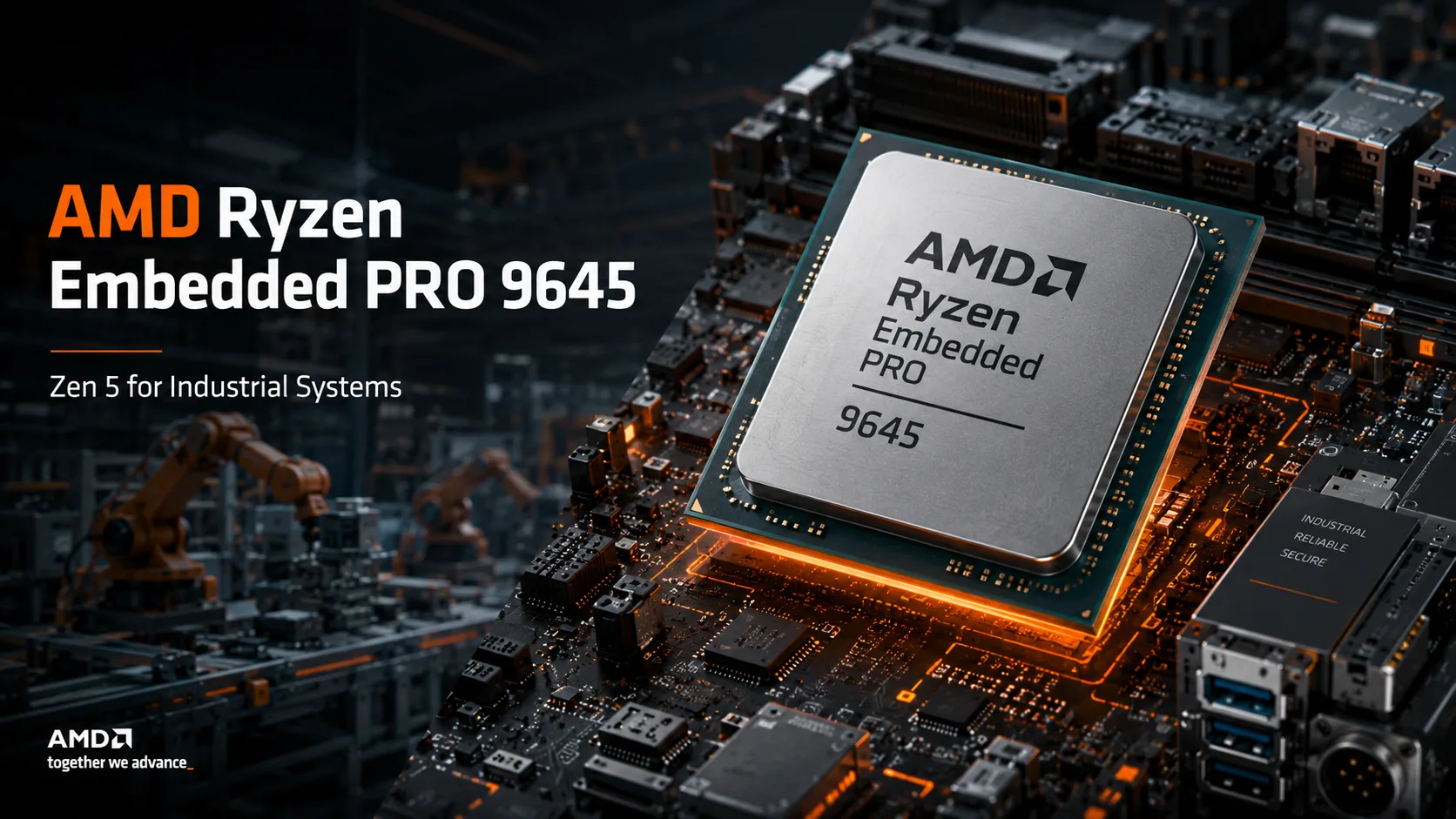
AMD Ryzen Embedded PRO 9645: How Industrial Zen 5 Differs from Ryzen 5 9600X
At first glance, the AMD Ryzen Embedded PRO 9645 looks similar to the standard 6-core Ryzen 9000. With Zen 5 architecture, 12 threads, frequencies up to 5.4 GHz, 32 MB L3 cache, and a TDP of 65 watts, its specifications are close to those of desktop Ryzen 5. However, this processor is not designed for home builds or gaming benchmarks. It is an AM5 processor for industrial PCs, automation, machine vision, and edge computing, where ECC memory, PCIe 5.0, long-term availability, and platform stability are valued.
The easiest comparison is with the Ryzen 5 9600X. The standard Ryzen 5 9600X is purchased for desktop PCs, the Ryzen 5 PRO 9645 is for corporate systems, while the Ryzen Embedded PRO 9645 is aimed at equipment manufacturers needing Zen 5 in devices designed for years of production and service.
Specifications of AMD Ryzen Embedded PRO 9645
| Parameter | Value |
|---|---|
| Series | AMD Ryzen Embedded PRO 9000 |
| Architecture | Zen 5 |
| Socket | AM5 |
| Cores / Threads | 6 / 12 |
| Base Frequency | 3.9 GHz |
| Max Frequency | up to 5.4 GHz |
| L3 Cache | 32 MB |
| TDP | 65 W |
| Memory | DDR5, 2 channels, ECC |
| PCIe | up to 28 lanes PCIe 5.0 |
| Integrated Graphics | Radeon Graphics, 1 CU |
| Graphics Frequency | up to 2200 MHz |
| Display Support | up to 4 |
| Junction Temperature Range | 0-105 °C |
| Long-term Availability | Last Time Buy 2036 |
From its specifications, it is evident that this processor is not designed for record-breaking performance, but for an industrial platform. It is not the fastest CPU in the line. The Ryzen Embedded PRO 9645 serves a different purpose: it provides equipment manufacturers with an AM5 platform featuring DDR5 ECC, PCIe 5.0, and long-term availability.
Why It's Not a Replacement for Ryzen 5 9600X
The similarities with the Ryzen 5 9600X are noticeable: 6 Zen 5 cores, 12 threads, 32 MB L3, frequencies up to 5.4 GHz, and 65 W TDP. Therefore, the Ryzen Embedded PRO 9645 can be considered a close relative of the standard 6-core desktop variant. However, they are intended for different scenarios.
The Ryzen 5 9600X is designed for regular PCs: home builds, gaming systems, entry-level workstations. In this segment, price, availability, overclocking, memory settings, and support for consumer motherboards are essential.
In contrast, the Ryzen Embedded PRO 9645 is required in environments where stable configurations over years are more important than overclocking. For an industrial computer or terminal manufacturer, it is crucial that the processor remains available for a long time, that the platform does not need to be changed every generation of devices, and that the system can work with ECC memory, expansion cards, network controllers, capture cards, and accelerators.
Thus, the Embedded version is aimed not at enthusiasts but at integrators and OEM manufacturers. Such a processor is almost unnecessary for a home upgrade. In an industrial device, it is more appropriate than a standard Ryzen.
Performance: Level of 6-Core Zen 5
There are currently few public tests of the Ryzen Embedded PRO 9645, so it makes sense to look at closely related models like the Ryzen 5 PRO 9645 and Ryzen 5 9600X. It should be close in processing performance to modern 6-core Zen 5 CPUs: high single-threaded speed, quick system response, and sufficient headroom for tasks that can utilize up to 12 threads.
This represents a significant advantage for the industrial segment. Such a processor can simultaneously handle operator interfaces, network services, data collection, local analytics, signal processing, and basic machine vision tasks. In older industrial systems, the CPU often becomes a bottleneck, especially when video management, analytics, and databases are added to equipment control.
However, evaluating it solely on peak benchmarks is not appropriate. In an industrial case, stable performance within a designated thermal envelope is more important. The outcome depends on the motherboard, BIOS, power limits, and cooling solutions. In a spacious industrial PC, the processor can maintain higher frequencies longer than in a compact, closed case with limited airflow.
Integrated Graphics: For Display Output
The integrated Radeon Graphics here is primarily needed for display output. One compute unit is sufficient for HMI panels, terminals, diagnostic screens, operator interfaces, and configurations with multiple displays.
This allows for a discrete graphics card to be avoided in simple configurations. However, it is not designed for gaming performance or serious GPU acceleration. Machine vision, neural networks, 3D visualization, and heavy video processing will require discrete graphics, a specialized accelerator, or a capture card.
Where Ryzen Embedded PRO 9645 is Suitable
The Ryzen Embedded PRO 9645 is suitable for devices where CPU performance, PCIe 5.0, ECC, and long-term availability are essential.
Typical scenarios include:
- Industrial PCs and compact workstations;
- Automation and equipment control;
- Machine vision and quality control;
- Edge servers and local analytics;
- Medical and measurement systems;
- HMI panels and operator terminals;
- Video surveillance and stream processing;
- Test benches and diagnostic equipment.
The processor makes particularly logical sense in mid-range systems. Higher-end Ryzen Embedded 9000 processors with 8, 12, and 16 cores are needed for heavy multithreaded loads, virtualization, and dense edge servers. The Ryzen Embedded PRO 9645 occupies a more mainstream niche: a fast CPU, moderate TDP, and configurations without paying a premium for extra cores.
What the PRO Version Offers
The PRO version is necessary where the processor becomes part of a managed and secured platform. Managed capabilities, boot protection, hardware security features, and configuration stability take priority. In such systems, the chip is installed not in a standard office PC but in a terminal, industrial computer, medical complex, or control system.
However, the processor itself does not guarantee a full set of capabilities in any configuration. Actual features depend on the motherboard, BIOS, firmware, and specific manufacturer's choices. The Ryzen Embedded PRO 9645 provides the hardware foundation, but the final feature set is determined by the OEM manufacturer.
Strengths
The strengths of the Ryzen Embedded PRO 9645 are clear: Zen 5 offers high single-threaded performance, AM5 and PCIe 5.0 provide I/O headroom, DDR5 ECC reduces memory error risks, and a 65 W TDP simplifies cooling. Long-term availability is also important for OEM manufacturers, as devices can be produced and serviced without an urgent platform change.
This is the key difference from the standard desktop Ryzen. In consumer PCs, a few percentage points of performance or retail price often take precedence over delivery timelines. In industrial systems, priorities are different: stable configurations, compatibility with expansion cards, operation within a specified thermal envelope, and predictable support.
Limitations
The Ryzen Embedded PRO 9645 is not versatile. For home PCs, it is more sensible to opt for the Ryzen 5 9600X, as it is more affordable in standard retail, better suited for consumer boards, memory, and configurations, and more predictable for gaming or work builds.
For heavy multithreaded workloads, older Ryzen Embedded 9000 models are better suited. Six cores are sufficient for mid-range industrial PCs, but they do not replace 12- or 16-core models in virtualization with many VMs, rendering, heavy analytics, and processing multiple video streams.
Integrated Radeon Graphics is also insufficient for graphics tasks. While it can handle display output, it does not replace discrete GPUs.
Conclusion
The AMD Ryzen Embedded PRO 9645 is not a gaming Ryzen or a processor for mass retail builds. Its value lies elsewhere: AMD is bringing Zen 5 and AM5 to the industrial segment, where DDR5 ECC, PCIe 5.0, 65 W TDP, PRO features, and long-term availability are required.
In terms of CPU performance, it is close to current 6-core Ryzen 9000 models, but the purpose of the Embedded version is not in benchmark records. Such processors are needed in ready-made devices: industrial PCs, automation, machine vision, edge servers, and measurement equipment.
For a home computer, the Ryzen Embedded PRO 9645 is almost certainly redundant. However, for a device that must be produced, serviced, and function for years, it becomes a more logical choice.
CPU Comparison
Compare Ryzen Embedded PRO 9645 with other CPUs
Basic
CPU Specifications
Memory Specifications
Interfaces and Ports
Miscellaneous
Share in social media
Or Link To Us
<a href="https://cputronic.com/en/cpu/amd-ryzen-embedded-pro-9645" target="_blank">AMD Ryzen Embedded PRO 9645</a>