AMD Ryzen AI 5 440GE
AMD Ryzen AI 5 440GE: A Successful Balance with Weak Integrated Graphics
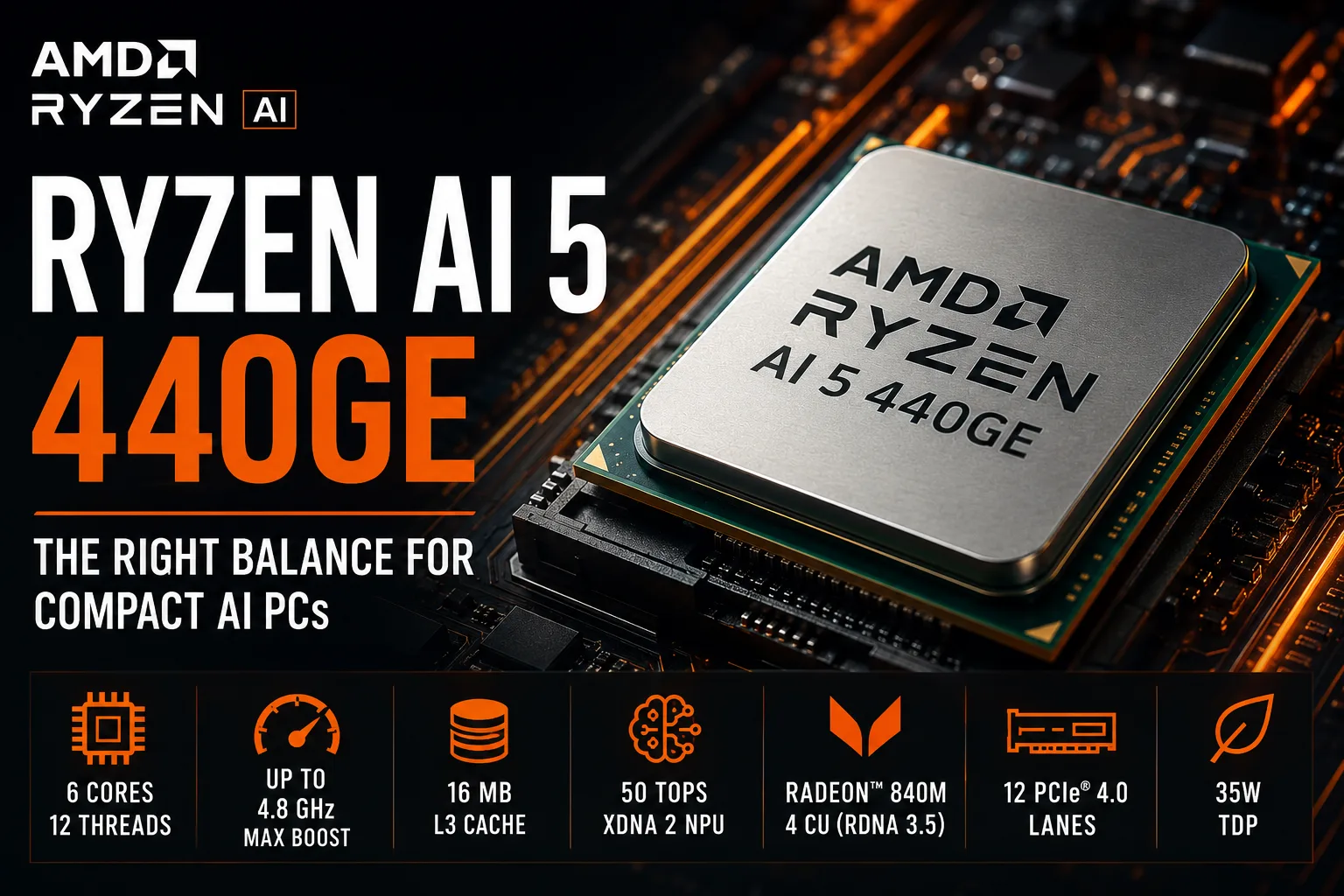
The AMD Ryzen AI 5 440GE appears to be the most balanced entry-level model in the Ryzen AI 400 desktop lineup. Unlike the 435GE, AMD has maintained 16 MB of L3 cache, increased the clock speed to 4.8 GHz, and retained twelve available PCIe 4.0 lanes.
As a result, the 440GE is better suited for a compact work computer than its lower version. However, it cannot be called an ideal APU: the four Radeon 840M compute units significantly limit gaming capabilities and tasks that can leverage the GPU.
Six Cores with a TDP of 35W
The Ryzen AI 5 440GE belongs to the Gorgon Point desktop family for the AM5 socket. The processor features six cores, supports twelve threads, and can boost up to 4.8 GHz. The standard TDP is 35W.
This power limit is designed for small cases, all-in-ones, and pre-built office computers where moderate heat and quiet cooling are essential. Six cores should be sufficient for browsing, office applications, programming, video calls, photo processing, and everyday multitasking.
In prolonged tasks such as rendering, compiling, or video encoding, the outcome will depend more on power and cooling limitations. In short bursts, the 440GE should outperform the 65W version less than during extended workloads across all cores, but the exact difference will be revealed through direct testing.
The model's essence unfolds precisely where the 35W TDP is a part of the computer's design. In a typical full-sized case with good cooling, the advantage of the GE version becomes less apparent.
Main Difference from the Ryzen AI 5 435GE
The Ryzen AI 5 440GE cannot be considered merely a faster version of the 435GE. While the 300 MHz difference is modest, the higher model has double the L3 cache - 16 MB instead of 8 MB.
The additional cache is potentially beneficial in gaming, compiling, archiving, and other memory-intensive tasks. How noticeable the increase will be depends on the specific application; however, the 440GE's configuration appears less cut down.
The number of available PCIe lanes has also increased from ten to twelve. For mini-PCs with a single drive, this is almost irrelevant. In a system with additional SSDs, network controllers, or a discrete graphics card, two extra lanes provide motherboard manufacturers a bit more flexibility.
At a similar price point, the Ryzen AI 5 440GE appears more rational compared to its lower model. The savings with the 435GE impact clock speeds, cache, and expansion possibilities all at once.
NPU Same as Higher Models
The integrated XDNA 2 unit provides up to 50 TOPS - the same as the more expensive Ryzen AI 400 models. It meets the requirements of Copilot+ PC and is designed for local Windows functions and compatible applications: image processing from the camera, noise cancellation, speech recognition, translation, and search.
For ongoing background operations, a dedicated NPU is more convenient than the CPU or integrated graphics: it performs specialized tasks with less load on the main compute units.
However, 50 TOPS do not make the processor a fully-fledged platform for heavy local work with large language models. In such scenarios, memory capacity, GPU capabilities, and support for specific software stacks are crucial. The NPU here is primarily useful for operating system functions and optimized applications.
Radeon 840M Remains a Weak Link
The integrated Radeon 840M uses RDNA 3.5 architecture and contains four Compute Units (CUs). For a work computer, this is sufficient: it can handle the system interface, high-resolution video, multiple monitors, and hardware encoding.
Older games, less demanding online projects, and some modern releases will also run, but they often require low settings and reduced resolutions.
Four CUs remain the baseline configuration. A frequency of up to 2.9 GHz does not compensate for the limited number of execution units, so the main limitation for the Ryzen AI 5 440GE in a gaming computer remains the graphics.
A noticeable upgrade is offered by the Ryzen AI 7 450GE with Radeon 860M and eight CUs. Doubling the number of compute units does not guarantee a twofold gain, especially given the same 35W TDP, but the difference between these graphical configurations should be significantly larger than between the Radeon 840M in the 435GE and 440GE.
Position of Ryzen AI 5 440GE in the Lineup
| Parameter | Ryzen AI 5 435GE | Ryzen AI 5 440GE | Ryzen AI 7 450GE |
|---|---|---|---|
| Cores and Threads | 6 / 12 | 6 / 12 | 8 / 16 |
| Maximum Clock Speed | 4.5 GHz | 4.8 GHz | 5.1 GHz |
| L3 Cache | 8 MB | 16 MB | 16 MB |
| Integrated Graphics | Radeon 840M | Radeon 840M | Radeon 860M |
| GPU Compute Units | 4 CU | 4 CU | 8 CU |
| Available PCIe Lanes | 10 | 12 | 12 |
| NPU | up to 50 TOPS | up to 50 TOPS | up to 50 TOPS |
| TDP | 35 W | 35 W | 35 W |
The Ryzen AI 5 440GE occupies a middle ground. Compared to the 435GE, it offers higher clock speeds, double the L3 cache, and a less restrictive PCIe configuration.
Transitioning to the Ryzen AI 7 450GE brings more noticeable changes: eight cores instead of six and Radeon 860M instead of Radeon 840M. Therefore, the premium for the 450GE makes sense not for the NPU - that remains the same - but for the CPU and integrated graphics.
Ryzen AI 5 440GE or 440G
The Ryzen AI 5 440GE and 440G share the same number of cores, maximum clock speed, cache size, integrated graphics, and stated NPU performance. The main difference lies in TDP: 35W for the GE and 65W for the G.
For a compact case, all-in-one, or quiet office system, the 440GE appears more logical. It is easier to cool, and in everyday short tasks, the difference may be minimal.
The Ryzen AI 5 440G is preferable for prolonged multi-threaded workloads. A greater power reserve should allow it to maintain higher clock speeds for a longer time, although the actual result will depend on the BIOS and cooling system settings.
Choosing the GE solely for the lower TDP figure in a full-sized build is unnecessary. This version is justified primarily where power consumption and thermal output are strictly limited.
AM5 Without Being Tied to a Pre-built Mini-PC
The Ryzen AI 5 440GE uses the AM5 socket and supports DDR5, so it is not tied to a closed platform of a pre-built computer. Owners can replace the motherboard, memory, storage drives, or even the processor itself.
However, the twelve available PCIe lanes still limit complex configurations. For a system with one or two SSDs, there’s almost no issue. When installing a discrete graphics card, multiple NVMe drives, and additional controllers, the lane distribution will depend on the specific motherboard.
Installing such a processor in an expensive flagship motherboard is not very rational. Its natural environment is a compact board, moderate memory size, one or two drives, and the absence of powerful discrete graphics.
Conclusion
The AMD Ryzen AI 5 440GE is a successful foundation for a quiet, compact AI PC. It features six cores, 16 MB of L3 cache, a modern NPU providing 50 TOPS, and enough platform capabilities for a typical work computer.
Compared to the 435GE, this model appears noticeably better balanced: AMD did not halve the cache and retained more PCIe lanes. At a similar price point, the premium for the 440GE is justified.
The main limitation remains the Radeon 840M. It is suitable for desktop use, multimedia, and multiple monitors but does not transform the processor into a gaming APU. For more intensive graphics, it is more logical to consider the Ryzen AI 7 450GE, while for prolonged multi-threaded workloads, the 65W Ryzen AI 5 440G is more appropriate.
The Ryzen AI 5 440GE itself occupies a rational middle ground: a sufficiently powerful CPU, a fully-fledged NPU, and a 35W TDP without the most contentious limitations of the lower model.
CPU Comparison
Compare Ryzen AI 5 440GE with other CPUs
Basic
CPU Specifications
Memory Specifications
GPU Specifications
Miscellaneous
Share in social media
Or Link To Us
<a href="https://cputronic.com/en/cpu/amd-ryzen-ai-5-440ge" target="_blank">AMD Ryzen AI 5 440GE</a>