AMD Ryzen AI 5 435GE
AMD Ryzen AI 5 435GE: 35 Watts, Strong NPU, and Controversial Savings
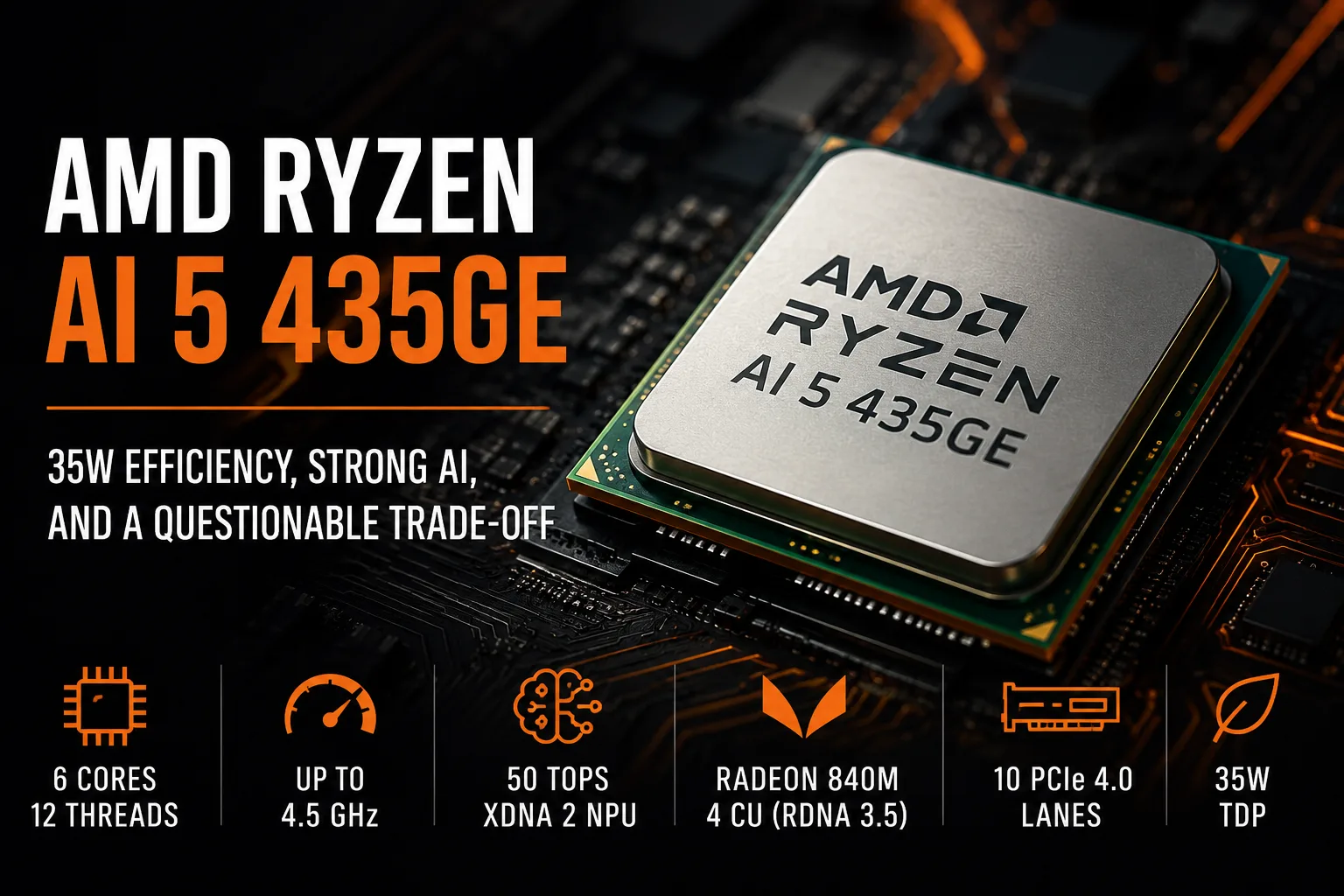
The AMD Ryzen AI 5 435GE features the same 50 TOPS NPU as the higher-end models in the series, but AMD has cut costs on frequencies, L3 cache, and PCIe lanes. Therefore, the main question is not whether this processor is fast enough, but how much cheaper it will be compared to the Ryzen AI 5 440GE.
Six cores are sufficient for web browsing, office applications, video calls, studying, and light photo editing. However, at a similar price, the older model looks significantly better: it is faster, has twice the L3 cache, and offers a less restricted platform configuration.
Six Cores at 35 W TDP
The Ryzen AI 5 435GE belongs to the Gorgon Point desktop family for the AM5 socket. The processor contains six cores and supports twelve threads. The maximum frequency reaches 4.5 GHz, and the standard TDP is 35 W.
This configuration is primarily designed for small cases and pre-built computers, where moderate power consumption, quiet cooling, and the absence of a discrete graphics card are important.
Under short loads, the processor can operate at high frequencies, but in prolonged rendering, compiling, or video encoding, performance will heavily depend on the power and cooling limits of the specific system.
This is the main distinction from the Ryzen AI 5 435G. The models share the same maximum frequency, cache, and integrated graphics, but the 65-watt version has greater power reserves for prolonged multithreaded loads.
50 TOPS - The Main Advantage of the 435GE
The Ryzen AI 5 435GE is equipped with an XDNA 2 block with up to 50 TOPS performance. It meets the requirements of Copilot+ PC and is primarily designed for constant background AI functions: image processing from cameras, noise reduction, speech recognition, local search, and compatible Windows tools.
For such scenarios, a separate NPU is more useful than performing the same operations on the CPU or integrated graphics. It consumes less power and does not use computational resources of main applications.
However, the 50 TOPS rating does not turn the 435GE into a platform for serious local work with large language models. In such tasks, factors such as memory size, GPU capabilities, supported formats, and software stack are also crucial. This NPU is intended for built-in operating system and application functions, not as a replacement for a discrete graphics card.
Radeon 840M: Sufficient for Desktop, Limited for Gaming
The integrated Radeon 840M utilizes the RDNA 3.5 architecture and contains four compute units (CUs). The graphics support modern video codecs, multiple displays, and high-resolution output.
For an office or home computer, this is enough. The system can operate without a discrete graphics card, play high-resolution video, and support multiple monitors. Older games and less demanding online projects will also run, although resolution and settings will often need to be lowered.
For modern heavy games, the Radeon 840M is too weak. Four CUs represent an entry-level configuration, and high frequency does not compensate for the limited number of execution units. A noticeable performance boost within the lineup starts with models equipped with the Radeon 860M with eight CUs.
The main limitation of the Ryzen AI 5 435GE in a gaming computer remains the graphics.
Ryzen AI 5 435GE vs. 440GE
At first glance, the Ryzen AI 5 435GE appears to be a slightly slower version of the 440GE. However, the difference between them extends beyond just frequency.
| Parameter | Ryzen AI 5 435GE | Ryzen AI 5 440GE |
|---|---|---|
| Cores and Threads | 6 / 12 | 6 / 12 |
| Maximum Frequency | 4.5 GHz | 4.8 GHz |
| L3 Cache | 8 MB | 16 MB |
| Integrated Graphics | Radeon 840M | Radeon 840M |
| Graphics Frequency | up to 2.8 GHz | up to 2.9 GHz |
| Available PCIe Lanes | 10 | 12 |
| TDP | 35 W | 35 W |
| NPU Performance | 50 TOPS | 50 TOPS |
The difference of 300 MHz does not seem critical by itself. Much more significant is the reduced L3 cache from 16 MB to 8 MB. A cache half its size can reduce performance in gaming, compiling, archiving, and other tasks with frequent memory access.
The 435GE is also limited to ten PCIe 4.0 lanes compared to twelve in the 440GE. For a pre-built mini-PC with one SSD, this is almost negligible. However, in a custom build with a discrete graphics card, additional drives, and controllers, this limitation becomes more pronounced.
Therefore, the Ryzen AI 5 440GE is not only a faster model but also a better-balanced one. With only a slight price difference, the savings on the 435GE start to lose their appeal.
AM5 Without Much Room for Expansion
The Ryzen AI 5 435GE remains an ordinary AM5 processor with support for DDR5, modern chipsets, memory overclocking, and current interfaces. This offers more freedom than mobile processors, which are only available inside ready-made laptops or mini-PCs.
However, the characteristics of the 435GE are best utilized in compact systems. The limited number of PCIe lanes does not pair well with an expensive full-sized motherboard and many expansion devices. Installing such a processor in a powerful motherboard with plans for future upgrades is not very rational.
Most likely, this model will be more commonly found in ready-made office computers, all-in-ones, and corporate systems than in retail. For PC manufacturers, it is convenient: allowing them to release a quiet Copilot+ PC without a separate graphics card and complex cooling.
Conclusion
The AMD Ryzen AI 5 435GE is a specialized processor for quiet and compact AI PCs. It offers six cores, a modern NPU, and integrated graphics sufficient for everyday work without a discrete graphics card.
However, the lower position in the lineup has not only been achieved by reducing frequencies. AMD has halved the L3 cache and reduced the number of available PCIe lanes, while the Radeon 840M remains at an entry-level position.
In a ready-made mini-PC, these limitations may go unnoticed. In a custom build, they carry more weight. The Ryzen AI 5 435GE is justified when there is a strict power consumption limit or significant savings relative to the Ryzen AI 5 440GE.
CPU Comparison
Compare Ryzen AI 5 435GE with other CPUs
Basic
CPU Specifications
Memory Specifications
GPU Specifications
Miscellaneous
Share in social media
Or Link To Us
<a href="https://cputronic.com/en/cpu/amd-ryzen-ai-5-435ge" target="_blank">AMD Ryzen AI 5 435GE</a>