AMD Ryzen 7 PRO 253
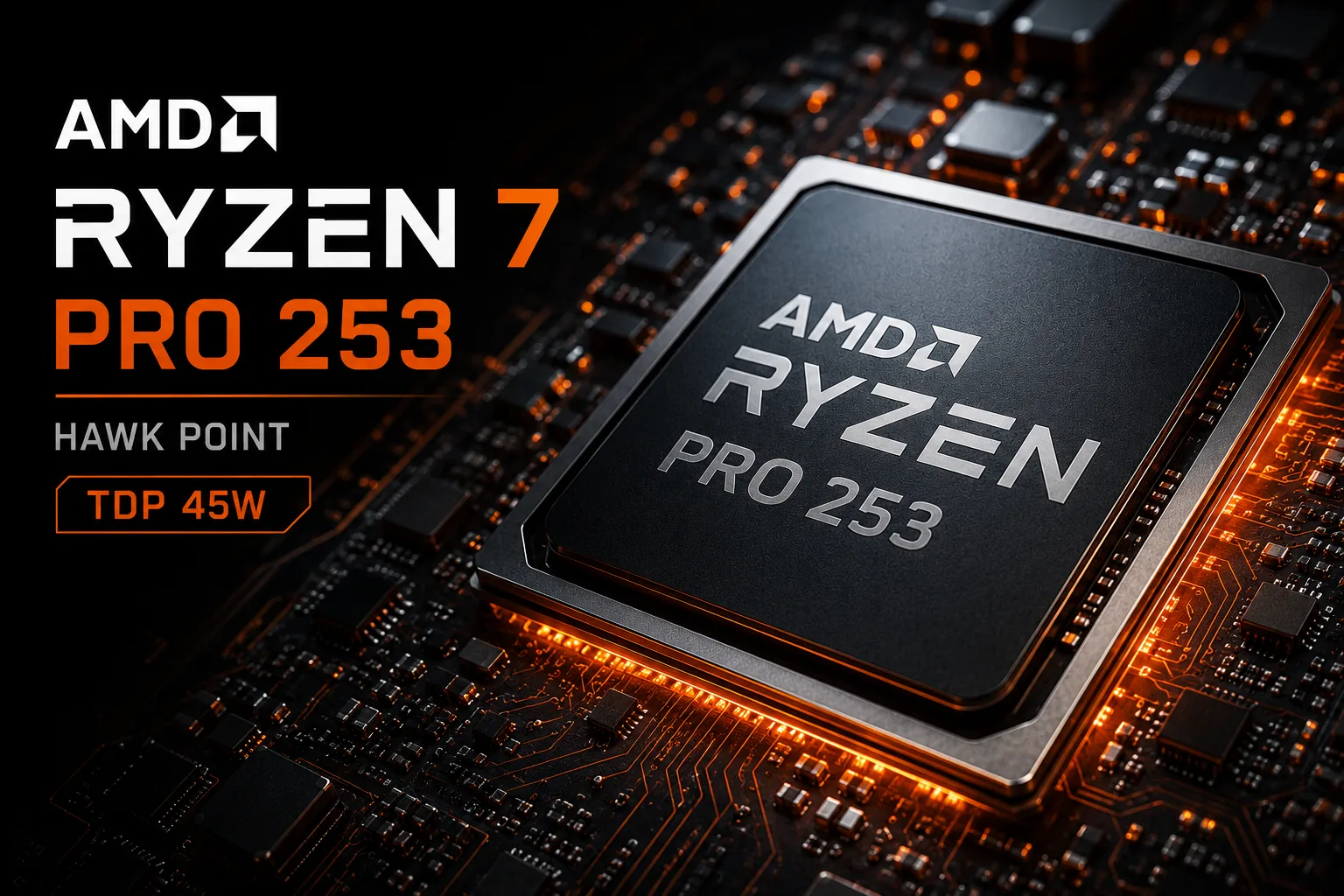
AMD Ryzen 7 PRO 253: Why Hawk Point Features a 45W TDP
The AMD Ryzen 7 PRO 253 was introduced in 2026, but it's based on the Hawk Point platform, featuring eight Zen 4 cores and Radeon 780M graphics. It differs from the closely related Ryzen 7 PRO 250 primarily in its power limit: the standard TDP has been increased from 28 to 45W. This difference defines the processor's intended use more than its new designation.
AMD employed Hawk Point in the higher-end segment of corporate laptops and compact PCs. A comparison with the Ryzen 7 PRO 250 best illustrates the intended purpose of the PRO 253: while they share the same architecture, their power limits and cooling requirements differ significantly.
PRO 253 vs. PRO 250: Same Cores, Different Power Limits
The naming suggests that the PRO 253 is just slightly faster than the PRO 250. In reality, the models are geared towards different types of computers.
| Specification | Ryzen 7 PRO 253 | Ryzen 7 PRO 250 |
|---|---|---|
| Base Clock | 3.6 GHz | 3.3 GHz |
| Max Boost Clock | 4.9 GHz | 5.1 GHz |
| Standard TDP | 45W | 28W |
| Configurable TDP | 35-54W | 15-30W |
| Radeon 780M Frequency | 2.5 GHz | 2.7 GHz |
Both processors feature eight Zen 4 cores, sixteen threads, 16MB of L3 cache, and an integrated Radeon 780M. The PRO 253 has a higher base clock, and its maximum configurable TDP reaches 54W compared to 30W for the PRO 250. However, the latter model benefits from a higher peak clock frequency for the CPU cores and graphics.
As a result, the PRO 253 may not be faster in every task. In short, single-threaded workloads, the difference will be minor, and the higher peak clock of the PRO 250 might even allow it to pull ahead at times.
The advantage of the PRO 253 should be evident in sustained multi-threaded workloads, where the increased power limit helps maintain higher frequencies longer. Actual performance will, however, depend on the cooling solution and specific system settings.
In a thin chassis, the increased power limit may raise temperatures and noise levels without yielding noticeable speed gains. Thus, the mere designation of 253 does not guarantee a faster system.
Where Eight Zen 4 Cores Remain Sufficient
The Ryzen 7 PRO 253 is manufactured using TSMC's 4nm process. The processor sports eight cores, sixteen threads, 8MB of L2 cache, and 16MB of L3 cache. The base clock is 3.6 GHz, and the maximum clock is 4.9 GHz.
In terms of speed and energy efficiency, the PRO 253 falls behind the newer Ryzen AI PRO models, but eight Zen 4 cores are adequate for most work scenarios.
The increased power limit mainly benefits tasks capable of loading all cores for extended periods:
- Compiling large projects;
- Batch processing photos and videos;
- Analyzing large data sets;
- Running multiple virtual machines;
- Simultaneous execution of resource-heavy applications.
However, the Ryzen 7 PRO 253 does not replace mobile HX-class processors. The power range is limited to 54W, and the L3 cache size is 16MB. For continuous rendering and complex engineering calculations, more powerful processors and full mobile workstations are better suited.
Radeon 780M Allows for the Absence of a Discrete Graphics Card
The processor features an integrated Radeon 780M based on RDNA 3 architecture with twelve graphics cores and a clock speed of up to 2.5 GHz. It supports modern video codecs, multiple external displays, and hardware AV1 encoding.
For a corporate computer without a discrete graphics card, the Radeon 780M covers most everyday graphics tasks. It is suitable for multi-monitor setups, high-resolution video playback, and basic image processing.
By lowering the resolution and graphics quality, it can also run online games and less demanding projects. However, in the PRO 253, the graphics operate 200 MHz slower than in the PRO 250.
The additional power headroom in the PRO 253 is primarily aimed at the CPU cores rather than the integrated graphics. Furthermore, the speed of the Radeon 780M heavily relies on memory. Dual-channel DDR5 or fast LPDDR5X is significantly more preferable than a single DDR5 module.
For serious video editing, 3D modeling, and modern gaming, a discrete graphics card will be necessary. But in a work laptop or mini-PC, the Radeon 780M allows for operation without an additional GPU, avoiding increases in cost, heat, and power consumption.
NPU with 16 TOPS - A Secondary Advantage
The Ryzen 7 PRO 253 comes with a first-generation AI processor, Ryzen AI, capable of delivering up to 16 TOPS. It can accelerate noise cancellation, background blurring, image processing from a camera, and specific on-device AI functions.
This performance is sufficient for video call effects and simple AI tasks but not for serious work with modern on-device models. The new Ryzen AI models are better suited for such tasks and are equipped with significantly more powerful neural processors.
The presence of Ryzen AI does not position the PRO 253 alongside modern Copilot+ PCs. For most buyers, the eight CPU cores and Radeon 780M will provide more benefit than the NPU with 16 TOPS.
It makes little sense to pay a premium for this model solely for its neural processor.
What Does the PRO Designation Offer?
The PRO designation denotes a set of corporate management and security features rather than additional performance.
The Ryzen 7 PRO 253 supports AMD PRO Technologies, DASH remote management, AMD Memory Guard memory encryption, and hardware AMD Secure Processor. The platform also includes firmware TPM, Virtualization-Based Security, and Windows Secured-Core PC requirements.
For organizations, these capabilities simplify the deployment, maintenance, and protection of a large fleet of computers. Therefore, Ryzen PRO is often installed in corporate laptops and desktop systems designed for centralized management.
The average home user is unlikely to notice a difference between the PRO and standard versions of the processor unless they use these features.
USB4, PCIe 4.0, and Up to 96GB of Memory
The platform supports two USB4 ports with speeds up to 40 Gbps, PCI Express 4.0, twenty PCIe lanes, DDR5-5600, and LPDDR5X. The maximum memory capacity reaches 96GB when using DDR5.
This array is sufficient for a modern work laptop, mini-PC, or compact desktop system. However, the actual capabilities depend on the device manufacturer.
The support for two USB4 ports in the processor does not guarantee that both ports will necessarily be available on the chassis. The same goes for the number of video outputs, memory configurations, and available PCIe lanes.
When to Choose Ryzen 7 PRO 253
The Ryzen 7 PRO 253 is better suited for corporate laptops with advanced cooling systems, mini-PCs, and compact desktops.
You should choose it if:
- The computer regularly operates under prolonged multi-threaded loads;
- Battery life is not a top priority;
- A discrete graphics card is not required, but powerful integrated graphics are essential;
- The organization uses AMD PRO management and security features;
- A computer with PRO 253 is significantly cheaper than a comparable model equipped with Ryzen AI PRO.
For a thin laptop that frequently runs on battery power, the Ryzen 7 PRO 250 is a better choice. It is more energy-efficient, features a higher peak clock, and has a slightly faster Radeon 780M.
For routine use of local AI models, the newer Ryzen AI PRO is a better fit. For rendering, complex 3D tasks, and gaming, a system with an HX-class processor or a discrete graphics card is needed.
Conclusion
The Ryzen 7 PRO 253 positions the Hawk Point into the 45-watt corporate processor class. Its primary advantage over the PRO 250 relates not to a new architecture but to its ability to sustain high loads under multi-threaded workloads for a longer duration.
The choice between these models primarily depends on the cooling solution of the specific computer. Without adequate cooling, the increased power limit will not provide a noticeable benefit.
With good cooling, the PRO 253 performs better under extended workloads across all cores. In a thin chassis, the difference may disappear, and the PRO 250 could prove to be quieter and more energy-efficient.
Comparing these processors solely by their index is meaningless. The design of the computer, power consumption settings, memory configuration, and price differences are far more critical.
CPU Comparison
Compare Ryzen 7 PRO 253 with other CPUs
Basic
CPU Specifications
Memory Specifications
GPU Specifications
Miscellaneous
Related CPU Comparisons

Share in social media
Or Link To Us
<a href="https://cputronic.com/en/cpu/amd-ryzen-7-pro-253" target="_blank">AMD Ryzen 7 PRO 253</a>