AMD Ryzen 7 7700X3D
AMD Ryzen 7 7700X3D: 8-Core X3D for AM5 with Reduced Frequencies
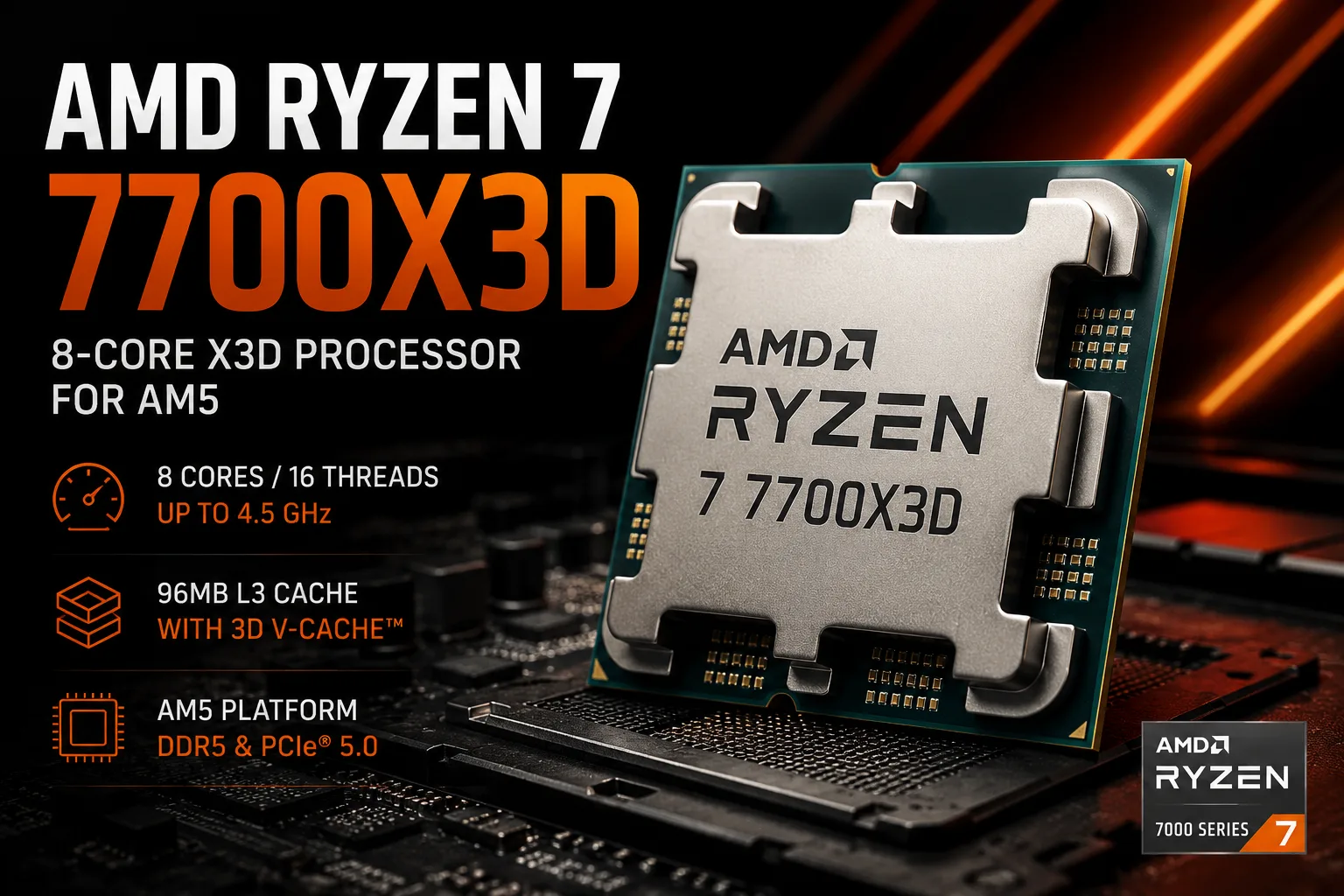
The AMD Ryzen 7 7700X3D is an 8-core Zen 4 processor for AM5 featuring 3D V-Cache. Its specifications are similar to the Ryzen 7 7800X3D: both have 8 cores, 16 threads, and 96 MB of L3 cache, but the 7700X3D operates at lower frequencies - 4.0 / 4.5 GHz instead of 4.2 / 5.0 GHz.
The primary evaluation criterion is the price in comparison to the Ryzen 7 7800X3D. If there is a significant price difference, the Ryzen 7 7700X3D will be justified as a gaming processor for AM5. If the prices are close, the advantage will lie with the Ryzen 7 7800X3D: it has higher frequencies and has been well-tested.
What Kind of Processor is This
The Ryzen 7 7700X3D has 8 cores and 16 threads. The base frequency is 4.0 GHz, and the maximum frequency is 4.5 GHz. The total L2 + L3 cache is 104 MB, with 96 MB being L3. The TDP is rated at 120 W.
The main distinguishing feature from regular Ryzen 7 processors is the AMD 3D V-Cache. The additional L3 cache often provides a performance boost specifically in games. The processor accesses system memory less frequently, which helps in projects sensitive to memory latency.
However, the Ryzen 7 7700X3D is not a flagship model. It does not feature a new architecture and is not a replacement for the Ryzen 7 7800X3D. AMD has added another 8-core X3D processor to the AM5 lineup at a lower price point.
Differences from Ryzen 7 7800X3D and Ryzen 7 9800X3D
The Ryzen 7 7700X3D is most similar to the Ryzen 7 7800X3D. They share the same foundation: 8 cores, 16 threads, Zen 4 architecture, AM5 platform, 96 MB of L3, and a TDP of 120 W. The difference lies in their clock speeds. The 7700X3D has lower frequencies: 4.0 / 4.5 GHz compared to 4.2 / 5.0 GHz for the 7800X3D.
| Processor | Architecture | Frequencies | L3 | Positioning |
|---|---|---|---|---|
| Ryzen 7 7700X3D | Zen 4 | 4.0 / 4.5 GHz | 96 MB | Entry-level 8-core X3D for AM5 |
| Ryzen 7 7800X3D | Zen 4 | 4.2 / 5.0 GHz | 96 MB | Faster version due to higher clocks |
| Ryzen 7 9800X3D | Zen 5 | 4.7 / 5.2 GHz | 96 MB | Newer and more expensive X3D |
Due to the same amount of L3 cache, the Ryzen 7 7700X3D should be close to the 7800X3D in games where performance relies on cache size. However, in tasks sensitive to clock speeds, the higher-end model will maintain its advantage. This applies to work applications, older games, lighter threads, and scenarios where 3D V-Cache offers minimal assistance.
The Ryzen 7 9800X3D belongs to a different tier. It features the newer Zen 5 architecture and higher clock speeds. The 7700X3D competes with it purely on price: if the 9800X3D is too expensive, the younger Zen 4 X3D becomes a more justified choice.
Why AMD Released the Ryzen 7 7700X3D
AMD positions the Ryzen 7 7700X3D as a more affordable 8-core X3D for AM5. The lineup already includes the Ryzen 7 7800X3D and Ryzen 7 9800X3D, both of which are more expensive gaming processors. The new chip fills the gap between the 6-core X3D models and the higher-priced 8-core options.
The support period for AM5 is also important. The platform uses DDR5 and PCIe 5.0, and the socket will remain relevant for future processors. For buyers, this means they can keep the motherboard for their next CPU upgrade.
The role of the Ryzen 7 7700X3D is not maximum performance, but rather a more affordable entry into AM5 with 3D V-Cache. This processor is intended for gaming builds where 8 cores, a large L3 cache, and future upgrade potential are critical.
Performance: What to Expect
Independent tests of the Ryzen 7 7700X3D are not yet available, so the exact gap with the Ryzen 7 7800X3D isn't known. Based on specifications, it can be expected that in games it will be closer to the Ryzen 7 7800X3D than to regular Ryzen 7 processors without 3D V-Cache. In gaming scenarios, a large L3 cache is often more important than maximum frequency, especially if performance is limited by the CPU rather than the GPU.
However, the Ryzen 7 7700X3D is not obligated to deliver the same level of performance as the 7800X3D. The difference in boost frequency is significant: 4.5 GHz compared to 5.0 GHz. In games less reliant on cache, older projects, and workloads, the gap with the 7800X3D is expected to be larger.
In rendering, video encoding, archiving, and compilation, 3D V-Cache usually offers less benefit. Here, a standard Ryzen 7 7700X with higher frequencies may prove to be more advantageous. Therefore, the Ryzen 7 7700X3D should be considered primarily for gaming PCs with a discrete graphics card.
Who to Compare Before Buying
The main competitor is the Ryzen 7 7800X3D. If it is only slightly more expensive, it is better to focus on it: with higher frequencies, its gaming performance is already confirmed by tests.
The Ryzen 7 9800X3D is an option for those willing to pay for Zen 5 and higher performance. It is stronger but belongs to a more expensive price segment.
The Ryzen 5 7600X3D could be a better value for purely gaming builds if priced significantly lower. However, with only 6 cores, it offers less headroom for future games. The Ryzen 7 7700X3D with its 8 cores is better suited for new games and background tasks.
The standard Ryzen 7 7700X remains an alternative for work-related tasks. While it lacks 3D V-Cache, it has higher frequencies. If the computer is needed not only for gaming but also for rendering, encoding, or compiling, the standard 7700X may be more beneficial for mixed workloads.
Should You Buy the Ryzen 7 7700X3D
The final evaluation of the Ryzen 7 7700X3D depends on its retail price. With a notable discount compared to the Ryzen 7 7800X3D, it is a justified gaming processor: 8 cores, 16 threads, AM5, DDR5, and 96 MB of L3 cache. This configuration is suitable for modern games without overpaying for extra cores.
When the price difference is small, the appeal of the model sharply decreases. In this case, the Ryzen 7 7700X3D becomes a slower version of the Ryzen 7 7800X3D. If the budget allows consideration of the Ryzen 7 9800X3D, the newer Zen 5 X3D is likely to be stronger and more promising.
The Ryzen 7 7700X3D is not a flagship and is not an all-purpose processor for every task. It is an entry-level 8-core X3D for AM5, aimed at buyers who find the Ryzen 7 7800X3D and Ryzen 7 9800X3D too expensive. Its advantage lies in its 8 cores and 96 MB of L3 cache at a lower price.
CPU Comparison
Compare Ryzen 7 7700X3D with other CPUs
Basic
CPU Specifications
Memory Specifications
GPU Specifications
Miscellaneous


Share in social media
Or Link To Us
<a href="https://cputronic.com/en/cpu/amd-ryzen-7-7700x3d" target="_blank">AMD Ryzen 7 7700X3D</a>