AMD Ryzen 7 4700LE

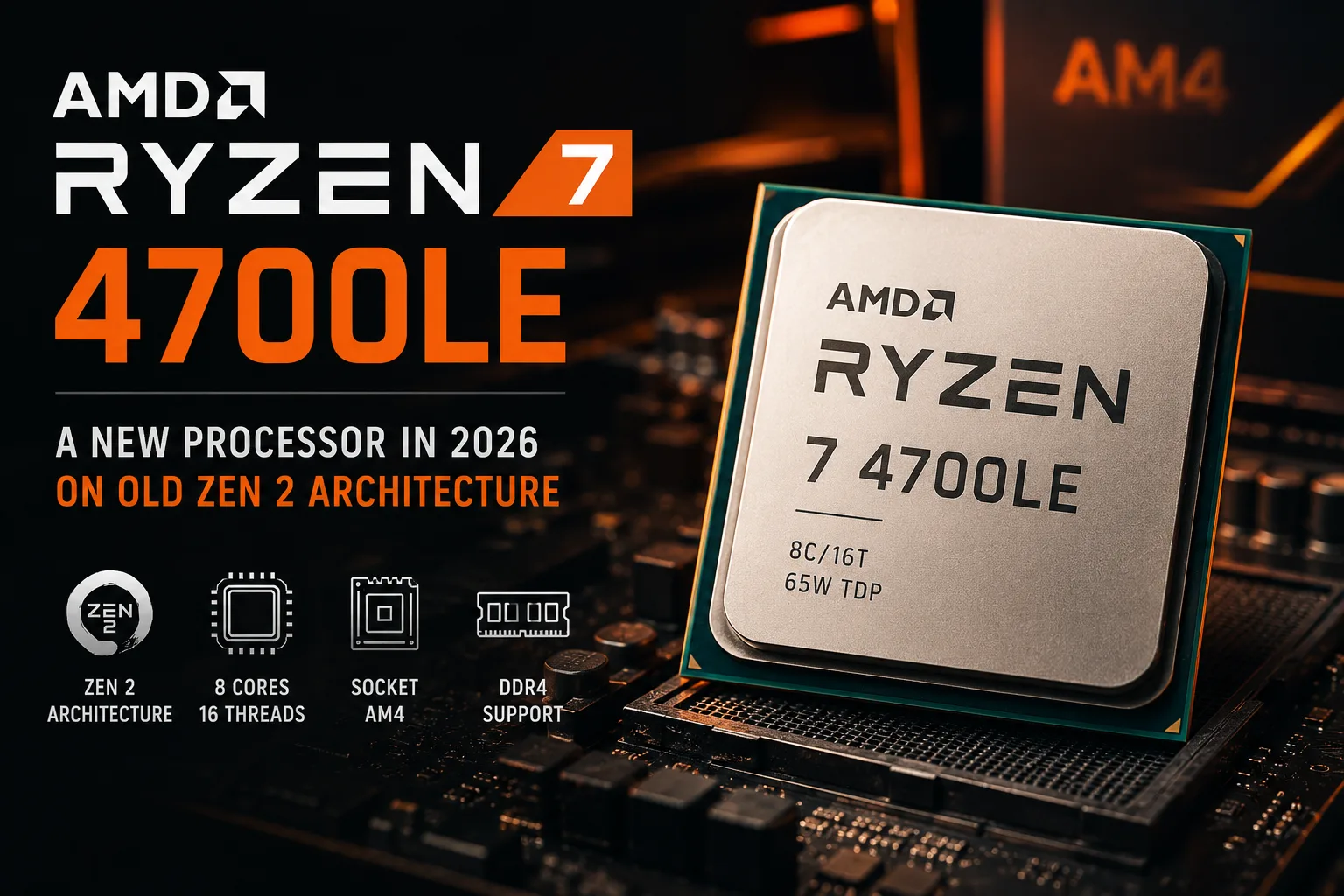
AMD Ryzen 7 4700LE: New Processor from 2026 Based on Old Zen 2
The AMD Ryzen 7 4700LE seems strange: the processor debuted in 2026, but it belongs to the old wave of Ryzen 4000 on the Zen 2 architecture. This is not an evolution of AM4, but an extension of an old platform for pre-built PCs.
It features 8 cores, 16 threads, an AM4 socket, DDR4, and a TDP of 65W. This is still enough for a budget system. However, there is an important catch: despite its lineage from Renoir, the Ryzen 7 4700LE lacks integrated graphics.
Renoir Without Integrated Graphics
Renoir is usually associated with APU. The Ryzen 7 4700G and Ryzen 7 4700GE combined Zen 2 cores with integrated Radeon graphics, allowing users to build a working PC without a separate graphics card.
The Ryzen 7 4700LE operates differently. The CPU part remains, but a discrete graphics card is needed to run the system. Because of this, the processor loses the main advantage of the old Ryzen 4000G models-the platform's independence.
Thus, it's difficult to consider the 4700LE a versatile option for AM4. Instead, it functions more as an OEM processor for systems where a graphics card is already included.
Why AMD Needs the Ryzen 7 4700LE
The Ryzen 7 4700LE makes sense for pre-built PC manufacturers. They may have leftover AM4 motherboards, DDR4 RAM, ready-made cases, power supplies, and cooling systems. This processor allows for the creation of a budget-friendly 8-core system without transitioning to a new platform.
From a retail perspective, however, its appeal is weaker. While AM4 is still alive, within this platform, there are already better processors available for upgrades and DIY builds.
Performance: 8 Cores, but an Old Base
In multi-threaded tasks, the Ryzen 7 4700LE remains a viable option thanks to its 8 cores and 16 threads. It is suitable for archiving, background tasks, light content processing, compiling, and running several heavy applications simultaneously.
However, in single-threaded tasks and gaming, it is simply the old Ryzen 4000 with all the limitations of Zen 2. The small L3 cache hinders performance in latency-sensitive tasks, and PCIe 3.0 showcases the age of the platform. This is sufficient for a budget graphics card and a regular SSD, but the 4700LE does not stand as a modern solution.
How It Compares Within AM4
The significance of the Ryzen 7 4700LE isn't in its own right, but rather in comparison to other processors for AM4. Such comparisons reveal why it seems more like an OEM component than a smart choice for DIY builds.
| Model | Main Difference |
|---|---|
| Ryzen 7 4700LE | 8 cores / 16 threads, Zen 2, no integrated graphics, OEM segment |
| Ryzen 7 4700G | Same Renoir base, but has integrated Radeon graphics |
| Ryzen 7 5700G | Zen 3, larger cache, has integrated graphics |
| Ryzen 5 5600 | Fewer cores, but Zen 3, larger cache, and PCIe 4.0 |
The table clearly illustrates the problem with the 4700LE. The Ryzen 7 4700G is more versatile due to its integrated graphics, the Ryzen 7 5700G offers Zen 3 and a larger cache, while the Ryzen 5 5600 often performs better for gaming and general home PCs, despite having fewer cores.
Where the Ryzen 7 4700LE Makes Sense
The Ryzen 7 4700LE can only be considered in the context of a budget pre-built PC with a discrete graphics card. In such a scenario, the user benefits from 8 cores and 16 threads without overspending on a new platform.
As a standalone processor for a new build, it falls short. It lacks integrated graphics, the architecture is old, the cache is small, and PCIe is limited to version 3.0. If the processor is already part of a pre-built system at a good price, that’s not an issue. Actively seeking it out for an AM4 upgrade is dubious at best.
Conclusion
The AMD Ryzen 7 4700LE is not a processor for enthusiasts, but for cheap OEM systems. Its advantage lies in offering 8 cores and 16 threads on AM4. Everything else reflects the compromises of an older platform: Zen 2, PCIe 3.0, a small L3 cache, and the absence of integrated graphics.
Buying the Ryzen 7 4700LE only makes sense when bundled with a pre-built PC, where the price offsets these limitations. For a DIY build, it’s more reasonable to look at the Ryzen 7 5700G, Ryzen 5 5600, or other AM4 models based on Zen 3.
CPU Comparison
Compare Ryzen 7 4700LE with other CPUs
Basic
CPU Specifications
Memory Specifications
GPU Specifications
Miscellaneous
Related CPU Comparisons


Share in social media
Or Link To Us
<a href="https://cputronic.com/en/cpu/amd-ryzen-7-4700le" target="_blank">AMD Ryzen 7 4700LE</a>