AMD Ryzen 7 253
AMD Ryzen 7 253: What Lies Behind the New Index
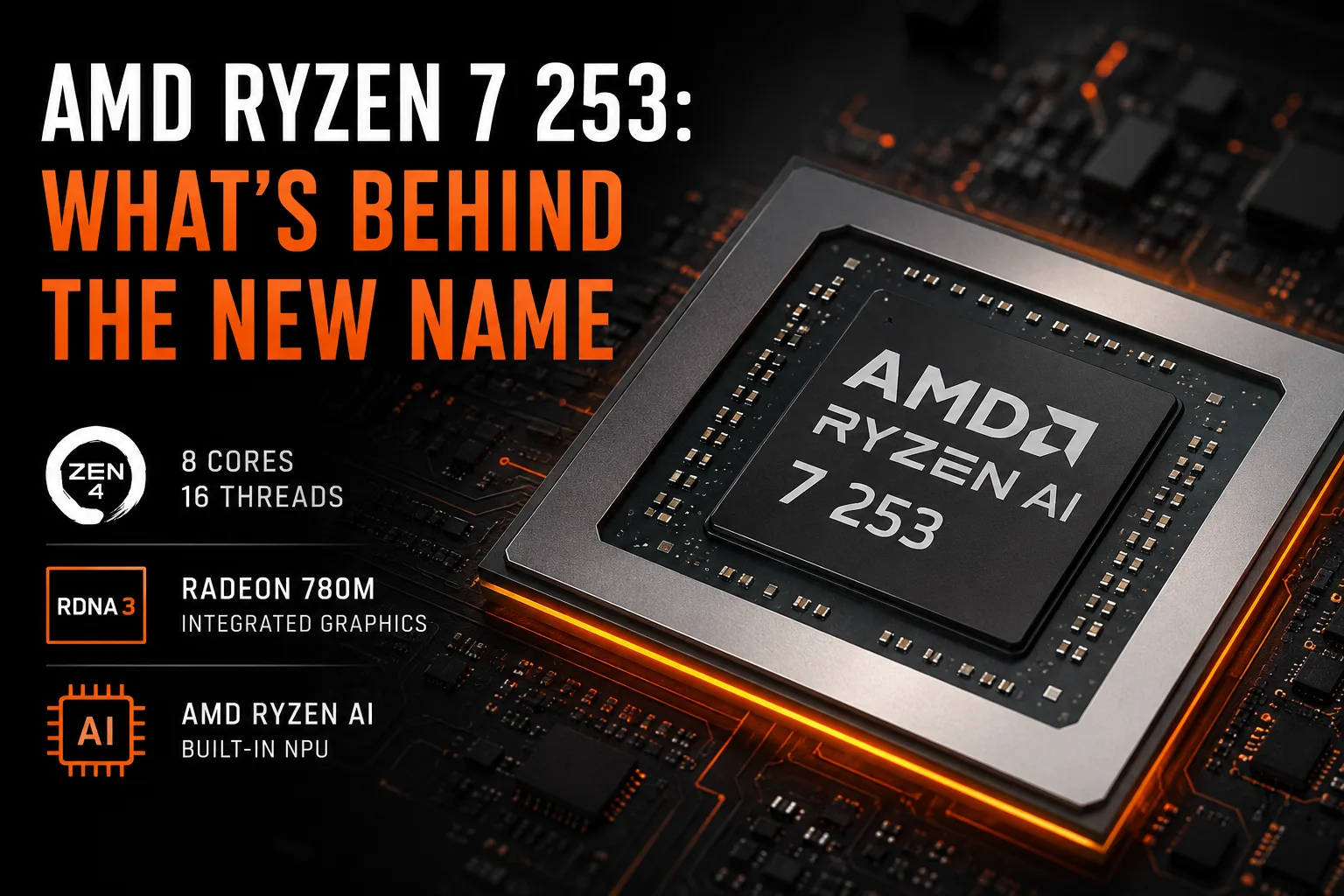
The AMD Ryzen 7 253 appears to be a new model, but in terms of hardware, it is not a new platform. The name, Ryzen 200 series, and Ryzen AI branding create the impression of a fresher generation. In reality, it is Hawk Point on Zen 4 - a close relative of the Ryzen 7 8845HS and Ryzen 7 260.
The Ryzen 7 253 remains a strong mobile processor. For a versatile laptop, it has all the important features: 8 cores, Radeon 780M, and ample performance for work tasks. However, such a laptop should not be evaluated solely based on the processor index, but rather on price and configuration.
Why Ryzen 7 253 Can Be Confusing
In the market, one might find Ryzen 7 250, Ryzen 7 253, Ryzen 7 260, Ryzen AI 7 350, and older models like the Ryzen 7 8840HS. By their names, they appear to belong to different generations, even though some models use the same foundation.
Ryzen 7 253 falls exactly into this confusing zone: the name is new, but the architecture is old. It does not feature Zen 5, does not have RDNA 3.5 graphics, and lacks a modern NPU like the current Ryzen AI 300. Therefore, when purchasing, the novelty of the index is less important than the price in relation to the actual level of hardware.
If a laptop with a Ryzen 7 253 is significantly cheaper than the models with Ryzen AI 300, it is worth considering. If the prices are almost the same, it is better to look for a more recent platform.
Performance: Fast CPU without an Architectural Leap
As a CPU, the Ryzen 7 253 remains a strong choice for everyday tasks. It can easily handle office tasks, development, photo processing, light video editing, and heavy multitasking.
However, one should not expect a leap compared to the Ryzen 7 8845HS or Ryzen 7 260. The architecture and number of cores are the same, so the difference will be not generational but rather configuration-based. Actual speeds will depend on cooling, power limits, and memory in the specific model.
In a thin chassis, the processor will hit thermal limits sooner, reducing clock speeds. In a larger laptop or mini-PC, it will maintain high clock speeds for longer. Therefore, two devices with Ryzen 7 253 may perform significantly differently in real-world usage.
Radeon 780M - The Main Practical Advantage
One of the main arguments for the Ryzen 7 253 is the integrated Radeon 780M. For integrated graphics, it is still strong, especially if the laptop utilizes fast dual-channel DDR5 or LPDDR5X memory.
The Radeon 780M is suitable for esports games, older AAA titles, and less demanding new releases. At 1080p, it can handle Dota 2, CS2, Valorant, Fortnite, GTA V, and similar games at moderate settings.
The main limitation remains unchanged: it is integrated graphics that use system memory. For demanding modern games at high settings, a laptop with a discrete graphics card is necessary. The Ryzen 7 253 is suitable for a versatile laptop but does not replace a gaming model with dedicated graphics.
Ryzen AI Is Present, But Not Worth the Extra Cost
The Ryzen 7 253 comes with a separate Ryzen AI NPU. This is more of an additional feature than a reason to choose this particular processor. In terms of AI performance, it is significantly weaker than the Ryzen AI 300 and does not reach the level of Copilot+.
Thus, the Ryzen AI marking here should not be overvalued. It does not turn the Ryzen 7 253 into a next-generation AI-class processor. Purchasing such a laptop should be based on the CPU, Radeon 780M, and price, rather than the sticker label.
Ryzen 7 253 Against Ryzen 7 250 and Ryzen 7 260
In the Ryzen 200 lineup, the 253 model looks intermediate. The Ryzen 7 250 is closer to energy-efficient laptops, while the Ryzen 7 260 targets higher-performance configurations. The Ryzen 7 253 sits in between.
At the same price, the Ryzen 7 260 is typically more appealing. It has a higher class in the lineup and a more attractive frequency configuration. The Ryzen 7 253 makes sense if the laptop is cheaper or has a better configuration: with adequate cooling, a good screen, and sufficient memory.
The situation with the Ryzen 7 8845HS is similar. If the price is the same, the 253 index does not provide an advantage by itself. This is a close class, so the specific laptop model is more important.
When the Ryzen 7 253 Will Be a Good Buy
The best scenario for the Ryzen 7 253 is a versatile laptop without a discrete graphics card. It is suitable for work, study, programming, light photo editing, and occasional gaming.
In a mini-PC, such a chip is also logical: high performance, integrated graphics already included, and a separate graphics card is not mandatory. This is a good option for a compact system where fast CPU and decent integrated graphics are more important than breaking records in gaming.
Before purchasing, the configuration of the device is more critical. The minimum should be 16GB of RAM, ideally in a fast dual-channel configuration, proper cooling, and a screen without rough cost-cutting. For Radeon 780M, memory is particularly crucial: slow or single-channel configurations significantly reduce gaming performance.
The poor scenario involves a laptop with 8GB of memory without upgrade potential, weak cooling, and a price at the level of newer Ryzen AI models. In such a configuration, the Ryzen 7 253 loses its appeal: the processor is fine, but the laptop turns out unbalanced.
Should You Choose AMD Ryzen 7 253?
The AMD Ryzen 7 253 is not a new generation of mobile Ryzen but a familiar Hawk Point under a fresh name. Its advantages are a fast 8-core CPU, Radeon 780M, and power reserves for a versatile laptop without discrete graphics.
The main downside is not the hardware but the positioning. The index might hint at a new platform, even though it technically belongs to Zen 4. While it has an NPU, it does not reach the level of modern Copilot+ processors.
You should only choose the Ryzen 7 253 if the price of the finished laptop is reasonable. If the device is cheaper than its Ryzen AI 300, Ryzen 7 260, or Ryzen 7 8845HS counterparts, it is worth considering. If the prices are nearly identical, it is better to opt for a faster or newer alternative.
The Ryzen 7 253 is a good processor for a reasonable purchase, but not a good reason to overpay.
CPU Comparison
Compare Ryzen 7 253 with other CPUs
Basic
CPU Specifications
Memory Specifications
GPU Specifications
Miscellaneous


Share in social media
Or Link To Us
<a href="https://cputronic.com/en/cpu/amd-ryzen-7-253" target="_blank">AMD Ryzen 7 253</a>