AMD Ryzen 7 249
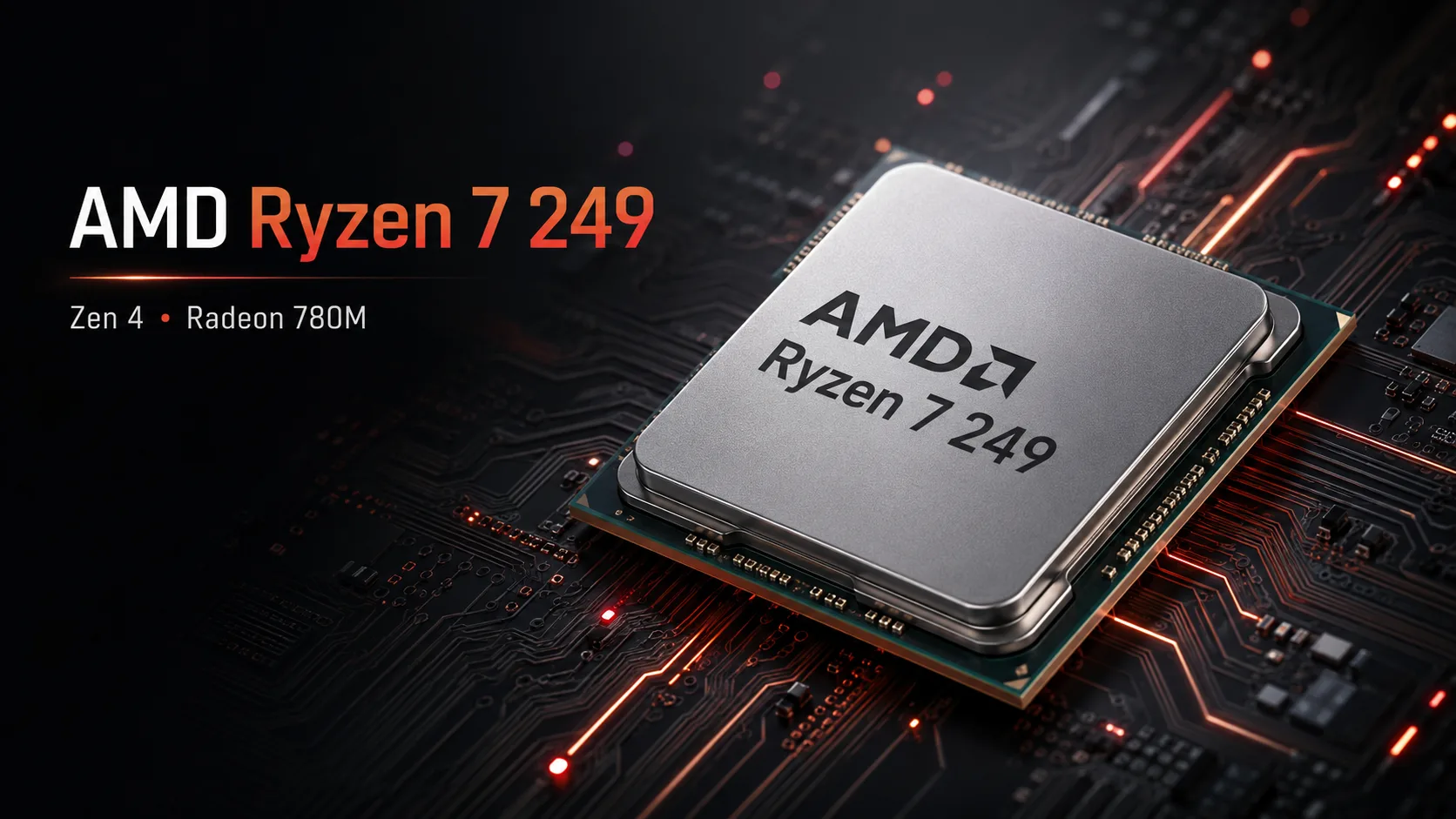
AMD Ryzen 7 249: 8 cores Zen 4, Radeon 780M, and no Ryzen AI
The AMD Ryzen 7 249 occupies a strange position in the Ryzen 200 lineup: it is numerically lower than the Ryzen 7 250, but in key specifications, it is quite close. This is an 8-core mobile processor based on Zen 4 with Radeon 780M, but it does not include a separate Ryzen AI/NPU block. The consumer value of the Ryzen 7 249 depends not on its novelty but on the price of the laptop: if the model with it is significantly cheaper than the higher configurations, it is a justified choice. If the price difference is small, it’s better to consider the Ryzen 7 250 or Ryzen AI 300.
Ryzen 7 249: Position in the Lineup
The Ryzen 7 249 is part of the mobile Ryzen 200 series and is built on the Hawk Point platform. It is not Zen 5, but the familiar Zen 4 in a new position within the lineup. The processor features 8 cores and 16 threads, with a base clock of 3.1 GHz and a boost up to 4.9 GHz.
For a laptop without a discrete GPU, this configuration provides a good margin. The Ryzen 7 249 is suitable for heavy browsing, office tasks, programming, photo editing, light video editing, and multitasking with several demanding applications. In multithreaded tasks, 8 cores give a noticeable advantage over lower-end 4 and 6-core models.
However, it is essential not to judge the processor solely by its index. The Ryzen 7 249 is not a flagship and is not a replacement for the Ryzen AI 300. It’s a work-focused mobile APU for versatile laptops that require a fast CPU, strong integrated graphics, and moderate power consumption.
What’s the Catch with Ryzen 7 249
The catch is in the positioning: the Ryzen 7 249 is very similar to the Ryzen 7 250 but has lower CPU and GPU frequencies and lacks an NPU for Ryzen AI. The Ryzen 7 250 has higher CPU core frequencies, a faster Radeon 780M, and a separate AI block. Therefore, the Ryzen 7 249 makes sense primarily as a more affordable configuration.
If a laptop with the Ryzen 7 249 costs nearly the same as a model with the Ryzen 7 250 or Ryzen AI 300, the advantage is questionable. However, if the manufacturer places this processor in a more affordable model with a good display, fast memory, and adequate cooling, the purchase becomes logical.
The Ryzen 7 249 cannot be evaluated separately from the specific laptop. The final performance depends not only on cores and frequencies but also on memory, power limits, cooling, battery, and price.
Radeon 780M - The Processor’s Strong Point
The integrated AMD Radeon 780M graphics is a key advantage of the Ryzen 7 249. It is not a basic graphics core "just for displaying images," but a powerful iGPU for thin laptops. It uses the RDNA 3 architecture, has 12 graphic cores, and operates at frequencies of up to 2500 MHz.
Radeon 780M allows one to do without a discrete graphics card and does not immediately resort to weak graphics. It handles interfaces, video, simple creative tasks, old games, and undemanding online projects with ease. In games like Dota 2, CS2, Fortnite, and GTA V, with fast dual-channel memory, one can expect playable FPS on moderate settings. In heavy modern games, it will be necessary to reduce the resolution and graphics quality.
The main limitation of the Radeon 780M is the memory. It does not have its dedicated video memory, so it uses the system RAM. For such a laptop, it’s better to choose 16 or 32 GB of memory, preferably in a fast dual-channel configuration. Slow or single-channel memory noticeably lowers FPS, even if the CPU itself appears strong in specifications.
How Ryzen 7 249 Performs in Tasks
In typical everyday workloads, the Ryzen 7 249 will be quick. The eight Zen 4 cores are sufficient for browsing, documents, messengers, IDEs, spreadsheets, archives, light photo editing, and several applications running simultaneously.
In prolonged workloads, power limits and cooling come into play. The processor's thermal package is 28 W, but manufacturers can set it up differently. One laptop may maintain high frequencies for a longer time, while another may quickly reduce power for the sake of quiet operation and battery life. In a thin chassis, the limitation will often not be with the chip itself but with the thermal package and cooling system.
For regular 3D rendering, heavy video editing, or modern gaming at high settings, it is better to look for laptops with discrete graphics. The Ryzen 7 249 is better considered as a versatile APU rather than a replacement for a gaming laptop or a mobile workstation.
Ryzen 7 249 vs. Ryzen 7 250
Comparing with the Ryzen 7 250 is more important than comparing with processors of another class. These models are close in fundamentals: both belong to Hawk Point, use Zen 4, have 8 cores, 16 threads, and integrated Radeon 780M graphics. But the Ryzen 7 250 received higher frequencies and the Ryzen AI NPU.
| Parameter | Ryzen 7 249 | Ryzen 7 250 |
|---|---|---|
| Architecture | Zen 4 / Hawk Point | Zen 4 / Hawk Point |
| Cores / Threads | 8 / 16 | 8 / 16 |
| CPU Frequency | 3.1-4.9 GHz | 3.3-5.1 GHz |
| Integrated Graphics | Radeon 780M | Radeon 780M |
| GPU Frequency | up to 2500 MHz | up to 2700 MHz |
| TDP | 28 W | 28 W |
| cTDP | 15-30 W | 15-30 W |
| Ryzen AI | no | yes |
The Ryzen 7 250 appears stronger: it has higher CPU and GPU frequencies, plus a separate AI block. However, the Ryzen 7 249 does not lose out in terms of baseline configuration: it still features 8 Zen 4 cores and Radeon 780M. If a laptop with the Ryzen 7 249 is cheaper or offers a better display, memory, cooling, and battery, it may be a more sensible purchase.
Who Is the Ryzen 7 249 Suitable For
The Ryzen 7 249 is suitable for a versatile laptop without discrete graphics. It is an option for those who need a fast system, strong integrated graphics, and a core surplus without overpaying for a gaming laptop.
It is well-suited for:
- Work and study;
- Browsing, office applications, and multitasking;
- Programming and light workloads;
- Photo editing and simple video editing;
- Old and undemanding games;
- Laptops without a discrete graphics card.
It is not advisable to choose the Ryzen 7 249 for AI features, heavy gaming, or professional rendering. For such tasks, the Ryzen AI 300/400, Core Ultra with more powerful NPU, or laptops with discrete graphics would be more appropriate.
What to Consider When Buying a Laptop
8 cores and Radeon 780M do not guarantee a successful laptop by themselves. A weak configuration can limit both the CPU and the integrated graphics. The primary focus should be on memory: at least 16 GB of RAM, preferably 32 GB, especially if gaming or working with heavy applications is planned.
The second factor is cooling and power limits. A thin chassis with a quiet setup may quickly drop frequencies. This does not make the Ryzen 7 249 a bad processor, but actual performance will be lower than in a laptop with a more successful cooling system.
It is also worth checking the screen and battery. The Ryzen 7 249 will likely be found in versatile laptops, and in this class, display quality and battery life often matter more than a 200 MHz difference between neighboring processors.
Conclusion
The AMD Ryzen 7 249 is not a revolutionary processor but a clear version of Hawk Point for versatile laptops. It features 8 Zen 4 cores, 16 threads, Radeon 780M, and a moderate thermal package of 28 W. The main limitations are the absence of Ryzen AI/NPU and lower frequencies compared to the Ryzen 7 250.
Purchasing a laptop with the Ryzen 7 249 should not be based on the name, but on the price and configuration. A good display, 16-32 GB of memory, adequate cooling, and reasonable cost make it a suitable option for work, study, multimedia, and light gaming. If a Ryzen 7 250 or Ryzen AI 300 is available in the same price range, the extra cost may be justified.
CPU Comparison
Compare Ryzen 7 249 with other CPUs
Basic
CPU Specifications
Memory Specifications
GPU Specifications
Miscellaneous
Share in social media
Or Link To Us
<a href="https://cputronic.com/en/cpu/amd-ryzen-7-249" target="_blank">AMD Ryzen 7 249</a>