AMD Ryzen 7 217
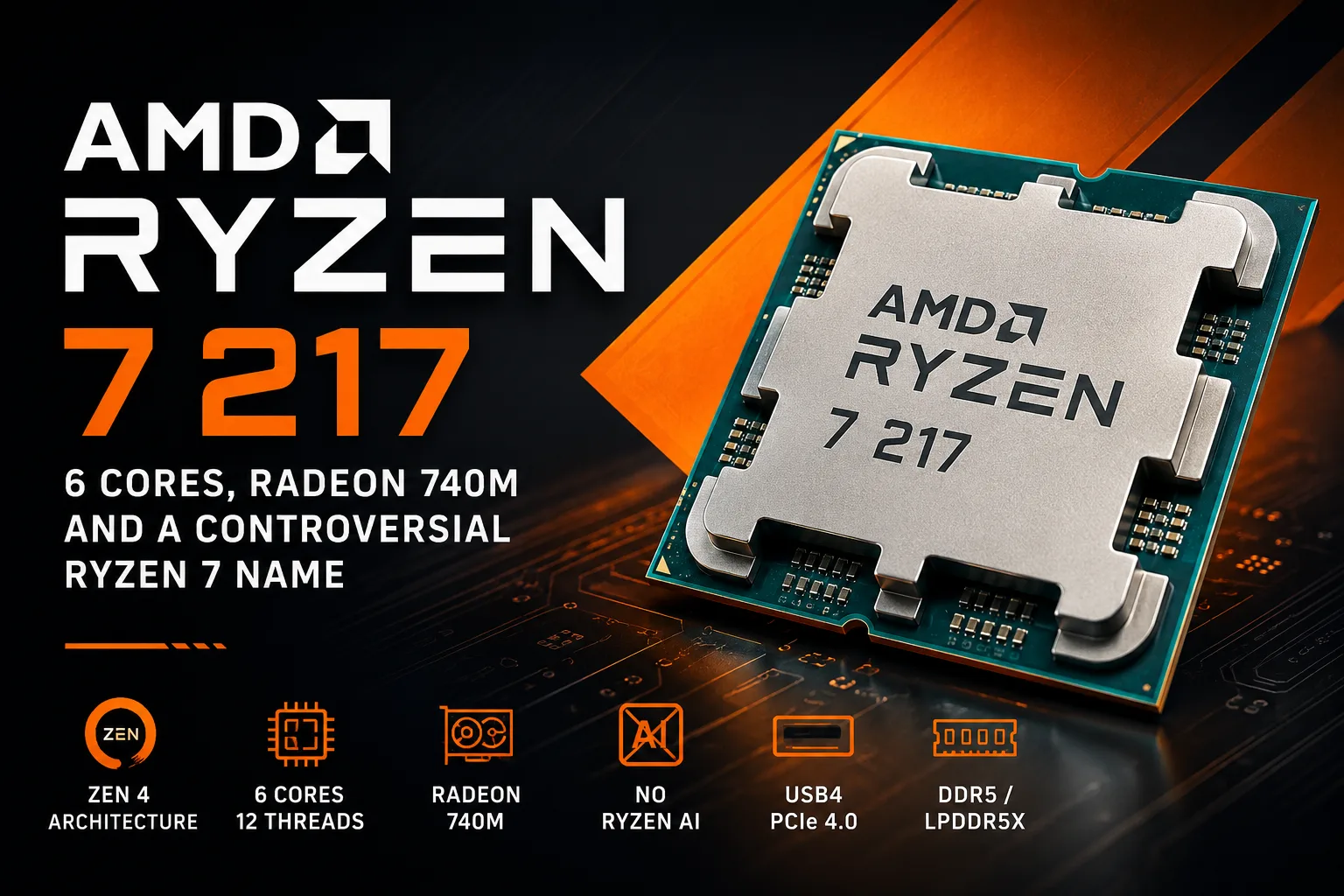
AMD Ryzen 7 217: Six Cores, Radeon 740M, and a Controversial Name
The AMD Ryzen 7 217 shares its name with a higher-end model, but its specifications place it closer to the mid-range. It has 6 cores, 12 threads, a mixed Zen 4/Zen 4c architecture, an integrated Radeon 740M, and lacks a Ryzen AI block. The main question when choosing a laptop with such a processor is not "is this a Ryzen 7 or not", but rather how much cheaper it is compared to models with 8 cores, Radeon 780M, and an NPU.
The Ryzen 7 217 belongs to the mobile Ryzen 200 series and the Hawk Point family. AMD specifies a 4nm TSMC process, a base frequency of 3.0 GHz, a boost up to 4.8 GHz, 6 MB of L2 cache, 16 MB of L3 cache, and a thermal package of 35 W with a configurable range of 15-40 W. The I/O interface set is relevant: it supports DDR5/LPDDR5X, PCIe 4.0, USB4, and up-to-date video outputs via the integrated graphics.
The main characteristic of the Ryzen 7 217 is its controversial positioning. It is neither a lower version of the higher Ryzen 7 models nor a replacement for models with 8 cores and powerful integrated graphics. Conceptually, it is closer to the 6-core Ryzen 5, but with slightly higher frequencies. The increase here is frequency-based rather than class-based.
Why Ryzen 7 217 is Closer to Ryzen 5 than to Ryzen 7 250
Many buyers of mobile and desktop Ryzen 7 processors are accustomed to seeing 8 cores. The Ryzen 7 217 lacks this association: while the name is higher, the configuration is closer to the mid-range.
The easiest way to understand its position is to compare it with neighboring models:
| Processor | Cores / Threads | Integrated Graphics | Ryzen AI | Positioning |
|---|---|---|---|---|
| Ryzen 5 216 | 6 / 12 | Radeon 740M | No | Close 6-core option |
| Ryzen 7 217 | 6 / 12 | Radeon 740M | No | Higher frequencies, similar config |
| Ryzen 7 250 | 8 / 16 | Radeon 780M | Yes | Significantly stronger model |
This comparison clearly shows the essence of the Ryzen 7 217. It differs from the Ryzen 5 216 mainly in frequency. The difference to the Ryzen 7 250 is more significant: more cores, stronger graphics, and the inclusion of Ryzen AI.
When choosing, it is more important to compare the prices of laptops with similar configurations. If the price difference to the Ryzen 7 250 is small, the higher model will be significantly more appealing in terms of overall balance. If the Ryzen 7 217 is noticeably cheaper, it can serve as a reasonable foundation for a work laptop.
CPU Performance: Work Level Without Upper Ryzen 7 Reserve
The Ryzen 7 217 cannot be called a weak processor. With a frequency of up to 4.8 GHz, 12 threads, and modern architecture, it should provide quick operation for everyday tasks: browsers, office applications, video conferencing, studying, light photo editing, and basic coding.
It is best suited for short and mixed workloads: opening applications, working with documents, spreadsheets, multiple programs, and a large number of tabs. In such scenarios, the limiting factors are more often not the CPU cores but rather the amount of RAM, SSD speed, and cooling quality.
For sustained workloads, the result depends on the specific laptop. The Ryzen 7 217 supports a range of 15-40 W, but the device manufacturer sets the limits. In a thin chassis, frequencies may be lower than in a larger model with adequate cooling.
The combination of Zen 4 and Zen 4c should not be confused with Intel Core's hybrid scheme. Zen 4c maintains compatibility with Zen 4 but is more compact and designed for mobile configurations. In practice, this provides decent speed in everyday tasks but does not turn the processor into a higher model.
Radeon 740M: Adequate for System and Video, Weak for Gaming
The integrated Radeon 740M is the main technical limitation of the Ryzen 7 217. This graphics solution is based on RDNA 3 architecture with 4 graphics cores. It runs the Windows interface without issues, handles video, web browsing, an external monitor, hardware decoding, and basic image work.
For gaming, this is the baseline level. Older titles, less demanding online games, and some indie projects can run on low settings, but comfortable gaming in modern heavyweight titles should not be expected. This is especially true for high resolutions or quality graphics.
In terms of graphics, the Ryzen 7 217 lags significantly behind models with Radeon 760M or Radeon 780M. The difference is noticeable not only in specifications but also in gaming performance. Higher iGPUs have more execution units, greater performance headroom, and are better suited for light gaming without a discrete graphics card.
If the laptop is only for work, the Radeon 740M will not pose a problem. However, if occasional gaming is desired, it is better to look for a model with stronger integrated graphics or a discrete GPU.
Absence of Ryzen AI
The Ryzen 7 217 lacks the Ryzen AI block. This is an important point as some models in the Ryzen 200 series support an NPU, and laptop manufacturers are increasingly promoting devices with AI features.
For regular work, the absence of an NPU is not critical. Browsing, office applications, video, messaging, and most familiar applications do not require a separate AI block. However, if the laptop is purchased for local AI functions within Windows and applications requiring an NPU, the Ryzen 7 217 appears weaker than models equipped with Ryzen AI.
In simple terms, this is a modern mobile Ryzen without a dedicated AI block.
For Which Laptops is Ryzen 7 217 Suitable
The Ryzen 7 217 is best suited for work and study laptops where normal system speed, modern memory, acceptable battery life, and not too high a price are important. It is suitable for browsing, documents, videos, messaging, remote work, working with web services, light image processing, and everyday multitasking.
It may also be appropriate in compact pre-built PCs and mini PCs when gaming graphics and heavy multi-threaded work are not expected from the system. In such a scenario, what matters more is how the manufacturer has configured the power, cooling, and memory rather than the Ryzen 7 name.
The Ryzen 7 217 is not the best choice if one needs:
- Gaming without a discrete graphics card;
- Heavy video editing and rendering;
- Prolonged loads on all cores;
- Local AI functions via NPU;
- A substantial headroom for multi-threaded performance;
- The performance level of higher Ryzen 7 models with 8 cores and Radeon 780M.
Should You Choose the AMD Ryzen 7 217?
The AMD Ryzen 7 217 should be considered only in the context of the specific laptop's price. The processor itself does not present problems for its class: it features modern architecture, 6 cores, 12 threads, decent frequencies, support for DDR5/LPDDR5X, and modern interfaces. This set is suitable for a work laptop.
The main criterion is the price relative to higher models. Essentially, the Ryzen 7 217 is a 6-core mid-range Hawk Point processor with Radeon 740M and lacks Ryzen AI. It is closer to the 6-core Ryzen 5 than to higher Ryzen 7s with 8 cores and Radeon 780M.
The Ryzen 7 217 makes sense only at a good price for the laptop. It is a reasonable processor for work and study but is not a substitute for higher Ryzen 7 models with stronger graphics and NPU. If the additional cost for such a configuration is small, it is better to look for something higher.
CPU Comparison
Compare Ryzen 7 217 with other CPUs
Basic
CPU Specifications
Memory Specifications
GPU Specifications
Miscellaneous
Related CPU Comparisons

Share in social media
Or Link To Us
<a href="https://cputronic.com/en/cpu/amd-ryzen-7-217" target="_blank">AMD Ryzen 7 217</a>