AMD Ryzen 7 165

AMD Ryzen 7 165: Why This Ryzen 7 Has Only Six Cores
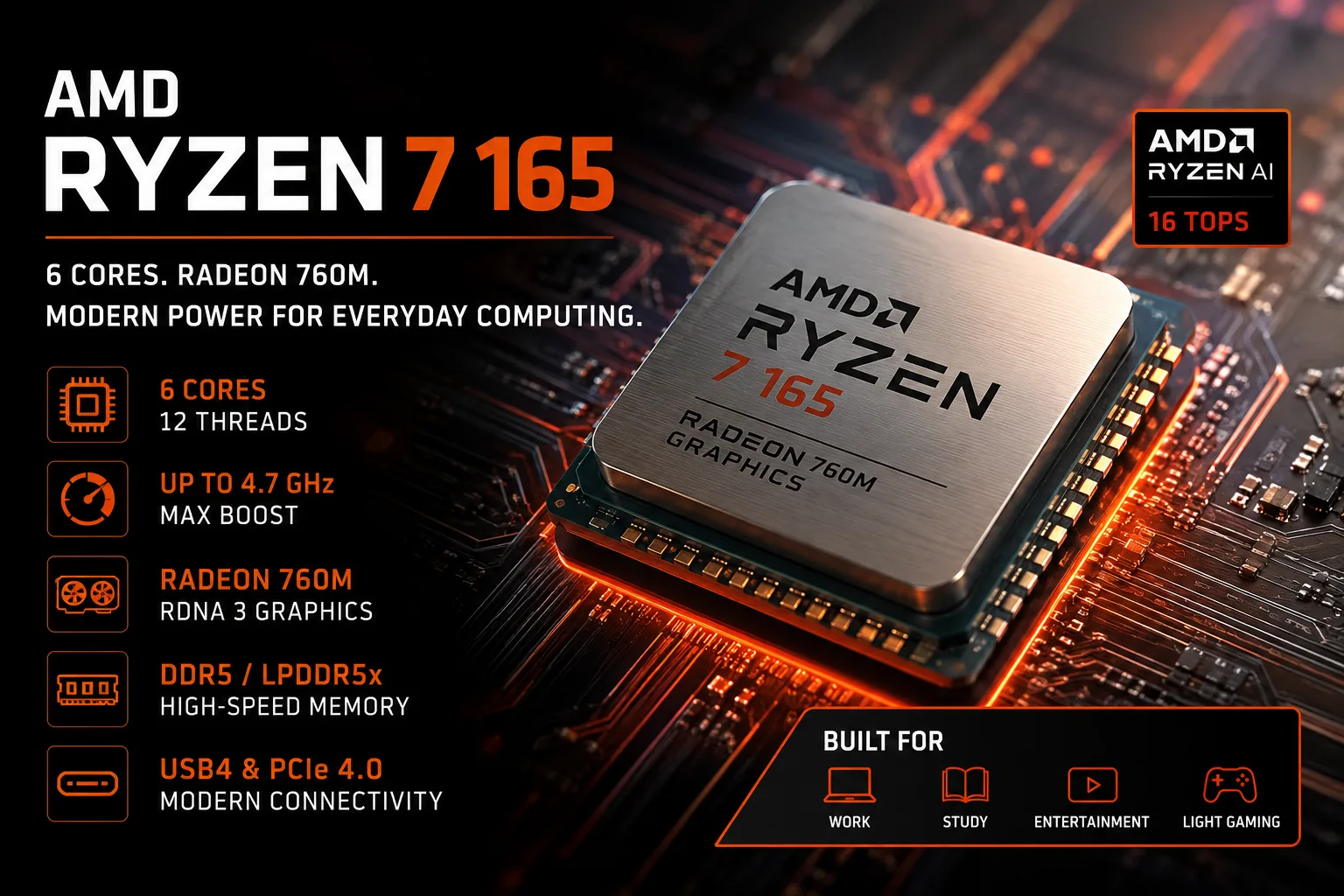
The AMD Ryzen 7 165 sounds older in name than it actually is in specifications. Formally, it is a Ryzen 7, but its configuration is closer to the mid-range: 6 cores, 12 threads, and a TDP of 28 watts. The main selling point of this model is not the CPU, but the integrated Radeon 760M, USB4, PCIe 4.0, and support for fast memory. Therefore, the Ryzen 7 165 should be assessed as a versatile mobile APU for laptops without a discrete graphics card, rather than a replacement for the 8-core Ryzen 7s.
Why This Isn't a Standard Ryzen 7
Typically, one expects Ryzen 7 processors to have 8 cores or at least a significant advantage over Ryzen 5. The Ryzen 7 165 has a simpler setup: 6 cores, 12 threads, clock speeds up to 4.7 GHz, and moderate thermal packaging.
For a versatile laptop, such a configuration is sufficient. Browsing, office applications, video calls, studying, document processing, light photo editing, and simple video editing should not bottleneck if the manufacturer hasn't cut costs on memory, SSD, and cooling.
However, the Ryzen 7 name here promises more than the CPU configuration delivers. In heavy multi-threaded tasks, 6 cores quickly become a limitation: rendering, building large projects, intensive video editing, and computations are better suited for older 8-core models.
The Ryzen 7 165 is more logically perceived as a higher-end 6-core APU, rather than a full replacement for more powerful Ryzen 7 and Ryzen 9 processors.
Ryzen 7 165 in Two Words
| Item | What It Means |
|---|---|
| CPU | 6 cores / 12 threads for versatile laptops |
| Graphics | Radeon 760M - the main advantage of the model |
| Gaming | older games, online projects, and less demanding titles |
| Ryzen AI | available, but not worth buying a laptop just for it |
| Platform | DDR5/LPDDR5x, PCIe 4.0, USB4 |
| Main Risk | expecting performance on par with 8-core Ryzen 7 |
The Ryzen 7 165 isn't about records. Its goal is to provide adequate speed for everyday tasks, integrated graphics above basic levels, and a modern interface set in a laptop without a discrete GPU.
CPU Performance: Good for Everyday Use, Not for Heavy Work
Six cores and twelve threads are a standard configuration for a work or home laptop. The Ryzen 7 165 shouldn't be a bottleneck for regular work: browsing, office tasks, video calls, studying, document handling, video viewing, and light image processing.
In heavy multi-threaded scenarios, however, the situation changes. Here, not only clock speeds matter but also the number of cores. For regular rendering, complex editing, building large projects, and heavy computations, the Ryzen 7 165 will fall short compared to older 8-core Ryzen models.
The practical conclusion is straightforward: the Ryzen 7 165 is suitable for work, studying, browsing, video, and simple home tasks. For demanding professional workloads, it does not suffice.
Radeon 760M - The Main Argument
The Radeon 760M is the primary difference between the Ryzen 7 165 and simpler mobile AMD models. The integrated graphics is based on RDNA 3 and has 8 computational units. This is significantly more interesting than the basic Radeon 740M, especially if the laptop is marketed without a discrete graphics card.
For gaming, the Radeon 760M remains an integrated GPU, not a substitute for the GeForce RTX or Radeon RX. However, it can deliver playability in light projects. Titles like Dota 2, League of Legends, Valorant, GTA V, older AAA games, and some less demanding online projects typically run on low or medium settings. In heavier games, one will need to reduce graphics quality and sometimes resolution.
Integrated graphics heavily depend on memory. The faster the memory, the better the chances for decent FPS. Therefore, a laptop with LPDDR5x or dual-channel DDR5 will perform better than a configuration with slow or single-channel memory.
How Ryzen 7 165 is Better than Ryzen 7 155
The Ryzen 7 165 comes to light when compared with the Ryzen 7 155. In terms of CPU, they are close: both models have 6 cores and 12 threads, and their maximum frequencies are nearly identical. However, in graphics and platform, the Ryzen 7 165 clearly excels.
The main difference is the Radeon 760M instead of the Radeon 740M. For a laptop without a discrete graphics card, this is more significant than the minor difference in CPU frequencies. The Radeon 760M provides more headroom for gaming, video processing, decoding, and light graphical work.
The second advantage is Ryzen AI. The Ryzen 7 165 has an NPU with a performance of up to 16 TOPS, while the Ryzen 7 155 lacks this unit. This doesn't turn the laptop into a new-class AI PC, but it adds support for AI functions performed directly on the device.
The third point is USB4, PCIe 4.0, and fast memory. Therefore, the essence of the Ryzen 7 165 lies not in its index but in its capabilities: better graphics, a more modern platform, and more use cases.
Ryzen AI: Useful but Not a Reason to Overpay
The Ryzen 7 165 has an AI block with up to 16 TOPS. It may be useful for specific local AI functions, but it shouldn't be the main reason for purchasing.
Modern AI laptop requirements are already higher than 16 TOPS. Therefore, it’s best to view the Ryzen 7 165 as a processor with a basic AI accelerator, rather than a chip for heavy on-device AI tasks. In actual purchases, factors like the laptop's price, memory size, screen, SSD, and cooling are more important.
Ambiguity in Specifications
There is some ambiguity in the official data for the Ryzen 7 165: the model belongs to the Hawk Point, but in AMD’s specifications, the architecture is indicated as Zen 3+. Yet, in many respects, it is closer to modern mobile AMD APUs: a 4nm manufacturing process, RDNA 3 graphics with Radeon 760M, Ryzen AI, and support for current interfaces.
For the buyer, this is not the main point, but it is an important detail for comparing models. The Ryzen 7 index here doesn't provide a complete understanding of the model, so one must look at the specific characteristics of the laptop.
Who Should Get a Laptop with Ryzen 7 165
The Ryzen 7 165 is suitable for versatile laptops without discrete graphics. These models are designed for work, studying, browsing, documents, video, messaging, light photo editing, and occasional gaming.
Opting for the Ryzen 7 165 makes sense when you need:
- fast system responsiveness in everyday tasks;
- integrated graphics above basic levels;
- USB4 and PCIe 4.0;
- support for fast DDR5/LPDDR5x memory;
- a laptop without a discrete graphics card;
- moderate energy consumption.
It is not advisable to choose the Ryzen 7 165 for heavy rendering, serious editing, laptops designed for heavy professional workloads, and modern games at high settings. For such tasks, it’s better to look at 8-core Ryzen 7/9 or models with discrete graphics.
Conclusion
The AMD Ryzen 7 165 is a 6-core mobile APU that should be evaluated more for its graphics and platform than its Ryzen 7 index. Its value lies in the Radeon 760M, USB4, PCIe 4.0, support for fast memory, and moderate power consumption.
The decision depends on the price and the specific laptop. At a reasonable price, with fast memory and adequate cooling, the Ryzen 7 165 can serve as a solid foundation for a work or home device without a discrete graphics card.
However, if you need a reserve for heavy multi-threading or modern games, the Ryzen 7 index does not negate the main point: it’s a 6-core mid-range model.
CPU Comparison
Compare Ryzen 7 165 with other CPUs
Basic
CPU Specifications
Memory Specifications
GPU Specifications
Miscellaneous
Share in social media
Or Link To Us
<a href="https://cputronic.com/en/cpu/amd-ryzen-7-165" target="_blank">AMD Ryzen 7 165</a>