AMD Ryzen 5 PRO 224

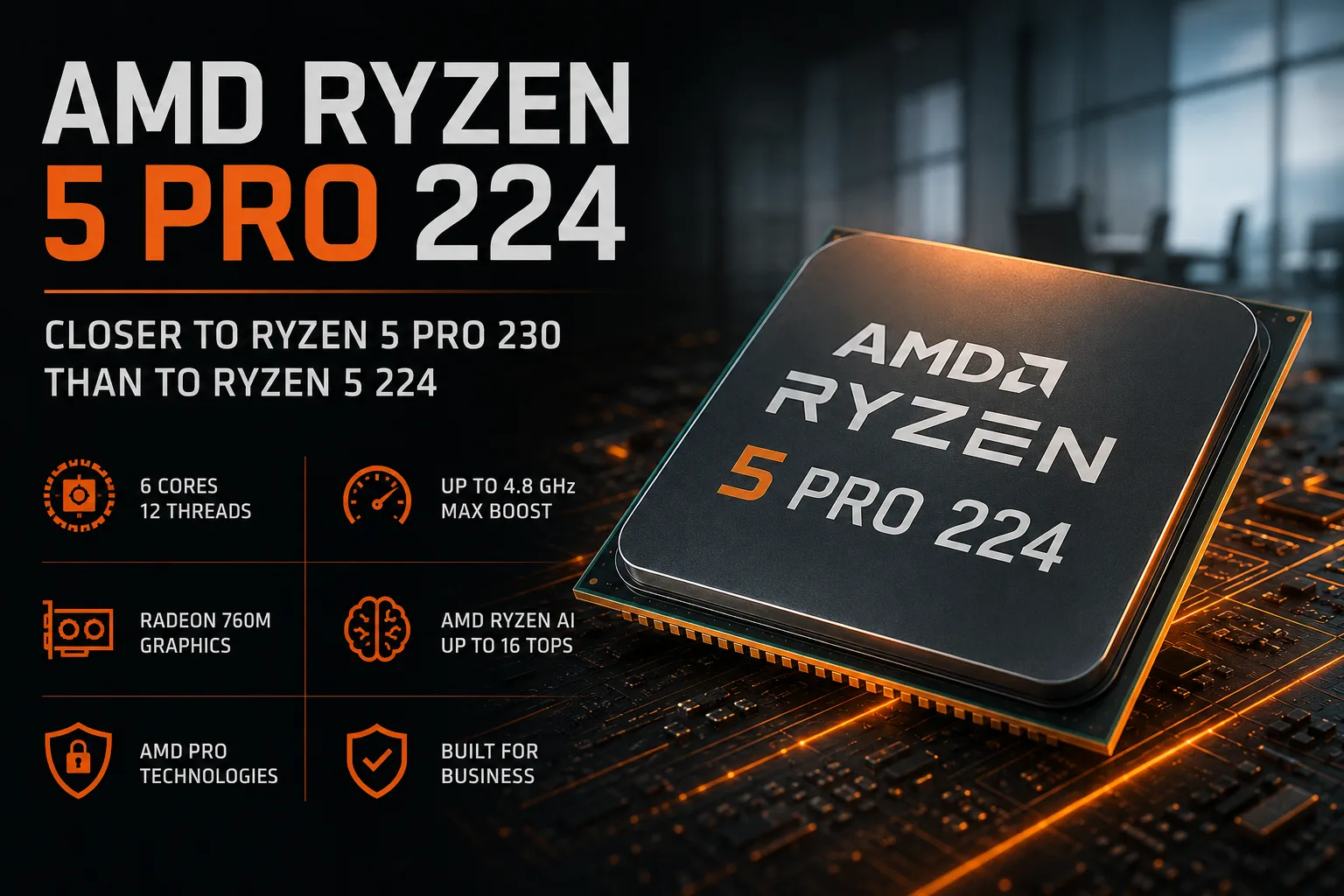
AMD Ryzen 5 PRO 224: Closer to PRO 230 than to the regular Ryzen 5 224
The AMD Ryzen 5 PRO 224 can easily be mistaken for the regular Ryzen 5 224 with a corporate label. However, in terms of specifications, it is not the same processor. The PRO version features 6 Zen 4 cores, Radeon 760M graphics, 16 MB of L3 cache, Ryzen AI, and AMD PRO Technologies. The regular Ryzen 5 224 has less L3 cache and does not include Ryzen AI.
Therefore, the Ryzen 5 PRO 224 is interesting not as a "PRO-labeled processor" but as the lower-tier business version of the Ryzen 5 PRO 230. AMD retained key features-Zen 4, Radeon 760M, 16 MB of L3, and Ryzen AI-but lowered the frequencies. This chip is needed for budget business laptops where price, manageability, and decent integrated graphics are important.
What's Inside the Ryzen 5 PRO 224
The Ryzen 5 PRO 224 belongs to the Ryzen PRO 200 series and uses the Zen 4 architecture. It has 6 cores and 12 threads, a base frequency of 3.3 GHz, and a maximum frequency of up to 4.8 GHz. The thermal package is 28 watts, with a configurable range of 15-30 watts.
For a work laptop, this is sufficient: browsing, office tasks, video conferencing, CRM, spreadsheets, and light photo processing should not max out the CPU. However, in the business segment, speed is not the only factor. Security, remote management, platform stability, and support duration are also crucial.
This is what sets the Ryzen 5 PRO 224 apart from regular Ryzen chips. The PRO label doesn’t make it dramatically faster, but it shifts the processor's intended use.
How the Ryzen 5 PRO 224 Differs from the Ryzen 5 PRO 230
It is better to compare the Ryzen 5 PRO 224 alongside the Ryzen 5 PRO 230, as it clarifies where AMD made savings.
| Attribute | Ryzen 5 PRO 224 | Ryzen 5 PRO 230 | Meaning |
|---|---|---|---|
| Cores / Threads | 6 / 12 | 6 / 12 | No differences in cores and threads |
| Base Frequency | 3.3 GHz | 3.5 GHz | Ryzen 5 PRO 230 performs better under sustained load |
| Max Frequency | up to 4.8 GHz | up to 4.9 GHz | The difference is small |
| L3 Cache | 16 MB | 16 MB | Ryzen 5 PRO 224 has no cache cut |
| Integrated Graphics | Radeon 760M | Radeon 760M | The level of iGPU is the same |
| Graphics Frequency | 2400 MHz | 2600 MHz | The Ryzen 5 PRO 230's graphics are slightly faster |
| Ryzen AI | Yes | Yes | Both chips support local AI functions |
| AMD PRO Technologies | Yes | Yes | Both are designed for business laptops |
The main difference lies in the frequencies. The Ryzen 5 PRO 230 is faster in CPU tasks and slightly more powerful in integrated graphics. However, the Ryzen 5 PRO 224 does not appear to be heavily cut back: it has the same L3 cache, the same Radeon 760M, includes Ryzen AI, and PRO features.
How the PRO 224 is Better than the Regular Ryzen 5 224
The difference with the regular Ryzen 5 224 is more significant. On paper, the models look similar: 6 cores, 12 threads, Zen 4, Radeon 760M, and the same TDP range. But the Ryzen 5 PRO 224 offers two advantages.
First, it has 16 MB of L3 cache. The regular Ryzen 5 224 has a smaller cache, so the PRO version is closer to the Ryzen 5 PRO 230. In games and tasks sensitive to cache size, this can provide an advantage.
Second, it features Ryzen AI. The regular Ryzen 5 224 lacks this block, while the PRO 224 includes it. This doesn’t turn the laptop into a powerful AI station but does make the model more relevant for local Windows functions and business applications.
Therefore, the Ryzen 5 PRO 224 cannot be described as simply "the same as the Ryzen 5 224, but for business." It is a more advantageous configuration, especially for a laptop intended to last several years.
Radeon 760M - An Important Plus, but Not a Gaming GPU
The integrated Radeon 760M is one of the main advantages of the Ryzen 5 PRO 224. It is RDNA 3 graphics with 8 compute units. For a business laptop, this is sufficient: multiple monitors, hardware video acceleration, light graphics, older games, and less demanding projects can be handled easily.
However, the Radeon 760M utilizes system memory. Thus, 16 GB of fast DDR5 or LPDDR5X memory is more important than it may seem from the processor's name. A version with only 8 GB of RAM, especially without an upgrade option, will limit both the system and the integrated graphics.
The Radeon 760M is suitable for Dota 2, League of Legends, Valorant, Minecraft, and older games. However, for heavy AAA projects, a different class of graphics is needed: a discrete graphics card or a higher-end APU with a more powerful iGPU.
Ryzen AI: Useful, but Not the Main Selling Point
The Ryzen 5 PRO 224 supports Ryzen AI with NPU performance of up to 16 TOPS. This is an important distinction from the regular Ryzen 5 224.
However, it should not be overestimated. This is not at the level of Ryzen AI 300 with a more powerful NPU. Ryzen AI in the Ryzen 5 PRO 224 addresses basic local scenarios and enhances the laptop's relevance, but it does not make it a machine for serious neural network tasks.
For a home user, this is a secondary benefit. For corporate procurement, it is a useful point if laptops are purchased with a margin for new Windows and business application features.
Why AMD PRO Technologies Matter
AMD PRO Technologies are the reason for this model's existence. In business laptops, cores and frequencies are not the only considerations. Features like security, remote management, virtualization, TPM, memory protection, and predictable platform support are necessary.
For companies, this simplifies the maintenance of device fleets and improves control over work laptops. For home users, the benefits are fewer. Therefore, the PRO label alone should not justify paying extra if corporate features are not needed.
When to Choose the Ryzen 5 PRO 224
The Ryzen 5 PRO 224 makes sense if a laptop with it is significantly cheaper than a model with the Ryzen 5 PRO 230 but not limited in memory, screen, and SSD. By key specifications, the lower model is quite good: 6 cores of Zen 4, 16 MB of L3, Radeon 760M, Ryzen AI, and PRO features.
The logic for choosing is simple:
- If a work laptop with corporate features is needed - the Ryzen 5 PRO 224 fits;
- If the price difference with the Ryzen 5 PRO 230 is small - it’s better to choose the Ryzen 5 PRO 230;
- If the laptop is for home use - the regular Ryzen might be more cost-effective;
- If modern gaming is needed - the availability of a discrete graphics card is more important;
- If the laptop only has 8 GB of RAM - it’s better to look for another configuration;
- If a powerful AI laptop is needed - it’s better to look at Ryzen AI 300 or Ryzen AI PRO 300.
Conclusion
The AMD Ryzen 5 PRO 224 is not simply the regular Ryzen 5 224 with corporate labeling. It is a lower-tier business version, closer to the Ryzen 5 PRO 230: 6 Zen 4 cores, 16 MB of L3 cache, Radeon 760M, Ryzen AI, and AMD PRO Technologies.
Its weak points are its frequencies and market positioning. The Ryzen 5 PRO 230 is faster, and regular Ryzen models can be cheaper. Therefore, the Ryzen 5 PRO 224 is justified only in the right configuration: 16 GB of memory, a decent screen, a fast SSD, and noticeable savings compared to the Ryzen 5 PRO 230.
If these conditions are met, the Ryzen 5 PRO 224 can be considered a strong foundation for a work laptop. If the additional cost for the Ryzen 5 PRO 230 is small, it’s better to opt for the higher model.
CPU Comparison
Compare Ryzen 5 PRO 224 with other CPUs
Basic
CPU Specifications
Memory Specifications
GPU Specifications
Miscellaneous
Share in social media
Or Link To Us
<a href="https://cputronic.com/en/cpu/amd-ryzen-5-pro-224" target="_blank">AMD Ryzen 5 PRO 224</a>