AMD Ryzen 5 439
AMD Ryzen 5 439: Zen 5 without NPU - What Sets the New Gorgon Point Apart
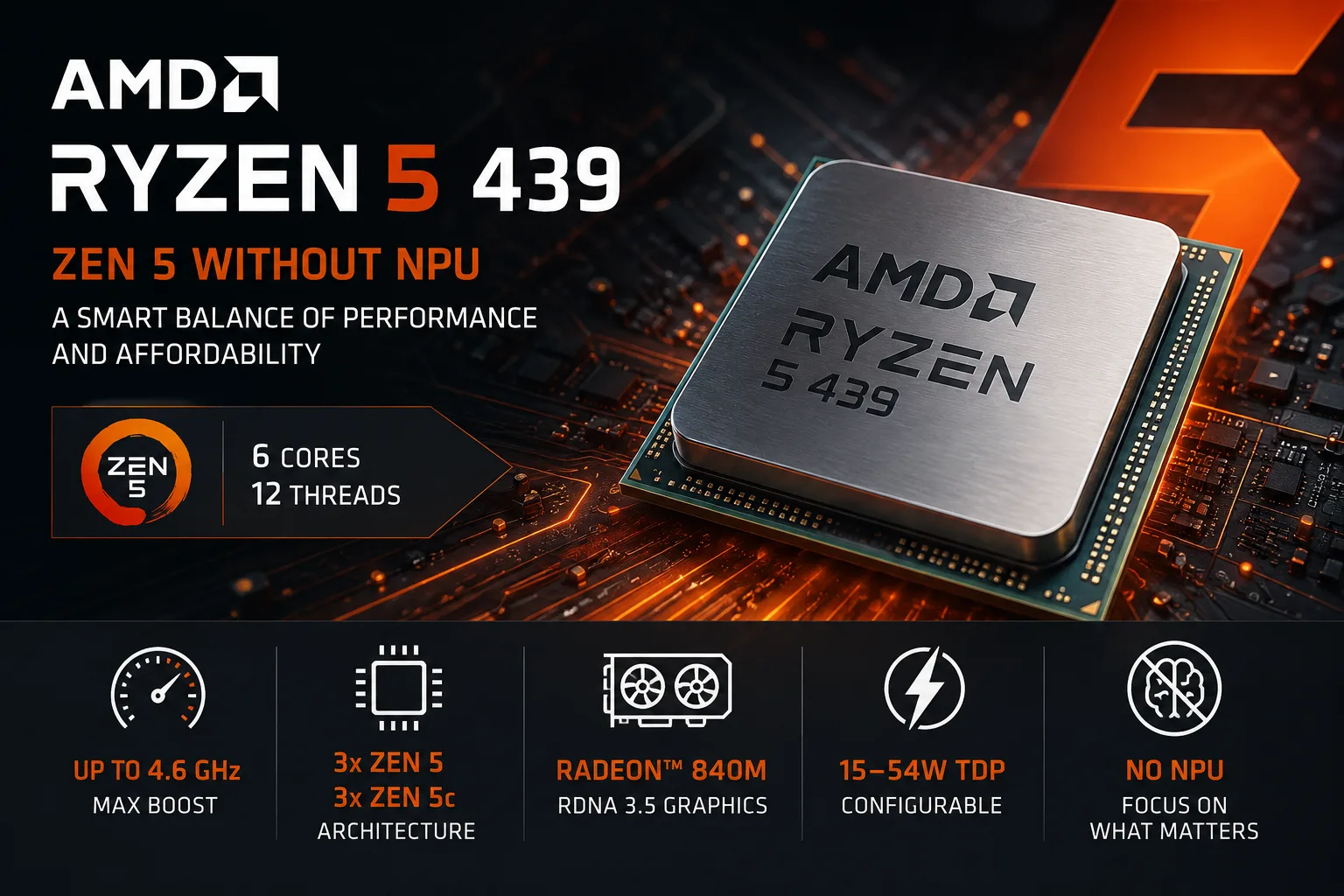
The AMD Ryzen 5 439 brings the Zen 5 architecture to a more affordable segment of the laptop lineup but lacks one of the key features of Ryzen AI-a separate NPU. The processor features six cores, Radeon 840M, and a configurable TDP ranging from 15 to 54 watts. AMD has maintained the CPU part of Gorgon Point but has omitted a separate block for local AI tasks.
| Ryzen 5 439 | Ryzen AI 5 435 | Ryzen AI 5 PRO 440 | |
|---|---|---|---|
| Cores / Threads | 6 / 12 | 6 / 12 | 6 / 12 |
| Configuration | 3× Zen 5 + 3× Zen 5c | 2× Zen 5 + 4× Zen 5c | 3× Zen 5 + 3× Zen 5c |
| Boost | 4.6 GHz | 4.5 GHz | 4.8 GHz |
| L3 | 8 MB | 8 MB | 16 MB |
| Integrated Graphics | Radeon 840M | Radeon 840M | Radeon 840M |
| GPU Frequency | 2.8 GHz | 2.8 GHz | 2.9 GHz |
| NPU | - | 50 TOPS | 50 TOPS |
Ryzen 5 439 - A Zen 5, Not a Renamed Old Ryzen
Despite the absence of the AI suffix in its name, the Ryzen 5 439 belongs to the Gorgon Point platform and uses Zen 5 cores.
Inside, there are three Zen 5 and three more compact Zen 5c cores. All six cores support SMT, allowing the processor to execute up to 12 threads simultaneously. The maximum frequency of Zen 5 reaches 4.6 GHz.
Zen 5c cannot be directly equated to Intel's E-cores. They use the same architecture and instruction set as Zen 5 but are optimized for a denser layout and operate at lower frequencies.
One notable limitation compared to the more powerful models is the 8 MB L3 cache. For instance, the Ryzen AI 5 PRO 440, with the same 3+3 configuration, has 16 MB. Therefore, the same number of cores does not necessarily mean the same performance.
Ryzen 5 439 Performance: Real Tests Await
As of now, the databases for Geekbench 6 and other common tests for the Ryzen 5 439 are insufficient. Thus, it is more prudent to rely on the processor specifications and await results from actual laptop models rather than extrapolating performance from adjacent models.
The closest benchmark remains the Ryzen AI 5 435. It also features six cores, 12 threads, 8 MB of L3 cache, and Radeon 840M, although the ratio of Zen 5 to Zen 5c differs.
With three full-sized Zen 5 cores and a boost up to 4.6 GHz, the most noticeable advantage of this configuration should manifest in short and single-threaded workloads.
That being said, the performance of specific laptops may vary significantly. AMD allows for TDP configuration from 15 to 54 watts. In a thin chassis with constrained power, the processor will behave differently than in a larger system with effective cooling and a high sustained power limit.
Thus, the upcoming benchmark table will particularly need results from specific laptop models rather than just average processor metrics.
Radeon 840M: Four CUs Set the Performance Limit
The Ryzen 5 439 utilizes the Radeon 840M based on RDNA 3.5 architecture. It features four compute units, and the maximum frequency reaches 2.8 GHz.
This is one of the lower-end configurations of integrated graphics from AMD. The Radeon 840M significantly lags behind the Radeon 860M, 880M, and 890M primarily due to its fewer compute units.
Such a GPU is designed for OS interface tasks, hardware video decoding, multimedia workloads, and gaming with moderate graphics demands. One should not expect performance on par with larger integrated Radeon models from four CUs.
RAM is also a significant factor. The Radeon 840M uses system RAM instead of dedicated video memory, meaning memory bandwidth directly impacts the performance of the integrated GPU.
Absence of NPU - The Key Difference from Ryzen AI
The Ryzen 5 439 does not feature a separate NPU, while the Ryzen AI 5 435 and other members of the Ryzen AI 400 series come with a neural accelerator capable of 50 TOPS.
For browsing, office applications, code compilation, archiving, and most traditional workloads, a separate NPU is unnecessary. The difference becomes apparent in programs and Windows features that can perform AI tasks directly on the neural accelerator.
This is why the Ryzen 5 439 cannot be viewed as a complete replacement for Ryzen AI. Its appeal will directly depend on how much cheaper the finished laptops turn out to be.
Which Laptops is the Ryzen 5 439 Intended For
The TDP range from 15 to 54 watts allows for the Ryzen 5 439 to be utilized in very different form factors. It may appear in thin business models as well as in larger 15-16 inch laptops capable of sustaining high power for longer.
When choosing a device, it is important to look not only at the processor name but also at the specific implementation of the laptop:
- Sustained power limit;
- Quality of the cooling system;
- RAM volume and configuration;
- Price compared to Ryzen AI 5 models.
With different settings, the same Ryzen 5 439 can deliver noticeably different results.
Should You Choose AMD Ryzen 5 439?
The Ryzen 5 439 is interesting because AMD didn't transfer an older architecture to the more affordable series. Here, we have Zen 5, six cores and 12 threads, Radeon 840M, and a flexible power consumption range.
The main cutbacks relate to the NPU and cache rather than the CPU generation.
Therefore, the Ryzen 5 439 appears to be a logical foundation for business and versatile laptops where processor performance and final price are more critical than local AI functions.
However, the decisive factor will be the cost of the ready devices. If there's a significant price difference, the Ryzen 5 439 could be more rational. If a laptop with Ryzen AI 5 costs nearly the same, the more functional Ryzen AI platform would be preferable.
CPU Comparison
Compare Ryzen 5 439 with other CPUs
Basic
CPU Specifications
Memory Specifications
GPU Specifications
Miscellaneous
Related CPU Comparisons


Share in social media
Or Link To Us
<a href="https://cputronic.com/en/cpu/amd-ryzen-5-439" target="_blank">AMD Ryzen 5 439</a>