AMD Ryzen 5 225

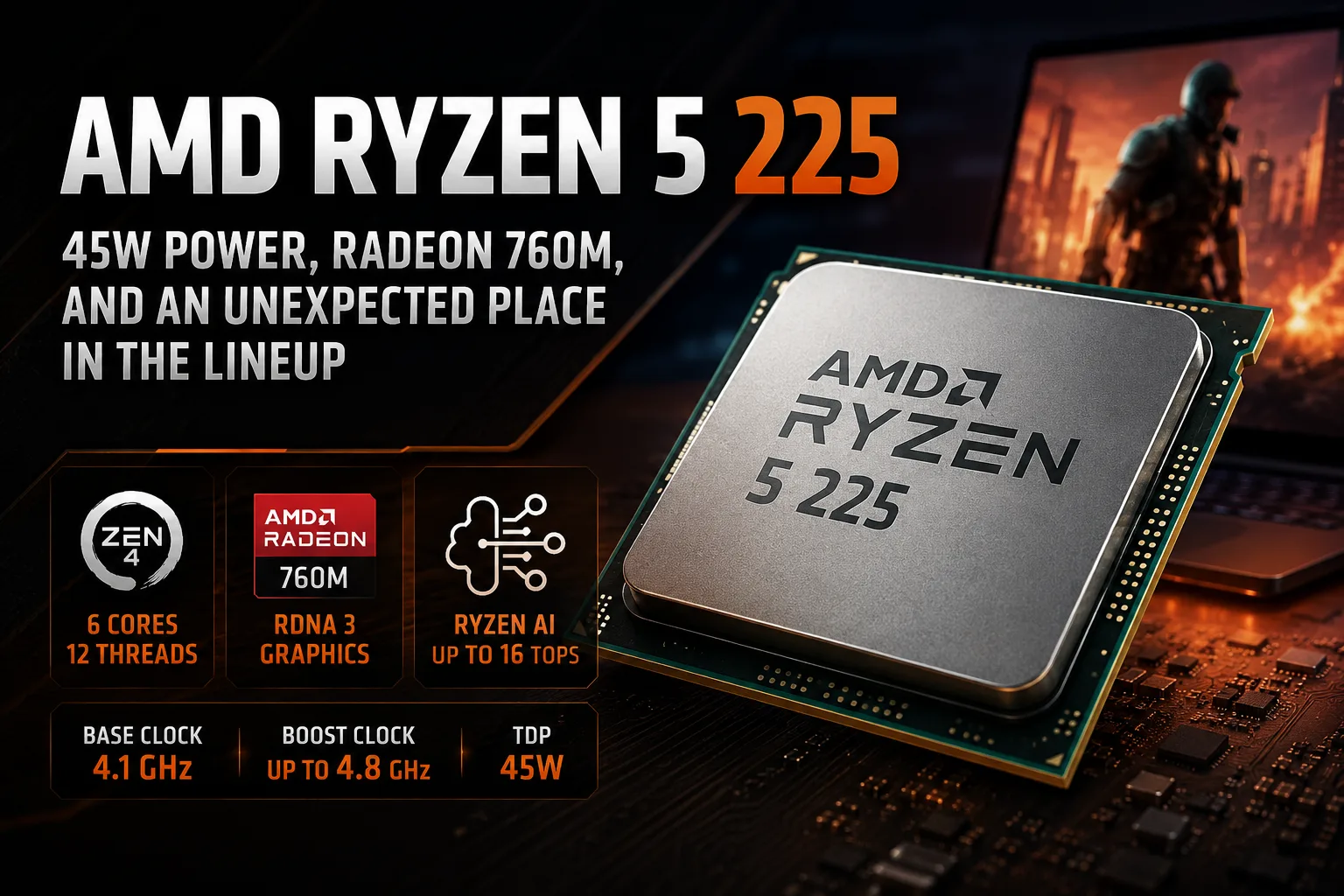
AMD Ryzen 5 225: 45W, Radeon 760M, and its Non-obvious Place in the Lineup
The AMD Ryzen 5 225 is formally positioned between the Ryzen 5 220 and Ryzen 5 230, but its specifications do not fit neatly into a simple model ladder. It has a 45-watt TDP like the Ryzen 5 240, but features lower CPU frequencies and the integrated Radeon 760M. Therefore, the Ryzen 5 225 should not be viewed as “just another Ryzen 5,” but rather as a distinct configuration for laptops and mini-PCs.
The Ryzen 5 225 belongs to the Hawk Point platform. It is a mobile APU based on Zen 4 architecture featuring 6 cores, 12 threads, a base frequency of 4.1 GHz, boost up to 4.8 GHz, and 16 MB of L3 cache. This processor is designed for laptops and compact systems where there is a need to combine a 6-core CPU, integrated graphics, and moderate power consumption.
This is not a new generation. The Ryzen 5 225 is closer to Ryzen 7040/8040 than to Ryzen AI 300. For a conventional laptop, this is not a concern: the six Zen 4 cores are sufficient for browsing, office work, video conferencing, light photo processing, and moderate multitasking.
The main question regarding the Ryzen 5 225 is its placement in the Ryzen 200 lineup. By its specifications, it is clearly superior to the Ryzen 5 220: it has stronger integrated graphics and includes a Ryzen AI block. However, next to the Ryzen 5 230 and Ryzen 5 240, its advantages become less obvious.
How the Ryzen 5 225 Differs from Ryzen 5 220, 230, and 240
| Model | Main Difference |
|---|---|
| Ryzen 5 220 | Weaker Radeon 740M graphics, no Ryzen AI, lower TDP |
| Ryzen 5 225 | 45W, Radeon 760M 2400 MHz, Ryzen AI up to 16 TOPS |
| Ryzen 5 230 | Radeon 760M running at 2600 MHz, lower standard TDP |
| Ryzen 5 240 | Higher CPU and GPU frequencies, same 45W class |
The comparison shows why the Ryzen 5 225 should not be judged by its name alone. It is noticeably more interesting than the Ryzen 5 220, but does not offer a clear advantage over the Ryzen 5 230 and Ryzen 5 240. The Ryzen 5 230 has a lower standard TDP, but a higher frequency for the Radeon 760M. Meanwhile, the Ryzen 5 240 operates within the same 45W class but has faster CPU and integrated GPU performance.
The Ryzen 5 225 makes sense only in a specific configuration. If a device featuring it is significantly cheaper than similar models on Ryzen 5 230, Ryzen 5 240, or Ryzen 7, it may be worth considering. If the prices are similar, the 225 index itself does not add any value.
Performance: 6 Cores of Zen 4 Without a Leap Forward
In terms of class, the Ryzen 5 225 is close to mobile Ryzen 5 chips based on Zen 4. One should not expect record performance from it, but it will not be a limitation in ordinary tasks. This level is sufficient for browsing, documents, messaging, video calls, and streaming video.
Under prolonged loads, the performance outcome depends on the chassis, cooling, and power limits. The nominal 45W does not guarantee that every laptop will maintain high frequencies for extended periods. In a thin chassis, manufacturers may limit power for temperature and noise reasons. In a larger laptop or mini-PC, the Ryzen 5 225 can operate more stably.
When selecting, it’s not just about the processor. One must also consider cooling, power limits, memory type, RAM volume, and dual-channel configuration. The same Ryzen 5 225 can yield significantly different results in different devices.
Radeon 760M: Stronger than Basic Graphics, but Lower Frequency than Neighbors
The Radeon 760M is one of the main advantages of the Ryzen 5 225. It is integrated graphics based on RDNA 3 architecture with 8 graphics cores. It does not replace a discrete graphics card, but is noticeably stronger than the basic Radeon 740M.
A practical benchmark would be older games, less demanding online projects, and some modern games on low settings. In heavier games, one may have to use 720p with reduced graphic settings and upscaling. For modern AAA games at high settings, a laptop with a discrete graphics card is necessary.
In the Ryzen 5 225, the frequency of the Radeon 760M is lower than that of the Ryzen 5 230 and Ryzen 5 240. This gap is not critical, but it is significant for gaming on integrated graphics. If a laptop is chosen specifically for the iGPU, neighboring models may be more beneficial.
Another limiting factor is memory. The integrated graphics use system RAM, so fast DDR5 or LPDDR5X and dual-channel mode directly influence FPS. With only one memory module, the results will be lower than in a configuration featuring fast dual-channel setup.
Ryzen AI: 16 TOPS is not an Argument for Copilot+
The Ryzen 5 225 features a Ryzen AI block with performance of up to 16 TOPS. This is useful only in applications that actually utilize the NPU for local AI tasks. Buying the Ryzen 5 225 for the NPU alone is not advisable.
For modern Windows AI features and Copilot+ PC, a more powerful NPU is required. Therefore, the 16 TOPS in the Ryzen 5 225 represents an added functionality rather than a resource for new AI features in Windows.
When to Consider the Ryzen 5 225
The Ryzen 5 225 is suitable for an affordable laptop or mini-PC without a discrete graphics card. It is adequate for studying, office tasks, browsing with many tabs, movies, video calls, light photo processing, and casual gaming.
It makes sense to buy a device with the Ryzen 5 225 if:
- it is significantly cheaper than similar models with Ryzen 5 240 or Ryzen 7;
- it features fast DDR5 or LPDDR5X in dual-channel mode;
- the cooling does not throttle the 45W APU;
- heavy gaming, video editing, 3D work, and serious local AI tasks are not needed.
It is not worth overpaying for the Ryzen 5 225 if there is a model with Ryzen 5 240 or Ryzen 7 available for a small price difference. For gaming on integrated graphics, it is also better to look for configurations where the Radeon 760M operates at higher frequencies.
Conclusion
The AMD Ryzen 5 225 is an adequate mobile processor, but its index can easily be misleading. It is a 6-core Zen 4 chip with Radeon 760M, a 45-watt TDP, and basic Ryzen AI capabilities. In basic scenarios, it is not weak, but it is also not the best Ryzen 5 in the lineup.
The Ryzen 5 225 is significantly better than the Ryzen 5 220 in graphics and AI capabilities but does not always offer better value than the Ryzen 5 230 and Ryzen 5 240. Therefore, it is not the numbers in the name that matter but rather the price, cooling, memory, and specific device’s power limits.
If a laptop with the Ryzen 5 225 is cheaper than neighboring models and is not limited on memory, such a configuration may be worthwhile. If the price difference with Ryzen 5 240 or Ryzen 7 is small, it is more logical to choose the more powerful processor.
CPU Comparison
Compare Ryzen 5 225 with other CPUs
Basic
CPU Specifications
Memory Specifications
GPU Specifications
Miscellaneous
Related CPU Comparisons

Share in social media
Or Link To Us
<a href="https://cputronic.com/en/cpu/amd-ryzen-5-225" target="_blank">AMD Ryzen 5 225</a>