AMD Ryzen 5 224

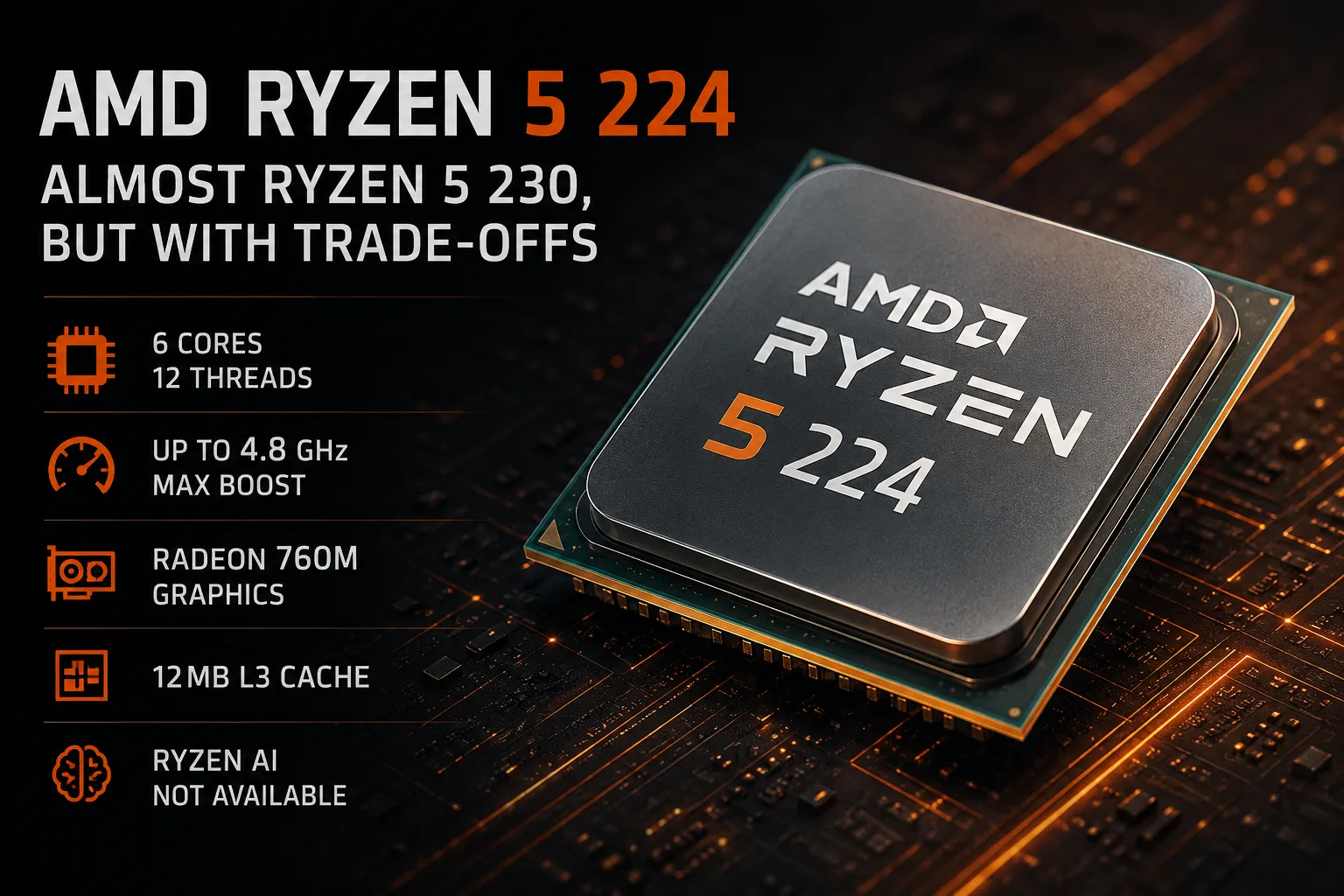
AMD Ryzen 5 224: Almost Ryzen 5 230, but with Cutbacks
The name AMD Ryzen 5 224 is easily mistaken for a typo. In the same series, there are already Ryzen 5 220 and Ryzen 5 230, so the index 224 seems like an intermediate one not only by number. In terms of specifications, Ryzen 5 224 is closer to the cheaper Ryzen 5 230: it has the same 6 Zen 4 cores and integrated Radeon 760M, but less L3 cache, lower frequencies, and no Ryzen AI.
The purpose of Ryzen 5 224 is not to achieve record performance. It serves as a more affordable configuration for mid-range laptops, where it is important for the manufacturer to maintain Zen 4 and Radeon 760M while keeping the device's price lower.
What's Inside Ryzen 5 224
Ryzen 5 224 belongs to the Ryzen 200 series and uses the Zen 4 architecture. It features 6 cores and 12 threads, a base frequency of 3.3 GHz, and a maximum frequency of up to 4.8 GHz. The thermal package is 28 W, with a configurable range of 15-30 W.
In terms of specifications, it is a typical mid-range mobile processor. For an everyday laptop, this performance is sufficient: browsing, documents, video calls, studying, and light photo editing should not stress the CPU. However, choosing a laptop solely based on the processor name is not advisable. Price, memory, cooling, and the display of a specific model matter here.
How Ryzen 5 224 Differs from Ryzen 5 230
It is better to consider Ryzen 5 224 alongside Ryzen 5 230. This makes it clearer where AMD has saved costs.
| Feature | Ryzen 5 224 | Ryzen 5 230 | What This Means |
|---|---|---|---|
| Cores / Threads | 6 / 12 | 6 / 12 | No differences in cores and threads |
| Maximum Frequency | up to 4.8 GHz | up to 4.9 GHz | Ryzen 5 230 has a slight edge |
| Base Frequency | 3.3 GHz | 3.5 GHz | Ryzen 5 230 should handle frequencies better under load |
| L3 Cache | 12 MB | 16 MB | Ryzen 5 224 has reduced cache |
| Integrated Graphics | Radeon 760M | Radeon 760M | The iGPU level is the same |
| Graphics Frequency | 2400 MHz | 2600 MHz | Ryzen 5 230 has slightly faster integrated graphics |
| Ryzen AI | No | Yes | Local AI functions are not a strong aspect of Ryzen 5 224 |
Ryzen 5 224 does not replace Ryzen 5 230. It is a more affordable version with the same Radeon 760M but less cache, lower frequencies, and no Ryzen AI.
Where Ryzen 5 224 Is Suitable
In typical tasks, Ryzen 5 224 will rarely be a limitation. Six Zen 4 cores are enough for Windows, browsing, office applications, video calls, and background tasks. In a budget laptop, the limitations often arise from memory, SSD, display, or cooling rather than the processor.
The best option would be a laptop with Ryzen 5 224, 16 GB of memory, a fast SSD, and a decent display. In such a configuration, the system will perform well for everyday tasks. A version with 8 GB of RAM, especially without the possibility of upgrading, will significantly limit the laptop.
Radeon 760M - The Main Advantage of Ryzen 5 224
The main advantage of Ryzen 5 224 over lower configurations is the Radeon 760M. This is an integrated graphics unit based on RDNA 3 architecture with 8 graphics blocks. It is significantly more interesting than the basic Radeon 740M and allows for more than just office tasks.
Radeon 760M is suitable for older games, less demanding projects, and esports disciplines. However, it is still integrated graphics, which uses system memory. Therefore, dual-channel mode and fast RAM are particularly important in gaming.
Gaming expectations should be kept moderate. Radeon 760M is suitable for Dota 2, League of Legends, Valorant, Minecraft, older games, and light projects. For heavy AAA titles, a different class of graphics is required: a discrete graphics card or a higher-tier APU with a more powerful iGPU.
What the Absence of Ryzen AI Means
Ryzen 5 224 lists Ryzen AI as unavailable in its specifications. For browsing, office, video, and gaming, the absence of an NPU does not change much.
However, when compared with Ryzen 5 230, this is an important distinction. Ryzen 5 224 should not be chosen for local AI functions in Windows. If a laptop is being purchased with a reserve for AI features, it’s better to look at models with full-fledged Ryzen AI.
When to Consider Ryzen 5 224
Ryzen 5 224 makes sense only at a significant discount relative to Ryzen 5 230. The difference in processor capabilities is small, but Ryzen 5 230 has clear advantages: more L3 cache, higher frequencies, faster iGPU clock speed, and Ryzen AI support.
The logic for selection is simple:
- If Ryzen 5 224 is significantly cheaper, it can be considered;
- If the difference with Ryzen 5 230 is small, it’s better to choose Ryzen 5 230;
- If modern gaming is needed, a discrete graphics card is more important;
- If AI features are important, Ryzen 5 224 is not the best candidate;
- If the laptop has only 8 GB of memory, it’s better to search for another configuration.
Conclusion
AMD Ryzen 5 224 is not a flagship or the main processor in the lineup, but rather an intermediate model for budget laptop configurations. It features Zen 4, 6 cores, 12 threads, and integrated Radeon 760M. This is a suitable base for everyday laptops without discrete graphics.
However, Ryzen 5 224 is justified only by its price. If a laptop with it is significantly cheaper than a model with Ryzen 5 230, such an option can be considered. If the premium for Ryzen 5 230 is small, it’s better to opt for the higher model: it is faster, has more cache, and supports Ryzen AI.
CPU Comparison
Compare Ryzen 5 224 with other CPUs
Basic
CPU Specifications
Memory Specifications
GPU Specifications
Miscellaneous
Share in social media
Or Link To Us
<a href="https://cputronic.com/en/cpu/amd-ryzen-5-224" target="_blank">AMD Ryzen 5 224</a>