AMD Ryzen 5 216
AMD Ryzen 5 216: New Ryzen 200 for Budget Laptops, but Without Ryzen AI
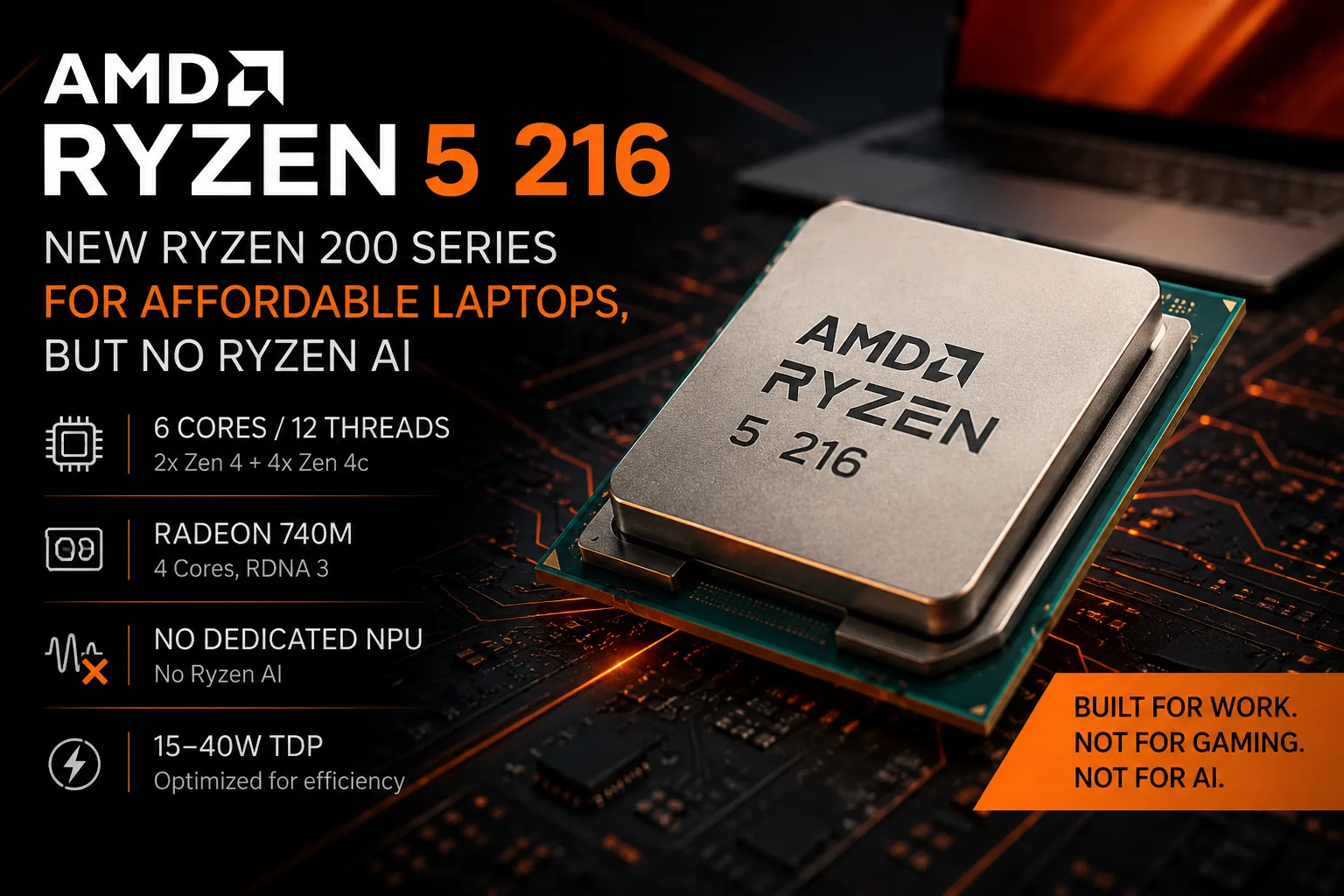
The AMD Ryzen 5 216 can easily be mistaken for a significant upgrade in budget laptops, but in practice, it is a basic Ryzen 200 model for everyday tasks. It features 6 cores and 12 threads with Zen 4/Zen 4c architecture, an integrated Radeon 740M, but lacks a dedicated Ryzen AI unit. This processor is suitable for work and study laptops rather than gaming or AI-oriented configurations.
The Ryzen 5 216 is important not as a leap in performance but as a lower-tier Ryzen 200 model with a new name and clear limitations. It is a chip for office work, studying, browsing, video calls, and multimedia. It should not be perceived as a gaming APU: the graphics are basic, and there is no NPU.
What the Ryzen 5 216 Represents
The AMD Ryzen 5 216 belongs to the Ryzen 200 series and carries the codename Hawk Point. Inside, it has 6 cores and 12 threads: 2 Zen 4 cores and 4 more compact Zen 4c cores. This allows AMD to achieve 12 threads without a sharp increase in power consumption.
The base frequency is 2.9 GHz, with a maximum frequency of up to 4.7 GHz. This is sufficient for browsing, office tasks, video calls, and simple photo editing. However, for heavy editing, long rendering sessions, and continuous full loads, it is better to choose a more powerful processor.
The TDP is listed at 28W, with a configurable range from 15 to 40W. Therefore, the actual speed depends on the laptop at least as much as on the chip itself. In a thin chassis with simple cooling, frequencies will drop faster, while in models with normal heat dissipation, the processor will maintain heightened power limits for longer.
Radeon 740M - Basic Integrated Graphics
The integrated graphics of the Ryzen 5 216 is the Radeon 740M based on the RDNA 3 architecture. The architecture is modern, but the configuration is modest: 4 graphics cores and a frequency of up to 2500 MHz.
This is adequate for Windows, video playback, external monitors, and older games. Simple games like Dota 2, League of Legends, Valorant, Minecraft, or older GTA titles will run on low settings, often at 720p or with reduced rendering scale.
The main limitation remains the graphics. The Radeon 740M uses system memory and lacks the performance for modern gaming. If the laptop is purchased without a discrete graphics card but with the expectation of faster integrated graphics, it's better to look at models with the Radeon 760M or Radeon 780M.
No Dedicated NPU
The Ryzen 5 216 does not have a dedicated NPU. For regular tasks, this is not a problem: browsing, office work, video, and video calls function without it. However, when purchasing a laptop for several years, this is a downside.
Some AI functions in Windows and applications may work through the CPU or GPU, but there is no separate accelerator in the Ryzen 5 216. If local AI scenarios are important, it’s better to choose higher-end AMD models with Ryzen AI.
How Ryzen 5 216 Differs from Ryzen 5 220 and Ryzen 5 224
The Ryzen 5 216 is simpler than the Ryzen 5 220 and noticeably weaker than the Ryzen 5 224. The difference is not only in frequencies: the higher model has better integrated graphics and includes Ryzen AI.
| Model | CPU | Graphics | Ryzen AI | When More Appealing |
|---|---|---|---|---|
| Ryzen 5 216 | 6 cores / 12 threads | Radeon 740M, 4 cores | No | If the laptop is significantly cheaper |
| Ryzen 5 220 | 6 cores / 12 threads | Radeon 740M, higher frequency | No | If the price is about the same |
| Ryzen 5 224 | 6 cores / 12 threads | Radeon 760M, 8 cores | Yes | If graphics, AI, and performance headroom are important |
The Ryzen 5 220 is close to the Ryzen 5 216 but operates at higher frequencies. With a small price difference, the Ryzen 5 220 is more advantageous.
The Ryzen 5 224 is significantly stronger in terms of integrated graphics. The Radeon 760M has more graphics blocks, and the inclusion of Ryzen AI makes this model more suitable for gaming, graphics tasks, and AI functions.
For Which Laptops the Ryzen 5 216 is Suitable
The Ryzen 5 216 is logical for budget and mid-range laptops, where price, battery life, and fast performance in basic tasks are essential. It is suitable for studying, office work, remote work, video calls, movies, documents, and home use.
The optimal configuration is 16 GB of RAM and a fast SSD. This is particularly important for integrated graphics: the Radeon 740M uses system memory, so slow or single-channel memory can further reduce performance.
Who Should Avoid the Ryzen 5 216
The Ryzen 5 216 is not suitable for those looking for a laptop for modern gaming, heavy graphics tasks, editing, 3D work, or local neural networks. There is neither powerful integrated graphics nor NPU.
There is also a price risk. If a laptop with the Ryzen 5 216 costs nearly the same as a model with the Ryzen 5 220 or Ryzen 5 224, an overpayment for the higher chip would be justified. The Ryzen 5 220 will provide higher frequencies, while the Ryzen 5 224 will offer stronger graphics and Ryzen AI.
Conclusion
The AMD Ryzen 5 216 is a basic processor for low-cost work laptops. It features 6 cores, 12 threads, Zen 4/Zen 4c architecture, support for current memory, and moderate power consumption.
The strong point of this model is its CPU for everyday work. Its weak points are the Radeon 740M graphics and the absence of an NPU. Therefore, a laptop with the Ryzen 5 216 makes sense only when there is significant savings. If the price difference is small, the Ryzen 5 220 will be more advantageous in terms of frequencies, while the Ryzen 5 224 will excel in graphics and AI functions.
CPU Comparison
Compare Ryzen 5 216 with other CPUs
Basic
CPU Specifications
Memory Specifications
GPU Specifications
Miscellaneous
Share in social media
Or Link To Us
<a href="https://cputronic.com/en/cpu/amd-ryzen-5-216" target="_blank">AMD Ryzen 5 216</a>