AMD Ryzen 3 PRO 205
AMD Ryzen 3 PRO 205: the same budget Hawk Point, but for corporate laptops
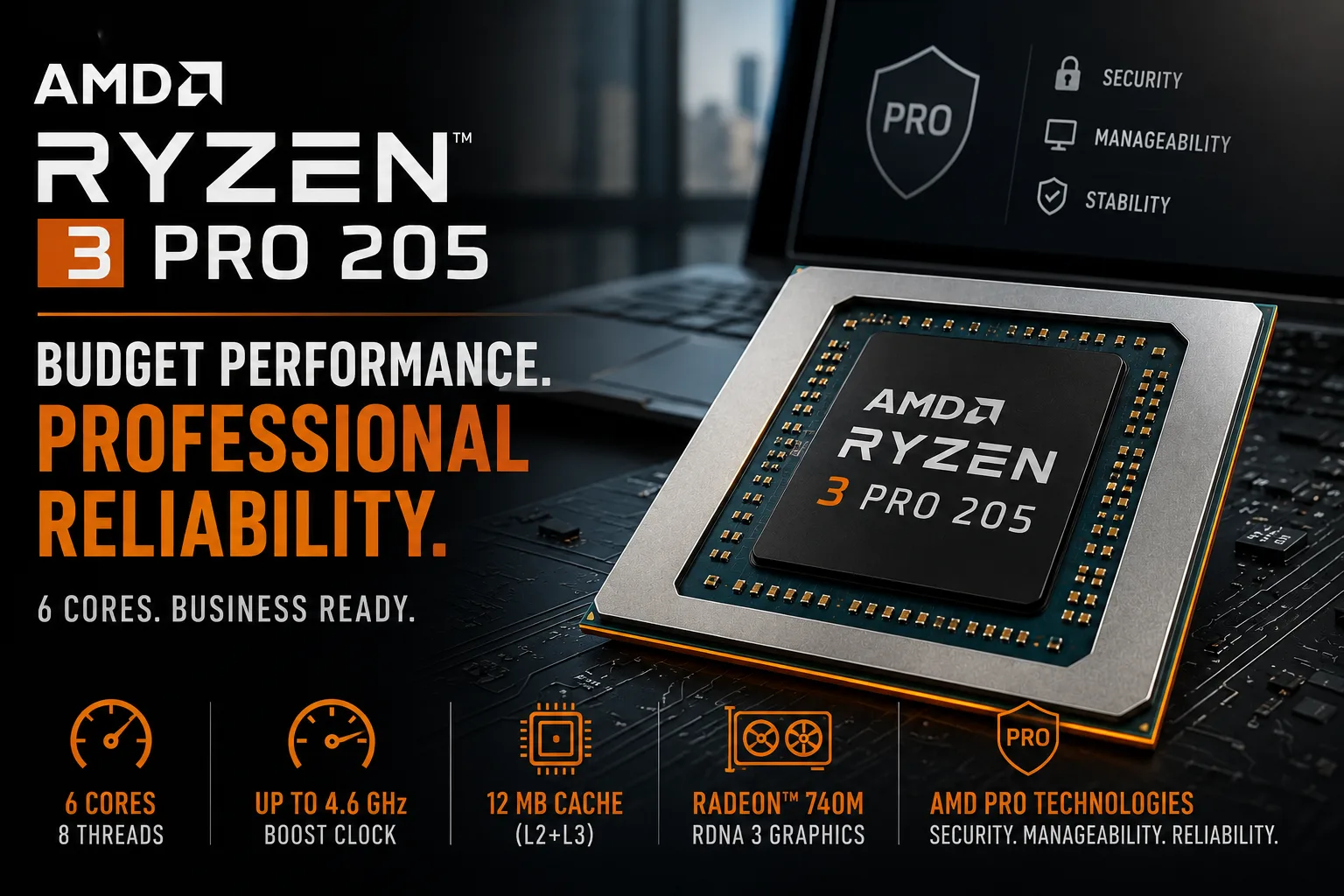
The AMD Ryzen 3 PRO 205 can easily be mistaken for the standard Ryzen 3 205 with a different label. In terms of processing power, it is indeed very similar: six physical cores, 8 threads, a combination of Zen 4 and Zen 4c, Radeon 740M graphics, and the Hawk Point platform. However, the purpose of the PRO version is not to increase speed. It is a lower-tier corporate processor for affordable laptops and compact systems where manageability, security, and predictable supply for business are crucial.
The main feature of the Ryzen 3 PRO 205 is its blend of budget performance and corporate capabilities. In regular retail, such a chip does not seem particularly outstanding: 6 cores with 8 threads, a small cache, basic integrated graphics, and no Ryzen AI. But for an office setup, this could be a perfectly normal configuration: no overpayment for a Ryzen 5, yet a modern platform with PRO features.
Why Ryzen 3 PRO 205 remains budget-oriented
The Ryzen 3 PRO 205 is built on the Zen 4 and Zen 4c architecture. It has six physical cores but only 8 threads. This immediately sets it apart from the higher Ryzen 5 PRO, where typically 12 threads and more cache are available with six cores.
In simple tasks, this is not an issue. Browsing, documents, email, video calls, CRM, office applications, and remote work do not require maximum multithreading. Here, a quick system response, a decent SSD, dual-channel memory, and cooling without significant throttling are more important.
However, in intensive tasks, the limitations become noticeable. Archiving, compiling, handling large files, working with multiple heavy applications, and lengthy calculations are better suited to the Ryzen 5 PRO or Ryzen 7 PRO. Therefore, the Ryzen 3 PRO 205 should not be perceived as a hidden Ryzen 5 for business. It is the lower option in the Hawk Point corporate lineup.
How the PRO version differs from the standard Ryzen 3 205
The main distinction lies not in the cores or graphics. The Ryzen 3 PRO 205 is particularly interesting due to the corporate set of AMD PRO Technologies. This includes security features, remote administration, and device management capabilities within a fleet.
For home users, this is nearly irrelevant. But for a company, the difference is significant. A laptop with a PRO processor can be integrated more easily into the corporate infrastructure: managing it, protecting data, ensuring compliance with security standards, and servicing the device fleet without manual setup for each laptop.
This is why the Ryzen 3 PRO 205 should be evaluated not as “faster or slower than the standard Ryzen 3 205,” but as an option for entry-level business laptops. The performance is roughly in the same class, but the purpose is different.
Comparison with neighboring models
| Processor | Cores / Threads | Boost | Cache L2 + L3 | Graphics | PRO features |
|---|---|---|---|---|---|
| Ryzen 3 205 | 6 / 8 | up to 4.6 GHz | 12 MB | Radeon 740M | no |
| Ryzen 3 PRO 205 | 6 / 8 | up to 4.6 GHz | 12 MB | Radeon 740M | yes |
| Ryzen 5 PRO 215 | 6 / 12 | up to 4.7 GHz | 22 MB | Radeon 740M | yes |
| Ryzen 5 PRO 230 | 6 / 12 | up to 4.9 GHz | 22 MB | Radeon 740M | yes |
In comparison with the standard Ryzen 3 205, the PRO version does not seem to be an upgrade in terms of speed. The CPU and graphics levels are nearly the same, but with corporate features.
Comparing with the Ryzen 5 PRO 215 and Ryzen 5 PRO 230 is simpler: the higher models are faster. They offer more threads, more cache, and better performance in working tasks. If laptops are purchased for the long term or users frequently work with heavy spreadsheets, numerous tabs, local databases, IDEs, or multiple heavy applications simultaneously, the Ryzen 5 PRO will perform better.
The Ryzen 3 PRO 205 is justified where price and basic manageability are important. This processor is aimed at mass office configurations, not workstations.
Radeon 740M: sufficient for the office, lacking for gaming
The Ryzen 3 PRO 205 uses the Radeon 740M based on the RDNA 3 architecture. This is basic integrated graphics. It is adequate for Windows, browsing, video, office applications, multiple monitors, and older games. For a corporate laptop, this is enough.
However, it lacks gaming capability. Simple online games may be possible at low settings, but modern, demanding games quickly hit the limits of few graphics modules, memory speed, and overall thermal envelope. Integrated graphics share power with the CPU, so in thin laptops, the performance will depend on cooling and manufacturer's limits.
For business scenarios, the Radeon 740M performs adequately. For gaming, video editing, and graphic work, it is better to opt for higher-end APUs or laptops with discrete graphics cards.
No Ryzen AI
The Ryzen 3 PRO 205 does not have a dedicated NPU. Therefore, it cannot be classified as a full-fledged AI processor, even despite the new Ryzen PRO 200 lineup.
For office, browsing, documents, video calls, and remote work, this isn’t a problem. However, if a company is purchasing laptops for local AI functions in Windows and applications, the Ryzen 3 PRO 205 will be a weak choice. For such tasks, higher models with Ryzen AI are required.
It is essential not to confuse positioning here. The Ryzen 3 PRO 205 is a corporate budget processor, not an AI platform.
Where the Ryzen 3 PRO 205 fits
The Ryzen 3 PRO 205 is well-suited for inexpensive corporate laptops: accounting, sales departments, call centers, document management, browser services, video conferencing, remote desktop, and office applications. In such tasks, stability, security, manageability, and the price of the device are important.
It is less suitable for developers, analysts dealing with heavy spreadsheets, engineers, designers, video editors, and users who frequently keep multiple resource-intensive applications open. For them, the Ryzen 5 PRO or Ryzen 7 PRO would be better.
In summary: the Ryzen 3 PRO 205 is a processor for the work laptop of an employee, not for a powerful personal machine.
What to look for when purchasing
The Ryzen 3 PRO 205 itself does not guarantee a good laptop. In the budget corporate segment, the final impression is often determined by RAM, SSD, screen, cooling, and manufacturer specifics.
For the Radeon 740M, dual-channel memory mode is crucial. A single RAM module can significantly reduce the performance of integrated graphics. For office work, this isn’t always critical, but when connecting multiple monitors, dealing with heavy web applications, and video calls, the difference can be felt.
Power limits are also important. The Ryzen 3 PRO 205 can operate within different thermal envelopes, so a thin laptop with strict limitations will be slower than a model with more efficient cooling. For corporate procurement, it is worthwhile to look not only at the processor but also at the specific laptop model.
Conclusion
The AMD Ryzen 3 PRO 205 is an entry-level corporate Hawk Point with an unusual configuration for Ryzen 3: 6 cores, 8 threads, Radeon 740M, and the FP8 platform. Its strength lies not in high performance but in the combination of modern architecture with AMD PRO Technologies.
For office use, browsing, documents, video conferencing, and mass workstations, it will suffice. For gaming, video editing, development, heavy analytics, and long-term purchases, it is better to look higher-at least at the Ryzen 5 PRO 215 or Ryzen 5 PRO 230.
The bottom line is simple: the Ryzen 3 PRO 205 makes sense in a corporate laptop if low cost and PRO features are needed. If performance is essential, cost-saving quickly becomes unbeneficial.
CPU Comparison
Compare Ryzen 3 PRO 205 with other CPUs
Basic
CPU Specifications
Memory Specifications
GPU Specifications
Miscellaneous
Share in social media
Or Link To Us
<a href="https://cputronic.com/en/cpu/amd-ryzen-3-pro-205" target="_blank">AMD Ryzen 3 PRO 205</a>