AMD EPYC 8635P
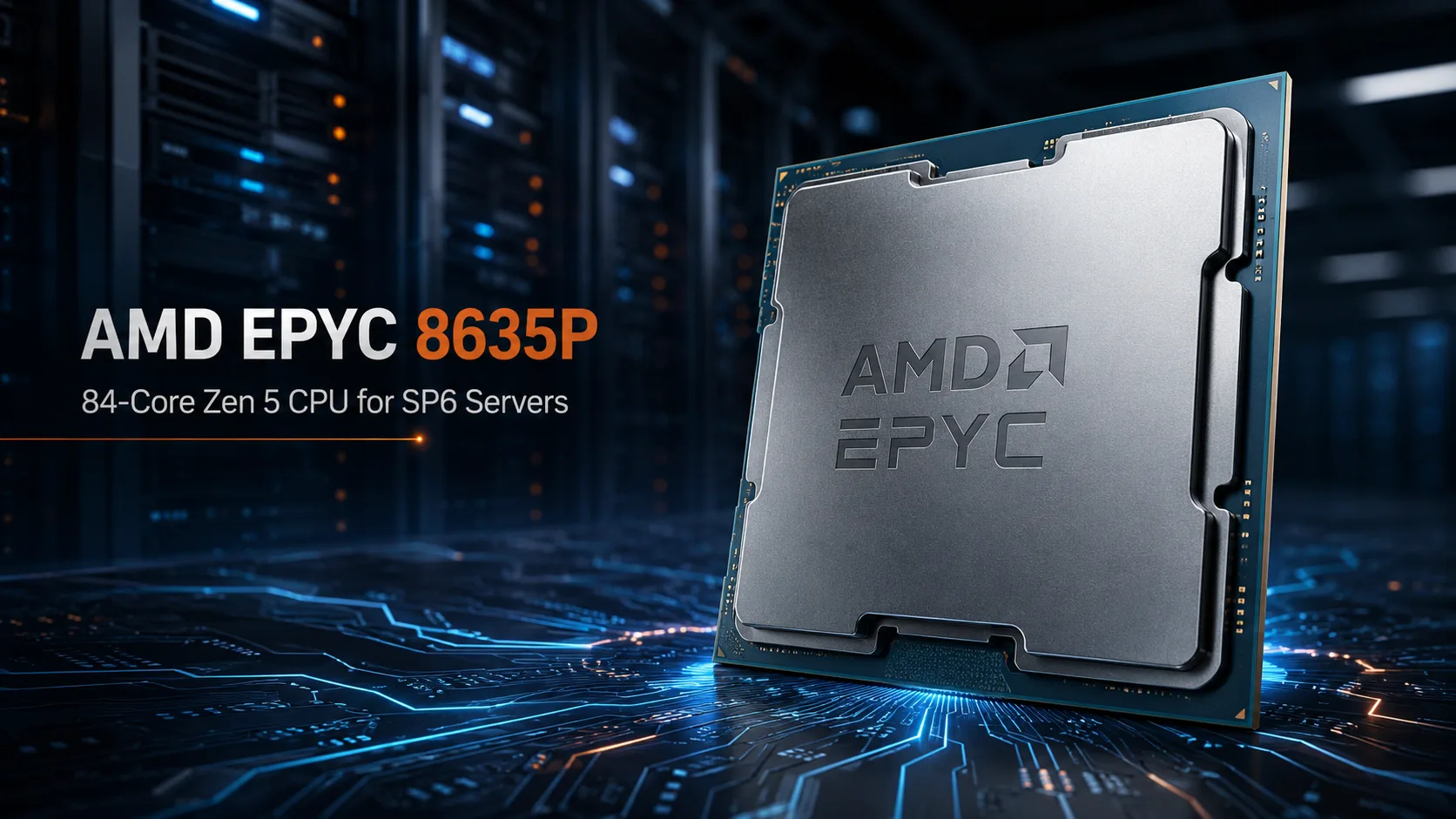
AMD EPYC 8635P: 84 Zen 5 Cores for the SP6 Platform
The AMD EPYC 8635P is the flagship model of the EPYC 8005 series for single-socket servers. The processor combines 84 Zen 5 cores, 384 MB of L3 cache, and 96 PCIe 5.0 lanes within the SP6 platform, designed for fewer memory channels and no dual-socket configurations, but offering a simpler server board with lower power and cooling requirements.
The main use cases are storage, telco/vRAN, virtualization, and edge nodes. It is not a replacement for the EPYC 9005 intended for systems demanding large memory and dual-socket configurations, but rather AMD's top model for SP6 servers.
SP6 Instead of SP5: Simpler Platform, Lower Scalability Limit
The EPYC 8635P is not a direct alternative to the higher-end EPYC 9005. SP5 offers more memory channels, a wider range of CPUs with a greater number of cores, and dual-socket configurations.
The EPYC 8005 is aimed at single-socket servers. This series is designed for systems where a simpler board, lower power and cooling requirements, and a lower platform cost are crucial. The EPYC 8635P is the highest model in this lineup: it features the maximum core count for SP6 but is not intended for systems with maximum memory capacity and dual CPUs.
The main distinction of the EPYC 8635P is its 84 cores in a single SP6 socket. This model is intended for systems where 32-64 cores are insufficient and transitioning to SP5 is excessive in terms of cost, power, and platform complexity.
What’s Changed Compared to EPYC 8004 Siena
Compared to the EPYC 8004, the main changes are more cores, more L3 cache, and faster memory. The top EPYC 8534P of the previous generation featured 64 cores and 128 threads, while the EPYC 8635P received 84 cores and 168 threads. The architecture has transitioned from Zen 4 to Zen 5, the L3 cache size has increased to 384 MB, and memory support has risen from DDR5-4800 to DDR5-6400.
TDP has increased from 200 to 225 W. This is a modest rise given the increase in core count, L3 size, and memory speed: the processor has 168 threads, 384 MB of L3, and supports DDR5-6400 while retaining the SP6 platform.
The practical advantage is the ability to upgrade existing SP6 systems after a BIOS firmware update. However, to utilize the benefits of DDR5-6400, compatible memory is required: if DDR5-4800 modules are retained, the memory bandwidth will remain at the level of the old configuration.
Performance: More Cores, More Cache, and Higher Frequencies
The EPYC 8635P is accelerated not only by its 84 cores. The L3 cache has been increased to 384 MB, memory support has risen to DDR5-6400, and the maximum boost frequency reaches 4.5 GHz. The base frequency is 1.6 GHz, and the all-core boost can reach about 3.45 GHz.
For an 84-core server CPU, this is a high boost frequency. Therefore, the EPYC 8635P is not just designed for tasks that load all cores simultaneously. Frequency, cache, and faster memory are important for workloads where the work is unevenly distributed across cores.
AMD claims a performance uplift of up to 40% in integer performance compared to its 64-core predecessor and a 9.5% increase in performance per watt. These figures are AMD's data under specific test conditions, not guaranteed improvements in all tasks. In a real system, the results will depend on memory, BIOS, cooling, and workload type.
Memory and PCIe Define Practical Benefits of the Processor
The EPYC 8635P supports 6 channels of DDR5-6400 ECC, up to 3 TB of memory, and 96 PCIe 5.0 lanes. This configuration is suitable for servers with NVMe arrays, high-throughput network adapters, storage controllers, and accelerators.
For storage servers and edge nodes, the combination of 84 cores and 96 PCIe 5.0 lanes is crucial. Here, the processor handles not only calculations but also disks, networking, controllers, encryption, replication, caching, and VMs.
If the workload is constrained by memory bandwidth or requires maximum RAM per socket, it's better to opt for the EPYC 9005.
Key Scenarios for EPYC 8635P
Software-defined storage and cloud storage are one of the key scenarios. Here, PCIe lanes for NVMe and network cards are needed, as well as many CPU threads for replication, caching, encryption, and metadata processing. In such nodes, the EPYC 8635P provides 84 cores and 96 PCIe 5.0 lanes without moving to SP5.
In telco and vRAN, the number of cores per server, performance per watt, and operation within power and cooling constraints are important. AMD specifically promotes the EPYC 8005 for telecom workloads, including LDPC optimizations and Layer 1 processing.
Another scenario is virtualization and containers. 84 cores and 168 threads allow for increasing the number of VMs or containers on a single node. Such a CPU enables dense virtualization without needing a second socket.
In edge AI, the EPYC 8635P can handle the CPU portion of tasks: networking, storage, data preparation, analytics, and service logic. It does not replace GPUs in model training and heavy inference workloads.
What to Compare the EPYC 8635P With
The EPYC 8635P should primarily be compared with the EPYC 8534P and EPYC 8535P. Against the EPYC 8534P, the new model boasts more cores, Zen 5 architecture, 384 MB of L3, and faster memory. This is a direct upgrade for SP6 systems limited by thread count.
The EPYC 8535P is a less demanding option regarding cooling if 64 cores are sufficient. It has simpler system requirements and a lower risk of overpaying for cores that won't be fully utilized. The EPYC 8635P is needed when the server genuinely utilizes the additional threads: in virtualization, storage, telco, and container workloads.
When compared to the EPYC 9005, the primary consideration shifts from core count to platform capabilities. The EPYC 8635P makes sense to choose instead of SP5 only if a single socket, 6 memory channels, and 96 PCIe 5.0 lanes are adequate. If 12 memory channels, larger RAM capacity, or dual sockets are required, it is better to go for the EPYC 9005.
Limitations
The main limitation of the EPYC 8635P is the single socket. This is not a processor for systems where a dual-socket configuration and maximum memory capacity are required.
The second limitation is memory. Six channels of DDR5-6400 fit the SP6 class, but this is less than SP5 with 12 memory channels. In workloads sensitive to RAM bandwidth, some cores may remain idle.
The third limitation is power consumption. 225 W is a high level for a compact server. Such a processor requires sufficient power overhead, effective cooling, and an adequately ventilated chassis.
Additionally, the EPYC 8635P is not a primary solution for systems where the main load is on GPU accelerators. It can service the CPU part of the pipeline: networking, storage, data preparation, and service logic.
Who Is the AMD EPYC 8635P For
The EPYC 8635P is suitable if server workloads can be well-parallelized and utilize dozens of cores. The main applications include storage, telco/vRAN, virtualization, containers, and edge nodes.
It is not suitable for tasks with poor scalability across threads, systems with major GPU workloads, dual-socket servers, and configurations where maximum memory capacity is required. In such cases, it is better to choose the EPYC 9005 for dual-socket systems and large memory capacities, while for AI workloads, platforms with GPU accelerators are recommended.
Conclusion
The AMD EPYC 8635P does not replace the EPYC 9005: it is the flagship model for SP6. The processor combines 84 Zen 5 cores, 384 MB of L3 cache, DDR5-6400, and 96 PCIe 5.0 lanes in a single-socket server.
The main applications include storage, telco, edge nodes, and dense virtualization. If the maximum SP6 configuration is required, the EPYC 8635P is the flagship model of the EPYC 8005 series and the optimum choice for the SP6 platform.
CPU Comparison
Compare EPYC 8635P with other CPUs
Basic
CPU Specifications
Memory Specifications
Interfaces and Ports
Miscellaneous
Share in social media
Or Link To Us
<a href="https://cputronic.com/en/cpu/amd-epyc-8635p" target="_blank">AMD EPYC 8635P</a>