AMD EPYC 8535P
AMD EPYC 8535P: 64 Zen 5 Cores for the SP6 Platform
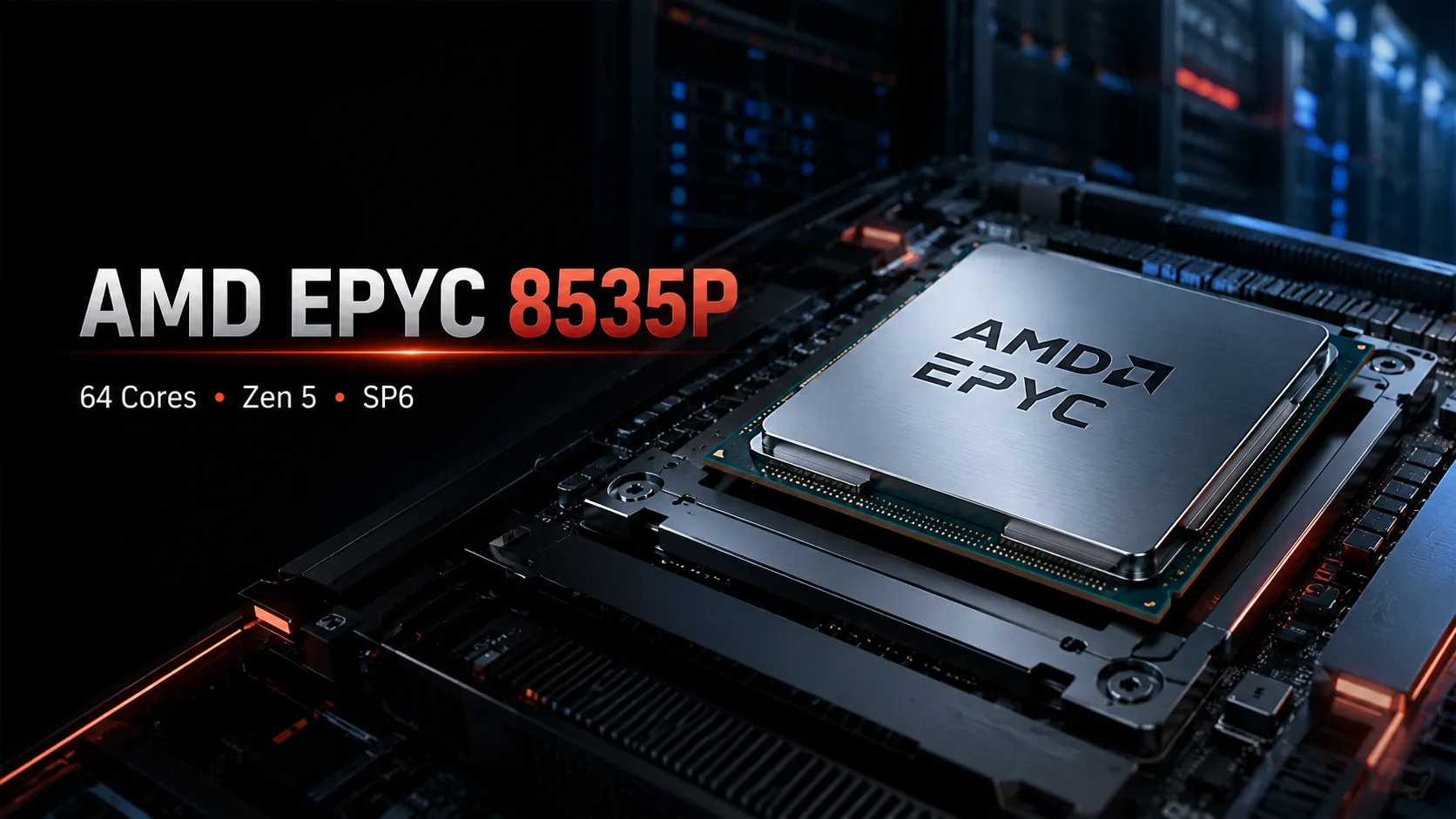
The AMD EPYC 8535P is a 64-core server processor from the EPYC 8005 series designed for the SP6 platform. The model utilizes Zen 5 architecture, operates solely in single-socket systems, and occupies a position between the 48-core EPYC 8435P and the 84-core EPYC 8635P.
The EPYC 8535P is aimed at high-threaded server workloads: it features 64 cores, 128 threads, 256 MB of L3 cache, and can boost up to 4.5 GHz. Its main competitor is the EPYC 8635P on the same SP6 platform, which offers 84 cores and shifts the selection logic within the lineup.
Position in the EPYC 8005 Lineup
EPYC 8005 is a dedicated server line from AMD for 1P servers. It is not a replacement for the higher-end EPYC 9005 series but a platform for systems with lower memory, I/O, and scaling requirements. The EPYC 9005 uses SP5, supports more memory channels, offers more PCIe lanes, and can operate in dual-processor configurations. The EPYC 8005 is limited to a single processor socket, 6 channels of DDR5, and 96 lines of PCIe 5.0.
The EPYC 8535P is positioned below the 84-core EPYC 8635P and above the 48-core EPYC 8435P. Therefore, it should be viewed as a 64-core option for servers where 64 cores are sufficient, and moving to 84 cores does not provide economic sense.
In terms of key specifications, the model occupies an intermediate position within the upper part of the EPYC 8005: 64 cores, 128 threads, a base frequency of 2.0 GHz, boost up to 4.5 GHz, all-core boost of 3.75 GHz, 256 MB of L3 cache, and a TDP of 210 W. The cTDP range is 155-225 W, allowing server manufacturers to tune the processor for different power and cooling limits.
Changes from EPYC 8534P
The EPYC 8535P is logically compared with the EPYC 8534P. Both processors have 64 cores and are designed for the SP6 platform, but belong to different generations. The EPYC 8534P was part of the EPYC 8004 Siena series and used Zen 4c. The EPYC 8535P transitioned to Zen 5, gained higher frequencies, DDR5-6400 support, and increased L3 cache.
This is not just a change in designation. The core count remained the same, but performance has improved for the same number of cores. In the open SPEC data for the EPYC 8535P, the SPECrate 2017 int_base is listed as 614 compared to 477 for the EPYC 8534P. Meanwhile, the TDP has increased moderately from 200 to 210 W.
The rationale for transitioning from 8534P to 8535P does not lie in the number of threads; they remain at 128. The main differences are the Zen 5 architecture, higher frequencies, larger L3 cache, and support for DDR5-6400. This is important for server tasks where the previous 64-core EPYC was already limited not only by core count but also by single-thread performance, cache, or memory.
SP6 Platform: Memory and PCIe
The EPYC 8535P supports 6 channels of DDR5-6400 and 96 lines of PCIe 5.0. For a single-socket server, this is sufficient to connect NVMe drives, network cards, storage controllers, and discrete accelerators within the SP6 framework.
However, SP6 remains a compromise platform. The EPYC 9005 on SP5 offers more memory channels and broader capacities for heavy server configurations. Therefore, the EPYC 8535P performs best where 6 memory channels, a single socket, and 96 lines of PCIe 5.0 are adequate. If the task strictly depends on memory bandwidth, the higher platform will be preferable.
For storage servers, the 96 PCIe 5.0 lanes allow the assembly of systems with a large number of NVMe drives and fast network interfaces in 1P configurations. For virtualization, 64 cores provide a large number of virtual cores in a single socket. For edge and telco applications, core density, modern memory, and a TDP of 210 W are important.
Best Fit for the EPYC 8535P
The EPYC 8535P is suitable for servers where cores, PCIe 5.0, and DDR5-6400 are needed, but there is no need to switch to a higher platform. The processor is better suited not for general maximum configurations but for systems constrained to a single processor socket.
Key scenarios include:
- Virtualization and containers - a large number of threads in one socket;
- Web hosting and server web workloads - high compute density without a dual-processor system;
- Storage and software-defined storage - PCIe 5.0 for NVMe and network cards;
- Edge and telco - many cores with moderate power consumption for the class;
- Compact 1U/2U servers - the combination of 64 cores, DDR5-6400, and 96 PCIe 5.0 lanes.
For databases, the nature of the workload is crucial: some tasks are more quickly bottlenecked by memory bandwidth than by core count. If the workload scales well across threads and does not require maximum memory bandwidth, the EPYC 8535P is suitable. If memory is the main limitation, it is better to consider the EPYC 9005 with its broader RAM subsystem.
EPYC 8435P, 8535P, and 8635P: Which to Choose
| Model | Position | When to Choose |
|---|---|---|
| EPYC 8435P | 48 cores, lower price and heat package | if 48 cores are sufficient and reducing cost is a priority |
| EPYC 8535P | 64 cores, mid-position in upper part SP6 | if a compromise between cores, TDP, and server price is needed |
| EPYC 8635P | 84 cores, maximum for EPYC 8005 | if maximum core density is needed and the platform is rated for 225 W |
The EPYC 8435P is suitable for servers where 48 cores fulfill the task without overpaying for higher models. The EPYC 8635P offers the maximum core count in EPYC 8005, but may be excessive under licensing based on core counts or power and cooling constraints. The EPYC 8535P occupies a middle ground between them: 64 cores, 210 W TDP, and all core functionalities of SP6 without moving to SP5.
Performance
According to open server benchmarks, the EPYC 8535P outperforms the EPYC 8534P in multi-threaded integer workloads. The SPECrate 2017 int_base rose from 477 to 614 with the same core count. This increase is influenced by the transition from Zen 4c to Zen 5, higher frequency, larger L3 cache, and DDR5-6400 support.
This increase cannot be directly applied to all workloads. Virtualization, build servers, web loads, and containers generally scale well across cores. Databases, analytics, and certain HPC tasks may hit memory limits faster. For such scenarios, not only core count but also memory subsystem width, latency, RAM volume, and platform settings are important.
Limitations
The EPYC 8535P is limited by the capabilities of the SP6 platform. It features a single processor socket, 6 memory channels, and 96 PCIe lanes. This is enough for many servers, but it is not a substitute for EPYC 9005 on SP5.
The second key point is the price of the entire system. The EPYC 8535P combines 64 cores, 256 MB of L3 cache, DDR5-6400, and 96 PCIe 5.0 lanes, but the EPYC 8635P with 84 cores is nearby. If the difference in a ready-made server is small, the higher model may prove more advantageous. If 64 cores are sufficient and extra cores increase licensing costs or cooling demands, the EPYC 8535P may be a more justified choice.
The third limitation involves memory-sensitive workloads. DDR5-6400 and 6 channels provide sufficient bandwidth for many server tasks, but SP5 offers more capabilities. If the processor is constantly waiting for data from memory, the 8535P may fall short compared to higher platforms, even with a high core count.
Conclusion
The AMD EPYC 8535P is a 64-core processor for single-socket servers. It brings Zen 5 architecture, 256 MB of L3 cache, DDR5-6400, 96 PCIe 5.0 lanes to the SP6 platform, with a noticeable performance improvement over the EPYC 8534P.
The model is suitable for virtualization, hosting, storage, edge, and telco servers where a single socket and 6 memory channels are sufficient. It is not AMD's maximum server platform but a configuration for systems needing 64 cores, modern memory, and PCIe 5.0 without transitioning to SP5.
The EPYC 8535P should be chosen if 64 cores are enough, and the EPYC 8635P does not justify the cost in a specific configuration. If the price difference is small, cooling is rated for 225 W, and the workload scales well up to 84 cores, the EPYC 8635P may be the more justified choice.
CPU Comparison
Compare EPYC 8535P with other CPUs
Basic
CPU Specifications
Memory Specifications
Interfaces and Ports
Miscellaneous
Share in social media
Or Link To Us
<a href="https://cputronic.com/en/cpu/amd-epyc-8535p" target="_blank">AMD EPYC 8535P</a>