AMD EPYC 8325P
AMD EPYC 8325P: 32 Zen 5 cores for SP6 servers
The AMD EPYC 8325P is a 32-core processor from the EPYC 8005 series designed for servers on the SP6 platform. It is intended for single-socket systems: virtualization, hosting, storage systems, network services, and edge infrastructure. The main difference from the EPYC 8324P is the transition from Zen 4c to Zen 5 without an increase in the number of cores.
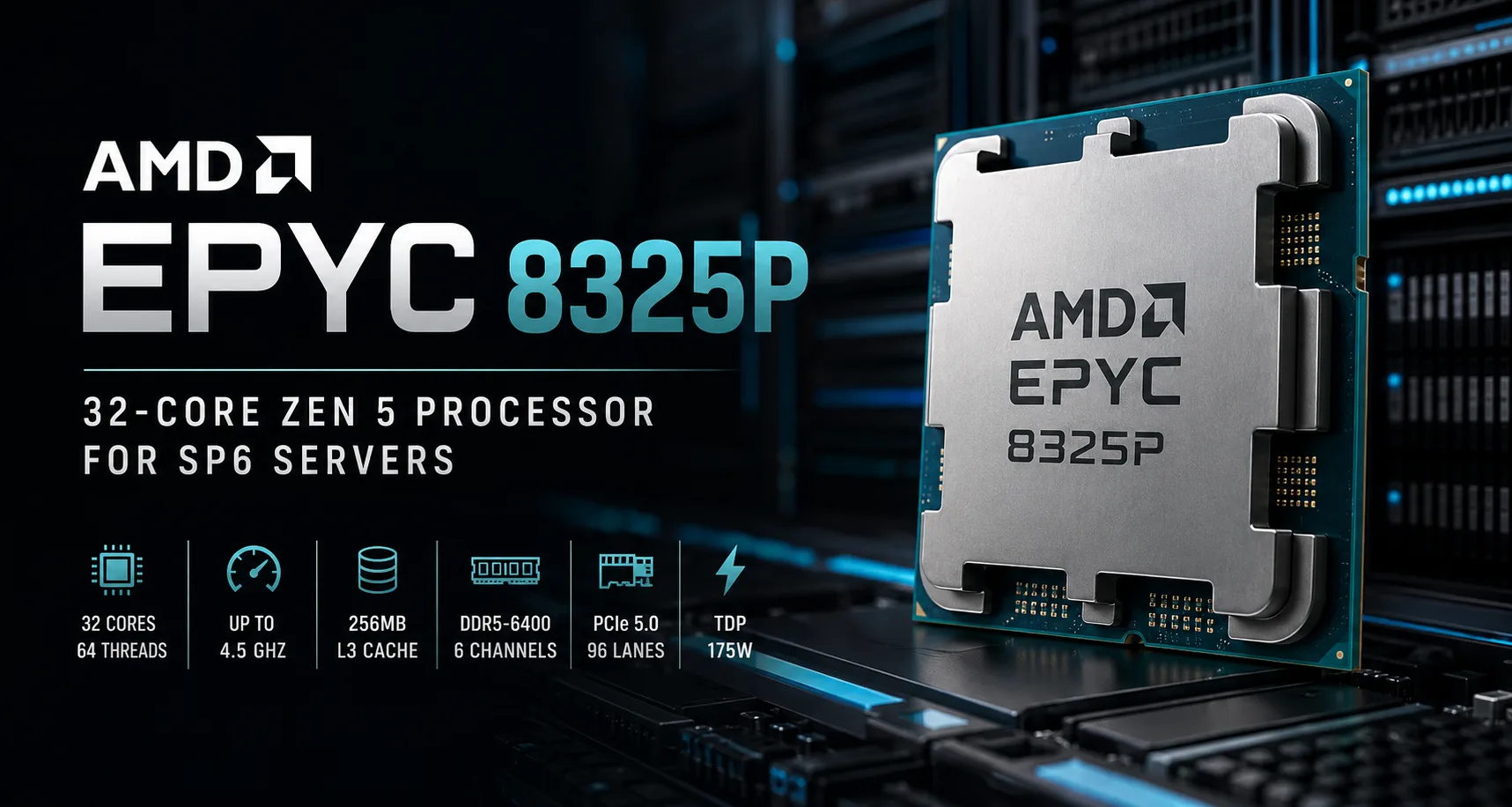
The EPYC 8325P features 32 cores, 64 threads, a boost frequency of up to 4.5 GHz, 256 MB of L3 cache, 6 channels of DDR5-6400 RAM, 96 PCIe 5.0 lanes, and a TDP of 175 watts. Essentially, this is not a new class of processor but an upgrade of the previous 32-core model for SP6: higher frequencies, increased cache, and faster memory.
Position in the EPYC 8005 lineup
In the EPYC 8005 lineup, the 8325P model stands between the 24-core EPYC 8225P and the 48-core EPYC 8435P. It is an option for cases where 24 cores are insufficient for the workload, but the 48-core model is excessive in terms of cost, TDP, or actual load.
This is not an entry-level model for basic tasks but a middle option within the EPYC 8005 series. 32 cores are already sufficient for dense virtualization, web hosting, storage systems, and network infrastructure. Moreover, the system remains on the more compact SP6 platform rather than moving to the higher-class EPYC 9005 on SP5.
Key differences from EPYC 8324P
The closest point of comparison is the EPYC 8324P. Both processors have 32 cores and 64 threads, utilize the SP6 socket, and are designed for single-socket servers. The differences lie in architecture, frequencies, cache, and memory.
| Parameter | EPYC 8324P | EPYC 8325P |
|---|---|---|
| Architecture | Zen 4c | Zen 5 |
| Cores / Threads | 32 / 64 | 32 / 64 |
| Boost | up to 3.0 GHz | up to 4.5 GHz |
| All-core boost | 3.0 GHz | 3.85 GHz |
| L3 Cache | 128 MB | 256 MB |
| Memory | DDR5-4800 | DDR5-6400 |
| Memory Bandwidth | 230.4 GB/s | 307 GB/s |
| TDP | 180 W | 175 W |
| Price 1kU | $1895 | $2299 |
The number of threads has not changed. The EPYC 8325P transitions to Zen 5, gains a higher boost frequency, doubles the L3 cache, and utilizes faster memory. Therefore, it is better perceived as an upgrade of the 32-core model for SP6: the number of cores remains the same, but the processor has improved in terms of frequencies, cache, and memory.
The increase in boost frequency from 3.0 GHz to 4.5 GHz is significant for tasks where part of the operations depends on the speed of a single thread. Virtual machines, databases, web services, and network tasks often depend not only on the number of threads but also on the performance of individual cores, memory latency, and cache size.
What this provides in real tasks
In purely multithreaded tasks, there may not be a sharp jump relative to the EPYC 8324P: the number of cores has remained the same. The primary gain should not come from a larger number of threads but from frequencies, Zen 5 architecture, 256 MB of L3 cache, and DDR5-6400.
This is important for servers where virtual machines, databases, web services, storage processes, and network services work simultaneously. In such conditions, the processor needs not only threads but also high performance from individual cores.
The EPYC 8325P is suitable for such scenarios:
- virtualization and hosting with a large number of different VMs;
- storage servers with NVMe drives;
- web services and application servers;
- medium-sized databases;
- network services, NFV, and telco infrastructure;
- edge servers where performance, power, and platform compactness are critical.
In these scenarios, it is more important to have a combination of CPU, memory, PCIe, and thermal package rather than just maximizing the number of cores. The EPYC 8325P provides enough threads for multithreaded server workloads and sufficient I/O for storage devices, network cards, and other PCIe devices.
Why SP6 is relevant here
SP6 is not a replacement for SP5 but a more compact server platform. SP5 has a higher core ceiling, more memory channels, and broader capabilities for heavy data center configurations. SP6 is more limited in scaling, but for the EPYC 8325P, this is sufficient: 6 channels of DDR5 and 96 PCIe 5.0 lanes are suitable for storage systems, edge servers, NVMe drives, and network cards without transitioning to SP5.
The strong point of the EPYC 8325P is the combination of 32 cores, modern memory, and I/O in a single socket system. For many servers, this is more important than simply having the maximum number of cores in the lineup.
When the EPYC 8325P looks like a sound choice
The EPYC 8325P should be considered if the 24-core model is already insufficient, but the 48-core model seems excessive. It is a suitable option for servers that need to run several dozen virtual machines, handle storage workloads, network services, or web projects.
It is also interesting as an upgrade from the EPYC 8324P. If the old processor limits in terms of frequencies, cache, or memory bandwidth, the EPYC 8325P provides a direct upgrade path without transitioning to another server platform.
This model is not intended for tasks requiring EPYC 9005 levels. If 64 or more cores, 12 memory channels, dual-socket configurations, or heavy computational tasks are required, it is better to look at the EPYC 9005 and the SP5 platform. If a simpler and cheaper server is needed, and 24 cores are sufficient, it makes more sense to consider the EPYC 8225P.
Conclusion
The AMD EPYC 8325P is an upgrade of the 32-core model in the EPYC 8005 lineup. Compared to the EPYC 8324P, it does not add cores but transitions to Zen 5, gains higher frequencies, 256 MB of L3 cache, and DDR5-6400.
This is a processor for compact single-socket SP6 servers and not an alternative to the higher EPYC 9005 models. Its strength lies in the balance of cores, memory, PCIe 5.0, and power consumption. In the EPYC 8005 lineup, it occupies a position between the 24-core and 48-core models: not a minimal configuration but also not transitioning to a more expensive class of servers.
CPU Comparison
Compare EPYC 8325P with other CPUs
Basic
CPU Specifications
Memory Specifications
Interfaces and Ports
Miscellaneous
Share in social media
Or Link To Us
<a href="https://cputronic.com/en/cpu/amd-epyc-8325p" target="_blank">AMD EPYC 8325P</a>