Qualcomm Snapdragon X2 Elite X2E-78-100
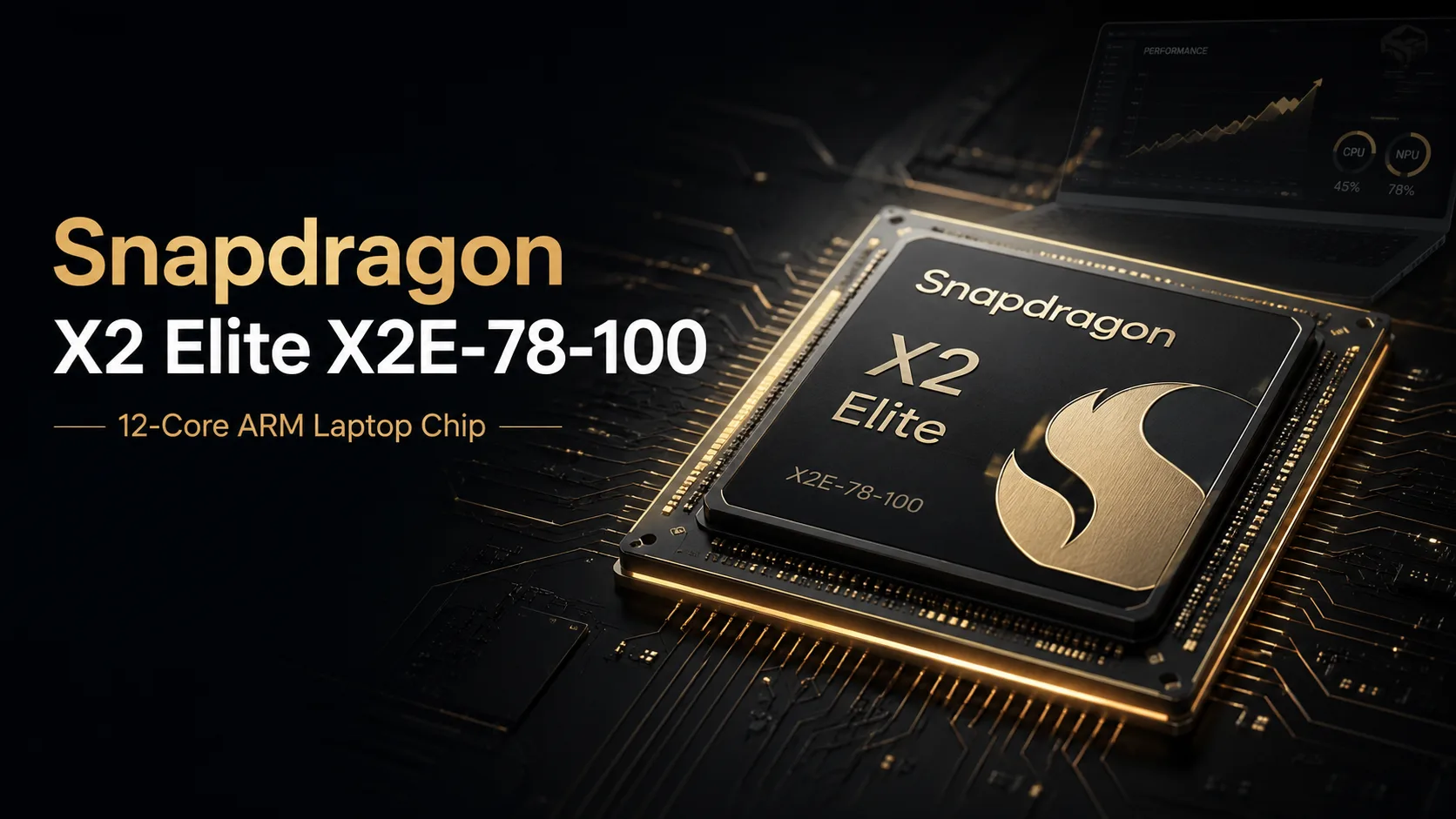
Qualcomm Snapdragon X2 Elite X2E-78-100: The Entry-Level Elite with Modest Frequency Overhead
The Qualcomm Snapdragon X2 Elite X2E-78-100 is the entry-level 12-core chip in the Snapdragon X2 Elite line for ARM-based Windows laptops. It retains key components from the higher-end platform: Oryon cores, an NPU with 80 TOPS, fast LPDDR5x memory, and relevant interfaces. However, in terms of CPU and integrated graphics frequencies, it is the most subdued option among the 12-core X2 Elite.
The X2E-78-100 serves as an entry-level choice within the Snapdragon X2 Elite range without the maximum CPU boost and high GPU frequency. Therefore, it should be evaluated not in isolation but in relation to the price of the specific laptop. It makes sense if the laptop is significantly cheaper than models with the X2E-80-100 or higher. With a small additional cost, the X2E-80-100 becomes a more interesting choice.
Position in the Snapdragon X2 Elite Lineup
The X2E-78-100 is not an entry-level office chip. It features 12 cores, 34 MB of cache, a Hexagon NPU with 80 TOPS, and LPDDR5x-9523 memory with a bandwidth of up to 152 GB/s. In terms of component configuration, it is designed for thin, next-generation laptops, not a stripped-down X2 Plus.
Within the Snapdragon X2 Elite lineup, this is the lower 12-core version. The main limitations are the frequencies of the CPU and integrated graphics. The Prime cores operate up to 4.0 GHz, while the Adreno X2-85 reaches up to 1.35 GHz. The higher-end 12-core versions have higher frequencies, meaning they should be faster for short CPU loads and graphics tasks.
| Model | Cores | CPU Boost | GPU | NPU | Model Purpose |
|---|---|---|---|---|---|
| Snapdragon X2 Elite X2E-78-100 | 12 | up to 4.0 GHz | up to 1.35 GHz | 80 TOPS | entry-level Elite |
| Snapdragon X2 Elite X2E-80-100 | 12 | up to 4.7 GHz | up to 1.70 GHz | 80 TOPS | higher frequencies with same 12-core base |
| Snapdragon X2 Elite X2E-84-100 | 12 | up to 4.7 GHz | up to 1.70 GHz | 85 TOPS | slightly higher AI block |
The 18-core versions of the X2 Elite should be considered a separate tier. They offer more cores, more cache, and a higher class of integrated graphics. These are options for tasks where multithreaded performance and stronger graphics are important.
CPU: 12 Cores, But No High Boost
The CPU section is built on third-generation Qualcomm Oryon cores. The configuration includes 6 Prime cores and 6 Performance cores. The Prime cores operate up to 4.0 GHz, while the Performance cores can reach up to 3.4 GHz.
For browsing, documents, video calls, IDEs, office applications, and general multitasking, this configuration should not be a bottleneck. For a thin work laptop, this CPU appears sufficient.
The limitation of the X2E-78-100 is not the number of cores but rather the frequencies. It lacks the high boost that distinguishes the higher versions of the Snapdragon X2 Elite. In short, single-threaded tasks and workloads where maximum frequency matters, the higher versions will perform better. In prolonged workloads, much depends not only on the chip but also on cooling, power limits, and the chassis of the specific laptop.
Graphics: The Main Compromise of the Entry-Level Version
The integrated Adreno X2-85 graphics in the X2E-78-100 operates up to 1.35 GHz. This is the main compromise of the model. The GPU name matches that of the faster 12-core X2 Elite versions, but the frequency is lower.
For the Windows interface, video, external monitors, browsing, and light graphics, this iGPU is adequate. However, gaming, 3D, and heavy GPU tasks represent the weak points of this configuration.
The low frequency doesn't make the Adreno X2-85 useless but does limit its potential. If a laptop is chosen with a focus on graphics performance, it's advisable to look at higher options or select a model with a discrete graphics card.
NPU: The Strong Point of the X2E-78-100
The NPU is the strongest block of the X2E-78-100 relative to its position in the lineup. The Hexagon NPU delivers 80 TOPS INT8, providing a good foundation for Copilot+ PC and local AI functions in Windows.
The limitations of this model lie in CPU/GPU frequencies, not in the neural processor. Therefore, for noise cancellation, image processing, local AI agents, Copilot+ PC functions, and other tasks utilizing the NPU, it boasts a significant reserve.
The benefits of the NPU depend on support within Windows, drivers, and specific applications. In this regard, the X2E-78-100 is closer to the higher versions than in terms of CPU and GPU.
Platform and Memory
The Snapdragon X2 Elite X2E-78-100 supports LPDDR5x-9523 with a 128-bit bus and bandwidth of up to 152 GB/s. For a laptop without discrete graphics, high memory bandwidth is especially important: it aids the CPU, integrated graphics, and the AI block.
The platform is also designed for fast connections: PCIe 5.0, USB4, Wi-Fi 7, and Bluetooth 5.4. These interfaces are crucial for external monitors, fast storage, and Wi-Fi 7 networks. In terms of platform capabilities, the X2E-78-100 aligns with the class of modern ARM laptops.
Performance and Scenarios
The X2E-78-100 is best suited for thin Windows laptops focused on battery life, quiet operation, and system responsiveness. Its scenarios include documents, browsing, video calls, studying, light development, basic photo editing, and everyday multitasking.
For heavy gaming, continuous rendering, complex 3D graphics, prolonged compilation, and batch processing, it's advisable to choose the higher versions of the Snapdragon X2 Elite. They offer higher frequencies, and the 18-core models also provide greater multithreaded capacity.
Benchmarks for the X2E-78-100 should be evaluated in the context of the specific laptop. The same chip can yield different results in a thin chassis versus a model with more robust cooling. For this version, power limits are particularly important: lower frequencies help make the laptop quieter and cooler, but do not turn it into a top-tier X2 Elite configuration.
Should You Choose the Snapdragon X2 Elite X2E-78-100?
The X2E-78-100 shines only at the right price for the laptop. It retains a strong base platform: 12 Oryon cores, 80 TOPS NPU, fast memory, and speedy interfaces. Its limitations are clear: lower CPU boost and integrated graphics frequency compared to the higher 12-core X2 Elite versions.
If a laptop with the X2E-78-100 is significantly cheaper than models with the X2E-80-100, then the choice seems reasonable. In this case, it provides a relevant ARM platform, a strong NPU, and sufficient speed for everyday tasks. If the price difference is small, it's better to look at the X2E-80-100: it has the same 12-core base but higher CPU and GPU frequencies.
The conclusion is simple: Snapdragon X2 Elite X2E-78-100 is not a weak Snapdragon, but rather the most subdued option in the X2 Elite lineup. It is suitable for thin laptops focusing on battery life, quiet operation, AI features, and everyday speed, but loses its appeal if the X2E-80-100 is available for a small additional cost.
CPU Comparison
Compare Snapdragon X2 Elite X2E-78-100 with other CPUs
Basic
CPU Specifications
Memory Specifications
GPU Specifications
AI Specifications
Connectivity
Interfaces and Ports
Miscellaneous
Related CPU Comparisons



Share in social media
Or Link To Us
<a href="https://cputronic.com/cpu/qualcomm-snapdragon-x2-elite-x2e-78-100" target="_blank">Qualcomm Snapdragon X2 Elite X2E-78-100</a>