Intel Core Ultra 7 260K

Intel Core Ultra 7 260K: Specifications, Performance, and Comparison with the 265K
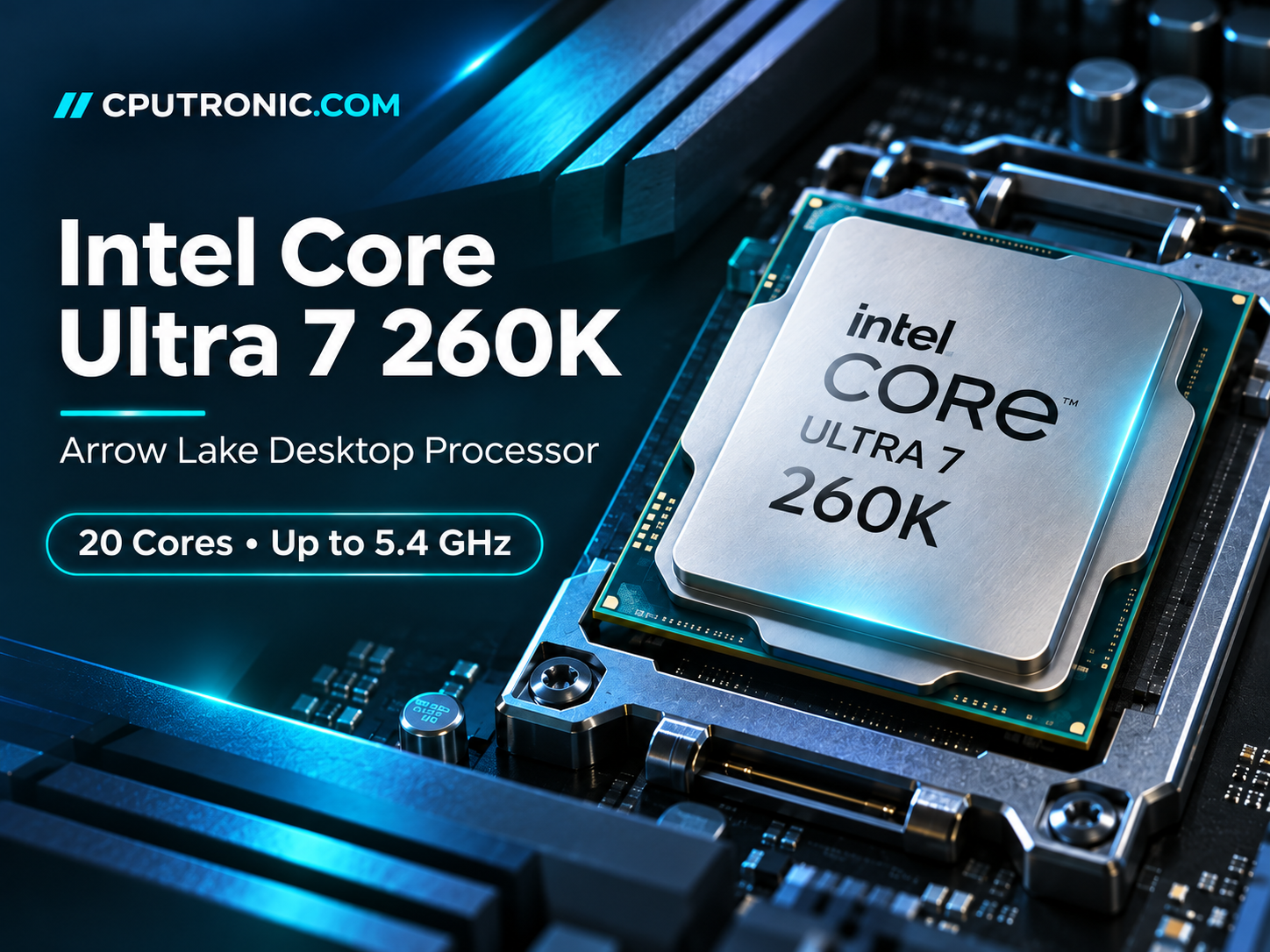
The Intel Core Ultra 7 260K is a 20-core desktop processor from the Arrow Lake family that went on sale in November 2026. Intel lists the third quarter of 2026 as its release period, but the first commercial offerings appeared later-in prebuilt ABS gaming computers and DIY component bundles.
In terms of specifications, the Core Ultra 7 260K is close to the Core Ultra 7 265K: both have 8 performance P-cores, 12 efficiency E-cores, and 30 MB of L3 cache. Maximum clock speeds are 100 MHz lower. The new model belongs to the original Arrow Lake architecture rather than the updated Arrow Lake Refresh series.
Differences from the Core Ultra 7 265K and 270K Plus
| Specification | Ultra 7 260K | Ultra 7 265K | Ultra 7 270K Plus |
|---|---|---|---|
| P-cores / E-cores | 8 / 12 | 8 / 12 | 8 / 16 |
| Threads | 20 | 20 | 24 |
| Max Turbo | 5.4 GHz | 5.5 GHz | 5.5 GHz |
| P-core Turbo | 5.3 GHz | 5.4 GHz | 5.4 GHz |
| E-core Turbo | 4.5 GHz | 4.6 GHz | 4.7 GHz |
| P-core Base | 3.9 GHz | 3.9 GHz | 3.7 GHz |
| E-core Base | 3.3 GHz | 3.3 GHz | 3.2 GHz |
| L2 Cache | 36 MB | 36 MB | 40 MB |
| L3 Cache | 30 MB | 30 MB | 36 MB |
| Memory | DDR5-6400 | DDR5-6400 | DDR5-7200 |
The Core Ultra 7 260K and 265K have the same core configuration, cache capacity, and base frequencies. Based on their published specifications, their performance should be similar.
The Core Ultra 7 270K Plus differs more substantially. Its additional four E-cores, larger cache, and faster memory subsystem give it an advantage primarily in multithreaded workloads.
Architecture and Technical Specifications
The Core Ultra 7 260K uses Lion Cove P-cores and Skymont E-cores. Its compute die is manufactured using TSMC’s N3B process. Hyper-Threading is not supported, so the 20 physical cores handle 20 hardware threads.
The processor’s main specifications:
- 36 MB of L2 cache and 30 MB of L3 cache.
- Dual-channel DDR5-6400 memory support, with up to 256 GB of capacity.
- 20 PCIe 5.0 lanes and 4 PCIe 4.0 lanes.
- 125 W base power and 250 W maximum turbo power.
- Unlocked multiplier.
- Integrated Intel Graphics with four Xe-cores.
- Intel AI Boost neural processing unit with up to 13 TOPS (INT8).
The processor uses the LGA1851 socket and is compatible with Intel 800-series motherboards that support it. A Z890 motherboard is required to overclock the compute cores. B860 models are suitable for stock operation but do not support this type of overclocking.
Performance Comparison with Other Processors
The Core Ultra 7 260K has not yet received a sufficient number of independent tests. The closest reference point is the Core Ultra 7 265K, which has slightly higher maximum clock speeds.
| Processor | GB6 Single | GB6 Multi | Time Spy CPU | Cyberpunk 2077, FPS | DOOM: The Dark Ages, FPS |
|---|---|---|---|---|---|
| Core Ultra 7 260K | - | - | - | - | - |
| Core Ultra 7 265K | 3199 | 21307 | 18520 | 217.3 | 190.3 |
| Core Ultra 7 270K Plus | 3374 | 24003 | 19134 | 235.0 | 199.6 |
| Core Ultra 5 245K | 3056 | 18215 | - | 209.3 | 175.4 |
| Ryzen 7 9700X | 3395 | 16828 | 15016 | 222.8 | 171.2 |
| Ryzen 7 9800X3D | 3309 | 18231 | - | 270.2 | 232.7 |
The Geekbench 6 and gaming results come from the same series of comparative tests. The Time Spy CPU results come from a separate series of measurements. The games were tested with a GeForce RTX 5090 at a resolution of 1920 × 1080 using the Medium preset. The figures show average FPS. Dashes indicate that no results were available in the tests under consideration.
Geekbench 6 and 3DMark
The Core Ultra 7 265K scores 3199 points in Geekbench 6 Single-Core, trailing the Ryzen 7 9700X by 5.8%. In the multithreaded test, Intel leads AMD by 26.6%-21307 versus 16828 points.
The Core Ultra 7 270K Plus is 12.7% faster than the 265K in Geekbench 6 Multi-Core, but only 3.3% faster in Time Spy CPU. This shows how much the performance gain from additional cores depends on the specific workload.
The Core Ultra 7 260K will most likely deliver performance close to that of the 265K. Its configuration of 8 P-cores and 12 E-cores is particularly interesting for compiling software, CPU rendering, video encoding, and other highly parallel workloads.
Gaming Performance
In Cyberpunk 2077, the Core Ultra 7 265K delivers 217.3 FPS, while the 270K Plus reaches 235 FPS. The updated model’s advantage is 8.1%. In DOOM: The Dark Ages, the difference falls to 4.9%.
The Ryzen 7 9800X3D is 24.3% faster than the 265K in Cyberpunk 2077 and 22.3% faster in DOOM. For a computer intended exclusively for gaming, AMD processors with 3D V-Cache remain serious competitors.
In systems with an RTX 5060 or RTX 5070, the difference between processors may be smaller than in tests with an RTX 5090. This is especially true at high graphics settings, when the graphics card becomes the limiting component.
Integrated Graphics, AI, and Cooling
Intel Graphics with four Xe-cores operates at up to 2.0 GHz. The integrated graphics support Intel Quick Sync Video and hardware processing of H.264, HEVC, and AV1. A discrete graphics card is required for demanding games.
The Intel AI Boost NPU delivers up to 13 TOPS (INT8) and is intended to accelerate compatible AI applications.
The processor’s maximum turbo power is 250 W, the same as that of the Core Ultra 7 265K. Effective cooling is required for sustained multithreaded workloads. The 260K’s lower maximum clock speeds do not, by themselves, guarantee a noticeable reduction in power consumption.
Where the Intel Core Ultra 7 260K Is Sold
In November 2026, the processor was available not only in prebuilt computers but also as part of the Newegg MB Starter Kit for DIY builds.
ABS Prebuilt Computers
| Specification | ABS Kaze II Aqua | ABS Flux II Aqua |
|---|---|---|
| Graphics card | RTX 5060 8 GB | RTX 5070 12 GB |
| Motherboard | MSI PRO B860-VC WIFI | ASRock B860M-C |
| System memory | 32 GB DDR5-6000 | 32 GB DDR5-6000 |
| SSD | 1 TB | 1 TB |
| CPU cooling | 360 mm AIO | 240 mm AIO |
| Power supply | 850 W Gold | 650 W Gold |
| Price | $1699.99 | $1999.99 |
Both configurations use the Core Ultra 7 260K, but they differ in more than just their graphics cards. The Kaze II is equipped with a larger cooling system and a more powerful power supply, while the Flux II uses a compact chassis.
For high-resolution gaming, the Flux II is more appealing thanks to its RTX 5070 with 12 GB of video memory. The Kaze II offers a more powerful power supply and a larger cooling system, but it has a less capable graphics card.
Newegg DIY Build Kit
The kit includes:
- Intel Core Ultra 7 260K.
- Gigabyte Z890 AORUS Elite WiFi7 ICE.
- Corsair Vengeance RGB, 16 GB (2 × 8 GB) DDR5-6000.
- Kingston NV3, 1 TB PCIe 4.0 SSD.
This is a bundle of core components, not a complete computer. A chassis, power supply, CPU cooler, and, if necessary, a discrete graphics card will be required to complete the build.
The Z890 motherboard supports processor overclocking. However, 16 GB of system memory may already limit the capabilities of a high-performance workstation, so a build intended for multithreaded workloads should reasonably include plans to increase the amount of RAM.
The kit’s price makes the Core Ultra 7 260K accessible for DIY builds as well, although it must be compared with separately sold processors while taking the cost of all included components into account.
Is the Core Ultra 7 260K Worth Buying in 2026?
For a prebuilt computer, the Core Ultra 7 260K is a powerful processor with capabilities close to those of the Core Ultra 7 265K. When choosing between systems with these models, it makes more sense to consider the total price, graphics card, memory, and cooling. The small difference in maximum clock speeds is unlikely to be decisive.
For a DIY build, the situation depends on the kit’s price. An offering with a Z890 motherboard, memory, and an SSD may be a better value than buying the components separately, especially if you plan to use the motherboard’s overclocking capabilities.
The Core Ultra 7 270K Plus is preferable for workloads that make good use of the additional E-cores. For a predominantly gaming-focused computer, it is also worth comparing the platform’s total cost with that of the Ryzen 7 9800X3D.
Owners of the Core i7-14700K and other high-performance processors from the previous generation have little reason to switch to the 260K solely to upgrade the platform. Replacing the motherboard increases costs, and a noticeable performance gain in specific workloads is not guaranteed.
Conclusion
The Intel Core Ultra 7 260K is an additional Arrow Lake family model whose specifications closely mirror those of the Core Ultra 7 265K. Its arrival expanded the selection of prebuilt computers and DIY kits based on LGA1851, but it did not introduce any substantial architectural changes.
The 260K’s main advantage depends on the price of the specific offering. As part of a competitively priced prebuilt computer or a kit with a Z890 motherboard, it may be a sensible purchase. At the same price as the Core Ultra 7 265K, the higher-clocked model is preferable, while the Core Ultra 7 270K Plus is worth considering for heavily multithreaded workloads.
CPU Comparison
Compare Core Ultra 7 260K with other CPUs
Basic
CPU Specifications
Memory Specifications
GPU Specifications
7680 x 4320 @ 60Hz (HDMI 2.1 FRL)
AI Specifications
Interfaces and Ports
Miscellaneous
Share in social media
Or Link To Us
<a href="https://cputronic.com/cpu/intel-core-ultra-7-260k" target="_blank">Intel Core Ultra 7 260K</a>