Intel Arc G3

Intel Arc G3
Intel Arc G3 processor review

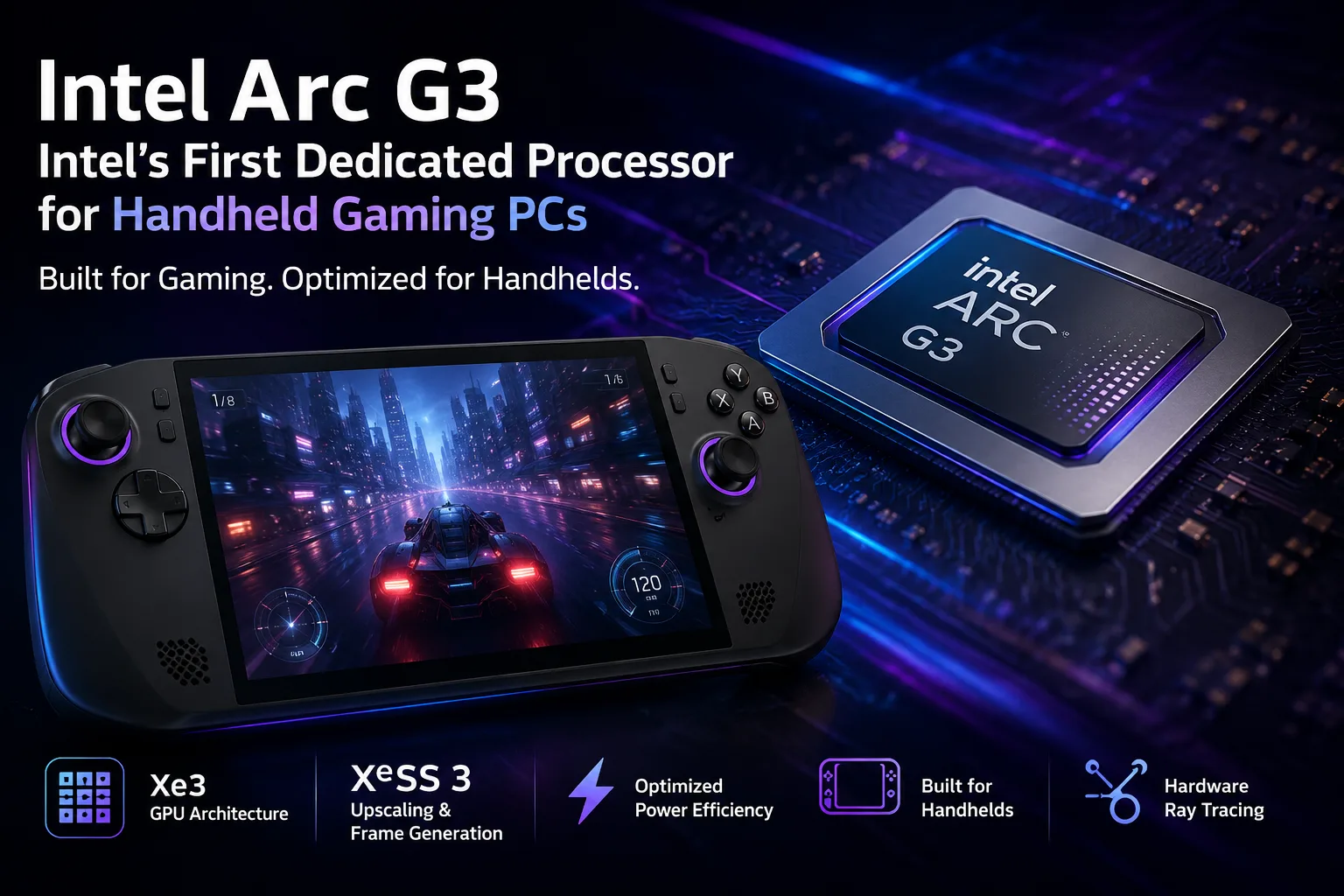
Intel Arc G3: The First Specialized Intel Processor for Portable Gaming PCs

AMD has been releasing specialized Ryzen Z processors for portable gaming PCs for several generations. Prior to the arrival of the Arc G3, manufacturers of such devices were using standard Intel Core Ultra laptop processors. The new series changes the approach: core configuration, graphics, and power management are initially designed for the gaming portable format.

Intel retained two performance P-cores, eight E-cores, and four low-power LP E-cores. This setup reduces the CPU load on the overall power limit and allows for a greater emphasis on integrated graphics.

The series includes the base Arc G3 with Arc B370 graphics and the higher-end Arc G3 Extreme with Arc B390. In terms of positioning, they are intended to compete with AMD Ryzen Z2 and Ryzen Z2 Extreme, respectively. However, independent tests have predominantly been published for the Extreme version so far.

What Sets Arc G3 Apart from G3 Extreme

Characteristic Intel Arc G3 Intel Arc G3 Extreme
Maximum CPU Frequency 4.6 GHz 4.7 GHz
Integrated Graphics Intel Arc B370 Intel Arc B390
Xe3 Cores 10 12
Maximum GPU Frequency 2.2 GHz 2.3 GHz

The CPU configuration, cache size, and base power of the processors are identical. The main difference lies in the graphics: the base G3 has 16.7% fewer Xe-cores and a slightly lower maximum GPU frequency.

This does not imply the same level of gaming performance disparity. The actual difference will depend on power limits, memory speed, cooling, and specific device settings.

Why Does a Gaming Processor Have Only Two P-Cores?

The total number of cores in the Arc G3 appears impressive - 14 cores and 14 threads. However, only two cores belong to the performance class. The others are intended for background processes, multi-threaded tasks, and efficient operation under low load.

For rendering, compiling, and other heavy CPU loads, such a configuration may fall short compared to processors with four or six P-cores. In a portable gaming PC, the priorities are different: the CPU and GPU share a common power limit, and the final frame rate is often limited by the graphics.

Intel refers to this approach as right-sized compute. The processor part needs to be fast enough for gaming but not excessive for a battery-operated device.

Xe3 Graphics and XeSS 3

The main focus of the Arc G3 is on the integrated graphics of the Xe3 generation. The base Arc B370 features 10 Xe-cores, while the Arc B390 in the Extreme version has 12. Both support DirectX 12 Ultimate and hardware ray tracing.

Performance is further enhanced by the XeSS 3 technology, which includes image scaling, frame generation, and latency reduction. This is particularly important for portable PCs: in demanding games, the integrated graphics often have to output at a lower internal resolution to maintain an acceptable frame rate.

It’s worth noting that frame generation does not replace baseline performance. If a game is initially running slowly, the FPS counter may increase, but input lag and artifacts will still be noticeable. Therefore, the Arc G3 should be primarily evaluated based on results without frame generation.

Benchmarks: Only Arc G3 Extreme So Far

Currently, there are insufficient independent tests of the base Intel Arc G3. The first retail device with detailed results is the MSI Claw 8 EX AI+ featuring Arc G3 Extreme.

For comparison, the ASUS ROG Xbox Ally X with AMD Ryzen AI Z2 Extreme is included below. All results were obtained from one edition, although the exact power modes in the table are not disclosed. Therefore, the comparison reflects finished devices rather than just the processors installed in them.

Device Processor Fire Strike Time Spy Steel Nomad Port Royal
MSI Claw 8 EX AI+ Intel Arc G3 Extreme 12,358 6,534 1,425 3,544
ASUS ROG Xbox Ally X AMD Ryzen AI Z2 Extreme 9,141 4,033 609 1,999

The MSI Claw outpaced the ASUS ROG Xbox Ally X in all four tests. Part of the difference may be related not only to the processor but also to power settings, memory, and cooling of the devices.

The largest lead was observed in Steel Nomad and Port Royal. The latter is particularly interesting as a ray tracing test, but the results still cannot be considered a pure comparison between Arc B390 and AMD graphics.

In gaming tests, the MSI Claw achieved 34 FPS in Black Myth: Wukong at 1080p with medium settings without XeSS. After enabling scaling, the result increased to 56 FPS. In Cyberpunk 2077 at 1080p and high settings, the device delivered 36.2 FPS without XeSS and 51.1 FPS with scaling.

These metrics cannot be directly translated to a standard Arc G3. The lower version has fewer graphic blocks and a lower maximum GPU frequency. How significant the difference will be in real games can only be demonstrated through tests of devices with Arc B370.

Performance Under Power Constraints

For the Arc G3, what matters more is not peak performance but performance within the 15-25 W power range. It is within this range that a portable device must balance FPS, heat, noise, and battery life.

Currently, there are no comparable tests of the base G3 and Ryzen Z2 under the same power limit. Therefore, assessing the effectiveness of the lower model and its standing against AMD is not yet possible.

Devices Featuring Intel Arc G3

Intel has named three initial series of portable gaming PCs based on the new platform:

  • Acer Predator Atlas 8 - configurations with Arc G3 and Arc G3 Extreme;
  • MSI Claw 8 EX AI+ - Arc G3 Extreme;
  • OneXPlayer - models on Arc G3 Extreme.

MSI was the first to release a device available for full independent testing. Acer is more crucial for evaluating the base Arc G3: the lower configuration of the Predator Atlas 8 should indicate how Arc B370 compares to B390 and whether it can compete with standard Ryzen Z2.

Conclusion

Arc G3 is not a new type of processor for the entire market, but a delayed yet logical response from Intel to the AMD Ryzen Z family. Previously, manufacturers of portable gaming PCs used general-purpose Core Ultra. Now, the core configuration, power management, and graphics have been initially designed for handheld devices.

In the first tests, the MSI Claw with G3 Extreme significantly outperformed the ASUS ROG Xbox Ally X with Ryzen AI Z2 Extreme. However, this is a comparison of two finished devices, not a pure check of processors under identical power conditions.

The base Arc G3 remains a model without full independent testing. Based on specifications, Arc B370 should moderately lag behind B390, but its actual suitability for gaming at 1080p will only become clear after tests of retail devices.

Basic

Label Name
Intel
Platform
Handheld
Launch Date
April 2026
Model Name
?
The Intel processor number is just one of several factors - along with processor brand, system configurations, and system-level benchmarks - to be considered when choosing the right processor for your computing needs.
G3
Code Name
Products formerly Panther Lake

CPU Specifications

Total Cores
?
Cores is a hardware term that describes the number of independent central processing units in a single computing component (die or chip).
14
Total Threads
?
Where applicable, Intel® Hyper-Threading Technology is only available on Performance-cores.
14
Performance-cores
2
Efficient-cores
8
Low Power Efficient-core Base Frequency
1.5 GHz
Low Power Efficient-core Max Turbo Frequency
3.1 GHz
Low Power Efficient-cores
4
Intel Virtualization Technology (VT-x)
?
Intel® Virtualization Technology (VT-x) allows one hardware platform to function as multiple “virtual” platforms. It offers improved manageability by limiting downtime and maintaining productivity by isolating computing activities into separate partitions.
Yes
Intel Virtualization Technology for Directed I/O (VT-d)
?
Intel® Virtualization Technology for Directed I/O (VT-d) continues from the existing support for IA-32 (VT-x) and Itanium® processor (VT-i) virtualization adding new support for I/O-device virtualization. Intel VT-d can help end users improve security and reliability of the systems and also improve performance of I/O devices in virtualized environments.
Yes
Max Turbo Frequency
?
Max Turbo Frequency is the maximum single-core frequency at which the processor is capable of operating using Intel® Turbo Boost Technology and, if present, Intel® Turbo Boost Max Technology 3.0 and Intel® Thermal Velocity Boost. Frequency is typically measured in gigahertz (GHz), or billion cycles per second.
4.6 GHz
Performance-core Base Frequency
1.9 GHz
Efficient-core Base Frequency
1.5 GHz
Efficient-core Max Turbo Frequency
?
Maximum E-core turbo frequency derived from Intel® Turbo Boost Technology.
3.3 GHz
Instruction Set Extensions
Intel® SSE4.1, Intel® SSE4.2, Intel® AVX2
Performance-core Max Turbo Frequency
?
Maximum P-core turbo frequency derived from Intel® Turbo Boost Technology.
4.6 GHz
Enhanced Intel SpeedStep Technology
?
Enhanced Intel SpeedStep® Technology is an advanced means of enabling high performance while meeting the power-conservation needs of mobile systems. Conventional Intel SpeedStep® Technology switches both voltage and frequency in tandem between high and low levels in response to processor load. Enhanced Intel SpeedStep® Technology builds upon that architecture using design strategies such as Separation between Voltage and Frequency Changes, and Clock Partitioning and Recovery.
Yes
Intel Turbo Boost Max Technology 3.0
?
Intel® Turbo Boost Max Technology 3.0 identifies the best performing core(s) on a processor and provides increased performance on those cores through increasing frequency as needed by taking advantage of power and thermal headroom.
Yes
Intel Turbo Boost Max Technology 3.0 Frequency
?
Intel® Turbo Boost Max Technology 3.0 identifies the best performing core(s) on a processor and provides increased performance on those cores through increasing frequency as needed by taking advantage of power and thermal headroom. Intel® Turbo Boost Max Technology 3.0 frequency is the clock frequency of the CPU when running in this mode.
4.6 GHz
Intel Turbo Boost Technology
?
Intel® Turbo Boost Technology dynamically increases the processor's frequency as needed by taking advantage of thermal and power headroom to give you a burst of speed when you need it, and increased energy efficiency when you don’t.
2.0
Cache
?
CPU Cache is an area of fast memory located on the processor. Intel® Smart Cache refers to the architecture that allows all cores to dynamically share access to the last level cache.
12 MB Intel® Smart Cache
CPU Socket
?
The socket is the component that provides the mechanical and electrical connections between the processor and motherboard.
FCBGA2540
Intel AES New Instructions
?
Intel® AES New Instructions (Intel® AES-NI) are a set of instructions that enable fast and secure data encryption and decryption. AES-NI are valuable for a wide range of cryptographic applications, for example: applications that perform bulk encryption/decryption, authentication, random number generation, and authenticated encryption.
Yes
Technology
?
Lithography refers to the semiconductor technology used to manufacture an integrated circuit, and is reported in nanometer (nm), indicative of the size of features built on the semiconductor.
Intel 18A
Processor Base Power
?
The time-averaged power dissipation that the processor is validated to not exceed during manufacturing while executing an Intel-specified high complexity workload at Base Frequency and at the junction temperature as specified in the Datasheet for the SKU segment and configuration.
25 W
Maximum Turbo Power
?
The maximum sustained (>1s) power dissipation of the processor as limited by current and/or temperature controls. Instantaneous power may exceed Maximum Turbo Power for short durations (<=10ms). Note: Maximum Turbo Power is configurable by system vendor and can be system specific.
80 W
Minimum Assured Power
15 W
Max. Operating Temperature
?
Junction Temperature is the maximum temperature allowed at the processor die.
100 °C
PCI Express Version
?
PCI Express Revision is the supported version of the PCI Express standard. Peripheral Component Interconnect Express (or PCIe) is a high-speed serial computer expansion bus standard for attaching hardware devices to a computer. The different PCI Express versions support different data rates.
5.0 and 4.0
Max Number of PCI Express Lanes
?
A PCI Express (PCIe) lane consists of two differential signaling pairs, one for receiving data, one for transmitting data, and is the basic unit of the PCIe bus. Max # of PCI Express Lanes is the total number of supported lanes.
12
Instruction Set
?
The instruction set is a hard program stored inside the CPU that guides and optimizes CPU operations. With these instruction sets, the CPU can run more efficiently. There are many manufacturers that design CPUs, which results in different instruction sets, such as the 8086 instruction set for the Intel camp and the RISC instruction set for the ARM camp. x86, ARM v8, and MIPS are all codes for instruction sets. Instruction sets can be extended; for example, x86 added 64-bit support to create x86-64. Manufacturers developing CPUs that are compatible with a certain instruction set need authorization from the instruction set patent holder. A typical example is Intel authorizing AMD, enabling the latter to develop CPUs compatible with the x86 instruction set.
64-bit
Intel 64
?
Intel® 64 architecture delivers 64-bit computing on server, workstation, desktop and mobile platforms when combined with supporting software.¹ Intel 64 architecture improves performance by allowing systems to address more than 4 GB of both virtual and physical memory.
Yes
Intel VT-x with Extended Page Tables (EPT)
?
Intel® VT-x with Extended Page Tables (EPT), also known as Second Level Address Translation (SLAT), provides acceleration for memory intensive virtualized applications. Extended Page Tables in Intel® Virtualization Technology platforms reduces the memory and power overhead costs and increases battery life through hardware optimization of page table management.
Yes
PCI Express Configurations
?
PCI Express (PCIe) Configurations describe the available PCIe lane configurations that can be used to link to PCIe devices.
x4 PCIe5 (1x4,2x2),
x4 PCIe4 (1x4, 2x2, 4x1)

Memory Specifications

Memory Type
?
Intel® processors come in four different types: Single Channel, Dual Channel, Triple Channel, and Flex Mode. Maximum supported memory speed may be lower when populating multiple DIMMs per channel on products that support multiple memory channels.
Up to LPDDR5X 8533 MT/s
Max Memory Size
?
Max memory size refers to the maximum memory capacity supported by the processor.
96 GB
Memory Channels
?
The number of memory channels refers to the bandwidth operation for real world application.
2

GPU Specifications

GPU Name
Intel® Arc™ B370 GPU
GPU TOPS
90
GPU Max Dynamic Frequency
2.2 GHz
Xe-cores
10
DirectX Support
?
DirectX* Support indicates support for a specific version of Microsoft’s collection of APIs (Application Programming Interfaces) for handling multimedia compute tasks.
DirectX 12 Ultimate
Max Resolution (DP)
?
Max Resolution (DP) is the maximum resolution supported by the processor via the DP interface (24bits per pixel & 60Hz). System or device display resolution is dependent on multiple system design factors; actual resolution may be lower on your system.
7680 x 4320 @ 60Hz
Max Resolution (eDP - Integrated Flat Panel)
?
Max Resolution (Integrated Flat Panel) is the maximum resolution supported by the processor for a device with an integrated flat panel (24bits per pixel & 60Hz). System or device display resolution is dependent on multiple system design factors; actual resolution may be lower on your device.
3840 x 2400 @ 120Hz
Number of Displays Supported
2
Graphics Output
?
Graphics Output defines the interfaces available to communicate with display devices.
eDP1.5, DP 2.1 UHBR20, HDMI 2.1 FRL
OpenGL Support
?
OpenGL (Open Graphics Library) is a cross-language, multi-platform API (Application Programming Interface) for rendering 2D and 3D vector graphics.
4.6
OpenCL Support
?
OpenCL (Open Computing Language) is a multi-platform API (Application Programming Interface) for heterogeneous parallel programming.
3.0
Intel Quick Sync Video
?
Intel® Quick Sync Video delivers fast conversion of video for portable media players, online sharing, and video editing and authoring.
Yes

AI Specifications

Intel Deep Learning Boost (Intel DL Boost) on CPU
?
A new set of embedded processor technologies designed to accelerate AI deep learning use cases. It extends Intel AVX-512 with a new Vector Neural Network Instruction (VNNI) that significantly increases deep learning inference performance over previous generations.
Yes

Interfaces and Ports

Intel Volume Management Device (VMD)
?
Intel® Volume Management Device (VMD) provides a common, robust method of hot plug and LED management for NVMe-based solid state drives.
Yes

Miscellaneous

Official Website
Intel Standard Manageability (ISM)
?
Intel® Standard Manageability is the manageability solution for Intel vPro® Essentials platforms and is a subset of Intel® AMT with out-of-band management over Ethernet and Wi-Fi, but no KVM or new life cycle management features.
Yes
Execute Disable Bit
?
Execute Disable Bit is a hardware-based security feature that can reduce exposure to viruses and malicious-code attacks and prevent harmful software from executing and propagating on the server or network.
Yes
Intel Active Management Technology (AMT)
No
Intel High Definition Audio
Yes
Intel Boot Guard
?
Intel® Device Protection Technology with Boot Guard helps protect the system’s pre-OS environment from viruses and malicious software attacks.
Yes
Intel Control-Flow Enforcement Technology
?
CET - Intel Control-flow Enforcement Technology (CET) helps protect against the misuse of legitimate code snippets through return-oriented programming (ROP) control-flow hijacking attacks.
Yes
Intel OS Guard
Yes