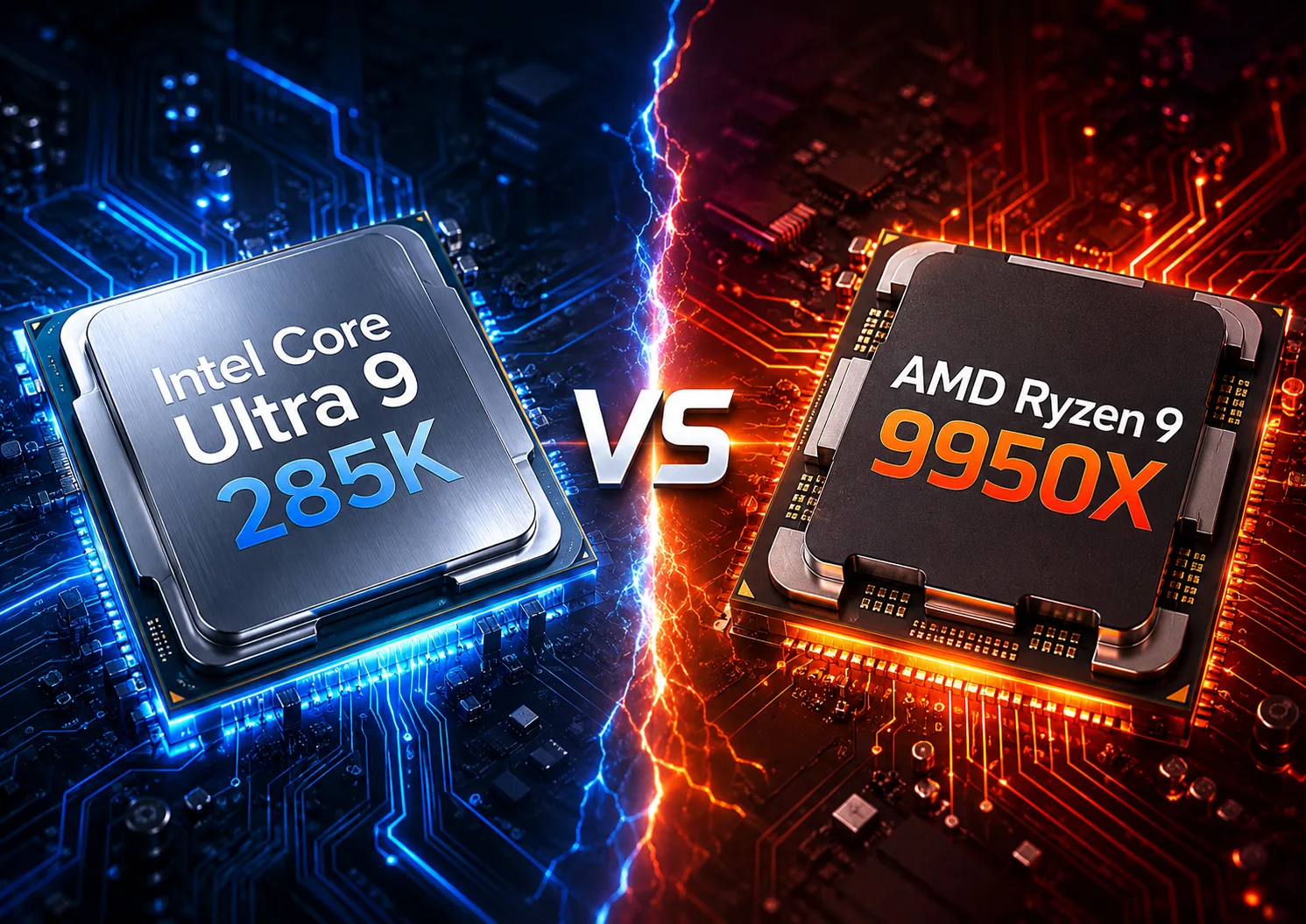
Intel Core Ultra 9 285K
vs
AMD Ryzen 9 9950X
vs

CPU Comparison Result

Intel Core Ultra 9 285K vs AMD Ryzen 9 9950X: Choosing a Laptop Flagship

Choosing a high-end laptop often comes down to the heart of the system - the processor. In the realm of absolute flagships for mobile platforms, two solutions currently dominate: the Intel Core Ultra 9 285K and the AMD Ryzen 9 9950X. Both chips are positioned as the peak of performance, but their architecture, design approach, and strengths differ significantly. In this article, we will analyze each aspect in detail to help determine which processor is better suited for your needs.

Architecture and Manufacturing Process

The differences between the competitors begin at a fundamental level.

Intel Core Ultra 9 285K is built on a hybrid architecture called Intel Core Ultra (codename Meteor Lake). Its structure includes heterogeneous compute modules:

  • Performance-core (P-cores): High-performance cores of the Redwood Cove architecture, responsible for the most demanding tasks.
  • Efficient-core (E-cores): Energy-efficient Crestmont cores that handle background and less complex processes, reducing overall power consumption.
  • AI Coprocessor (NPU): A dedicated unit to accelerate AI tasks, offloading work from the CPU and GPU.
  • Integrated GPU: The Intel Arc graphics core, based on the Xe-LPG architecture, provides a significant performance boost compared to previous generations of Intel integrated graphics.
  • Manufacturing Process: Utilizes the Foveros 3D technology, combining chips manufactured using different processes (such as Intel 4).

AMD Ryzen 9 9950X features the new Zen 5 architecture, produced using an optimized 4nm process by TSMC. Its approach is different:

  • Architecture: High-performance Zen 5 cores. A heterogeneous configuration with different types of cores (like Intel) is unnecessary here, as Zen 5 cores are inherently energy-efficient.
  • Cache Memory: AMD typically offers a large amount of L3 cache, which is important for gaming and a range of professional applications.
  • Integrated Graphics: Features the updated RDNA 3.5 (RDNA 3+) architecture, delivering high performance for integrated graphics.
  • AI: Supports AI instruction sets and potential integration of a dedicated NPU (based on XDNA 2), similar to Intel's AI Boost.

The key distinction: Intel focuses on task division between different types of cores and a powerful NPU, while AMD relies on a homogeneous architecture consisting of equally high-performing last-generation cores.

Power Consumption and Thermal Design Power (TDP)

This is a critical parameter for a laptop, directly affecting system design, cooling noise levels, and battery life.

Both processors belong to high-performance mobile HX-series. Their nominal thermal design power (TDP) typically starts at 55-65W, but in turbo modes (cTDP up), it can reach 100-120W or more to unlock maximum performance.

  • Intel Core Ultra 9 285K: The hybrid architecture theoretically offers better energy efficiency under mixed and light loads. E-cores take on background tasks, allowing P-cores to operate at lower frequencies or be turned off. However, under sustained heavy load across all cores, power consumption can be very high, necessitating robust cooling systems.
  • AMD Ryzen 9 9950X: The Zen 5 architecture claims significant advancements in performance per watt (IPC). In practice, this may mean that at equal levels of multi-core performance, the Ryzen 9 consumes less power or can deliver greater computational power at the same power envelope.

Conclusion: For slim workstations or powerful ultrabooks, where balancing performance and thermal output is essential, Ryzen 9 9950X may be preferable. For larger gaming laptops or mobile workstations with strong cooling solutions, both processors can be fully utilized.

Real-World Performance

Office Work and Web Browsing: For these tasks, both processors are overkill. Either will provide instant system responsiveness. The difference may be noticeable in battery life, as the more energy-efficient architecture allows the laptop to run longer.

Multimedia and Content Creation:

  • Video Encoding/Decoding: Both chips support modern hardware codecs (AV1, H.264/265, VP9). Performance will be similar, with minor variations depending on software optimization.
  • Photo Editors (Photoshop, Lightroom): High single-thread performance and responsiveness are critical here. Both processors will deliver excellent results.
  • 3D Rendering, Code Compilation, Complex Calculations: This is the domain of multi-core performance. With the same number of cores and threads, the advantage will go to the processor with higher IPC and effective memory management.

Gaming:

  • With a Discrete GPU (NVIDIA RTX/AMD Radeon): In most modern games at high resolutions, the main load falls on the graphics card. The difference between flagship CPUs will be minimal. However, in less demanding or esports titles, a processor with higher single-thread performance and larger cache may provide higher FPS.
  • With Integrated Graphics (iGPU): Intel Arc and AMD RDNA 3.5 offer performance levels that allow comfortable gaming at Full HD on low and medium settings. The specific leader depends on driver and game optimizations.

Use Cases: Who Needs Such a Processor?

These processors are aimed at demanding users:

  1. Content Creation Professionals: Video editors, 3D artists, architects, engineers, programmers. Multi-core performance is critical for them.
  2. Demanding Gamers: Those who seek maximum FPS in CPU-intensive games or build systems without limits for top-tier GPUs.
  3. Users Working with AI Locally: For running local LLMs, neural network models for image or video processing. Dedicated AI accelerators (NPU) can provide a substantial performance boost.
  4. Enthusiasts: Those needing the latest and most powerful laptop without regard to price.

For everyday tasks, office work, and moderate gaming, these processors are excessive. Consider lower-tier models (Core Ultra 7 or Ryzen 7) for savings.

Battery Life and Power-Saving Technologies

Battery life depends on the battery capacity, display, OS optimization, and processor.

  • Intel Core Ultra 9 285K: The hybrid architecture and the presence of low-voltage E-cores are geared toward energy efficiency. In idle or light workloads, the system can primarily run on E-cores and the NPU, saving charge.
  • AMD Ryzen 9 9950X: The platform traditionally demonstrates good battery life due to the efficient Zen cores. Precision power management technologies for each core minimize consumption.

General Advice: Maximum battery life can be expected in laptops with large batteries (90+ Wh) and energy-efficient components (LPDDR5x memory, variable refresh rate displays). In larger gaming laptops, battery life rarely exceeds 3-4 hours with active usage.

Comparison with Competitors and Previous Generations

  • Previous Generation (Intel 13th/14th Gen HX, AMD Ryzen 9 7945HX): New processors offer IPC gains, more advanced iGPUs, support for the latest communication standards, and dedicated NPUs for AI tasks.
  • Apple M3 Max: A direct competitor in the segment of powerful mobile workstations, showcasing outstanding energy efficiency and performance in ARM-optimized applications, but operating within the macOS ecosystem.
  • Lower Models (Core Ultra 7, Ryzen 7): Often provide 90-95% of flagship performance in multi-threaded tasks and identical performance in games, but at lower costs and with reduced heat generation. This is a reasonable compromise for most users.

Pros and Cons

Intel Core Ultra 9 285K: Pros:

  • Dedicated NPU for AI tasks.
  • Powerful integrated Arc graphics core.
  • Hybrid architecture potentially more efficient under mixed loads.
  • Broad support and optimization from software developers.

Cons:

  • May lag in pure multi-threaded performance and efficiency per watt compared to the competitor.
  • Highly dependent on the quality of the cooling system implementation in specific laptops.

AMD Ryzen 9 9950X: Pros:

  • Zen 5 architecture promises significant IPC gains and better performance per watt.
  • Large cache size positively impacts gaming and various applications.
  • Traditionally strong performance in multi-threaded workloads.
  • Integrated RDNA 3.5 graphics performs well.

Cons:

  • AI acceleration may be implemented differently than Intel's dedicated NPU.
  • In the past, top AMD chips were less frequently found in flagship laptop models, although this is changing.

Recommendations for Laptop Selection

Choosing a processor is just the first step. The laptop it is housed in is equally important.

  1. Device Type:
  • Power Workstation / Gaming Laptop (17-18 inches): Here, both processors will be fully utilized. Look for models with effective cooling systems (preferably with vapor chambers), high-frequency DDR5 memory, fast PCIe 4.0/5.0 storage, and powerful discrete graphics cards.
  • Slim Workstation / Professional Ultrabook (14-16 inches): Prioritize a balance between weight, thickness, battery life, and performance. Key parameters include a high-quality display, large battery, and Thunderbolt 4/USB4 ports.
  1. What to Pay Attention To:
  • Cooling: Check reviews that focus on temperature and noise under load.
  • Screen: For color work - high color coverage (100% sRGB/DCI-P3), for gaming - high refresh rate (144Hz and above).
  • Upgradability: The ability to increase RAM and replace the SSD will extend the laptop's lifespan.
  • Ports: Availability of necessary interfaces (USB-A, HDMI, card reader).
  • Brand and Warranty: The level of service support in your region.

Final Conclusion

Choosing between Intel Core Ultra 9 285K and AMD Ryzen 9 9950X is a decision between two different approaches to achieving maximum performance.

  • Choose Intel Core Ultra 9 285K if: You believe in the future of local AI tasks and want a dedicated accelerator (NPU) for them. You value powerful integrated graphics or prefer a brand with a long-standing market presence. Your workflow involves mixed, not always fully loading all cores tasks.

  • Choose AMD Ryzen 9 9950X if: Your priority is absolute multi-threaded performance in traditional workloads (rendering, compilation, encoding) and better performance per watt. You are a gamer aiming for maximum FPS in CPU-intensive games. You seek an optimal balance of power and battery life in a thinner form factor.

Both processors are outstanding engineering solutions, and a laptop based on either will be a powerful tool for years to come. The key to success is a clear understanding of your tasks and a careful selection of the specific laptop model, as even the best processor may not realize its potential in a poorly designed system.

Advantages

  • More Total Cores: 24 (24 vs 16)
  • Higher Technology: 3 nm (3 nm vs TSMC 4nm FinFET)
  • Newer Launch Date: December 2024 (December 2024 vs August 2024)
  • Larger L3 Cache: 64 MB (36 MB shared vs 64 MB)

Basic

Intel
Label Name
AMD
December 2024
Launch Date
August 2024
Desktop
Platform
Desktop
Core Ultra 9 285K
Model Name
?
The Intel processor number is just one of several factors - along with processor brand, system configurations, and system-level benchmarks - to be considered when choosing the right processor for your computing needs.
Ryzen 9 9950X
Arrow Lake-S
Code Name
Granite Ridge AM5
Intel
Foundry
-
Ultra 9 (Arrow Lake-S)
Generation
Zen 5

CPU Specifications

24
Total Cores
?
Cores is a hardware term that describes the number of independent central processing units in a single computing component (die or chip).
16
24
Total Threads
?
Where applicable, Intel® Hyper-Threading Technology is only available on Performance-cores.
32
8
Performance-cores
-
16
Efficient-cores
-
-
Basic Frequency
4.3 GHz
-
Max Turbo Frequency
?
Max Turbo Frequency is the maximum single-core frequency at which the processor is capable of operating using Intel® Turbo Boost Technology and, if present, Intel® Turbo Boost Max Technology 3.0 and Intel® Thermal Velocity Boost. Frequency is typically measured in gigahertz (GHz), or billion cycles per second.
Up to 5.7 GHz
3.3 GHz
Performance-core Base Frequency
-
1 GHz
Efficient-core Base Frequency
-
5.7 GHz
Performance-core Max Turbo Frequency
?
Maximum P-core turbo frequency derived from Intel® Turbo Boost Technology.
-
4.6 GHz
Efficient-core Max Turbo Frequency
?
Maximum E-core turbo frequency derived from Intel® Turbo Boost Technology.
-
112 KB per core
L1 Cache
1280 KB
24 MB
L2 Cache
16 MB
36 MB shared
L3 Cache
64 MB
-
Unlocked for Overclocking
?
AMD`s product warranty does not cover damages caused by overclocking, even when overclocking is enabled via AMD hardware and/or software. GD-26.
Yes
Yes
Unlocked Multiplier
-
32
Multiplier
-
100 MHz
Bus Frequency
-
Intel Socket 1851
CPU Socket
?
The socket is the component that provides the mechanical and electrical connections between the processor and motherboard.
AM5
3 nm
Technology
?
Lithography refers to the semiconductor technology used to manufacture an integrated circuit, and is reported in nanometer (nm), indicative of the size of features built on the semiconductor.
TSMC 4nm FinFET
125 W
TDP
170W
105 °C
Max. Operating Temperature
?
Junction Temperature is the maximum temperature allowed at the processor die.
95°C
5
PCIe Version
?
PCI Express is a high-speed serial computer expansion bus standard used for connecting high-speed components, replacing older standards such as AGP, PCI, and PCI-X. It has gone through multiple revisions and improvements since its initial release. PCIe 1.0 was first introduced in 2002, and in order to meet the growing demand for higher bandwidth, subsequent versions have been released over time.
-
-
PCI Express Version
?
PCI Express Revision is the supported version of the PCI Express standard. Peripheral Component Interconnect Express (or PCIe) is a high-speed serial computer expansion bus standard for attaching hardware devices to a computer. The different PCI Express versions support different data rates.
PCIe® 5.0
-
Instruction Set
?
The instruction set is a hard program stored inside the CPU that guides and optimizes CPU operations. With these instruction sets, the CPU can run more efficiently. There are many manufacturers that design CPUs, which results in different instruction sets, such as the 8086 instruction set for the Intel camp and the RISC instruction set for the ARM camp. x86, ARM v8, and MIPS are all codes for instruction sets. Instruction sets can be extended; for example, x86 added 64-bit support to create x86-64. Manufacturers developing CPUs that are compatible with a certain instruction set need authorization from the instruction set patent holder. A typical example is Intel authorizing AMD, enabling the latter to develop CPUs compatible with the x86 instruction set.
x86-64

Memory Specifications

DDR5-6400
Memory Type
?
Intel® processors come in four different types: Single Channel, Dual Channel, Triple Channel, and Flex Mode. Maximum supported memory speed may be lower when populating multiple DIMMs per channel on products that support multiple memory channels.
DDR5
256 GB
Max Memory Size
?
Max memory size refers to the maximum memory capacity supported by the processor.
256 GB
2
Memory Channels
?
The number of memory channels refers to the bandwidth operation for real world application.
2
-
Maximum Memory Speed
2x1R DDR5-5600, 2x2R DDR5-5600, 4x1R DDR5-3600, 4x2R DDR5-3600
102.4 GB/s
Max Memory Bandwidth
?
Max Memory bandwidth is the maximum rate at which data can be read from or stored into a semiconductor memory by the processor (in GB/s).
-
Yes
ECC Memory Support
Yes (Requires mobo support)

GPU Specifications

true
Integrated Graphics Model
?
An integrated GPU refers to the graphics core that is integrated into the CPU processor. Leveraging the processor's powerful computational capabilities and intelligent power efficiency management, it delivers outstanding graphics performance and a smooth application experience at a lower power consumption.
AMD Radeon™ Graphics
-
Graphics Frequency
?
Graphics max dynamic frequency refers to the maximum opportunistic graphics render clock frequency (in MHz) that can be supported using Intel® HD Graphics with Dynamic Frequency feature.
2200 MHz
1800 MHz
GPU Max Dynamic Frequency
-
600 MHz
GPU Base Frequency
-
-
Graphics Core Count
2
4
Execution Units
?
The Execution Unit is the foundational building block of Intel’s graphics architecture. Execution Units are compute processors optimized for simultaneous Multi-Threading for high throughput compute power.
-
1.79 TFLOPS
Graphics Performance
-

Miscellaneous

-
Official Website
-
OS Support
Windows 11 - 64-Bit Edition, Windows 10 - 64-Bit Edition, RHEL x86 64-Bit, Ubuntu x86 64-Bit

Benchmarks

Geekbench 6 Single Core
Core Ultra 9 285K
3450 +3%
Ryzen 9 9950X
3359
Geekbench 6 Multi Core
Core Ultra 9 285K
23006 +12%
Ryzen 9 9950X
20550
Passmark CPU Single Core
Core Ultra 9 285K
5268 +12%
Ryzen 9 9950X
4717
Passmark CPU Multi Core
Core Ultra 9 285K
46872
Ryzen 9 9950X
66918 +43%