Intel Core Ultra 7 270K Plus
vs
AMD Ryzen 9 9900X


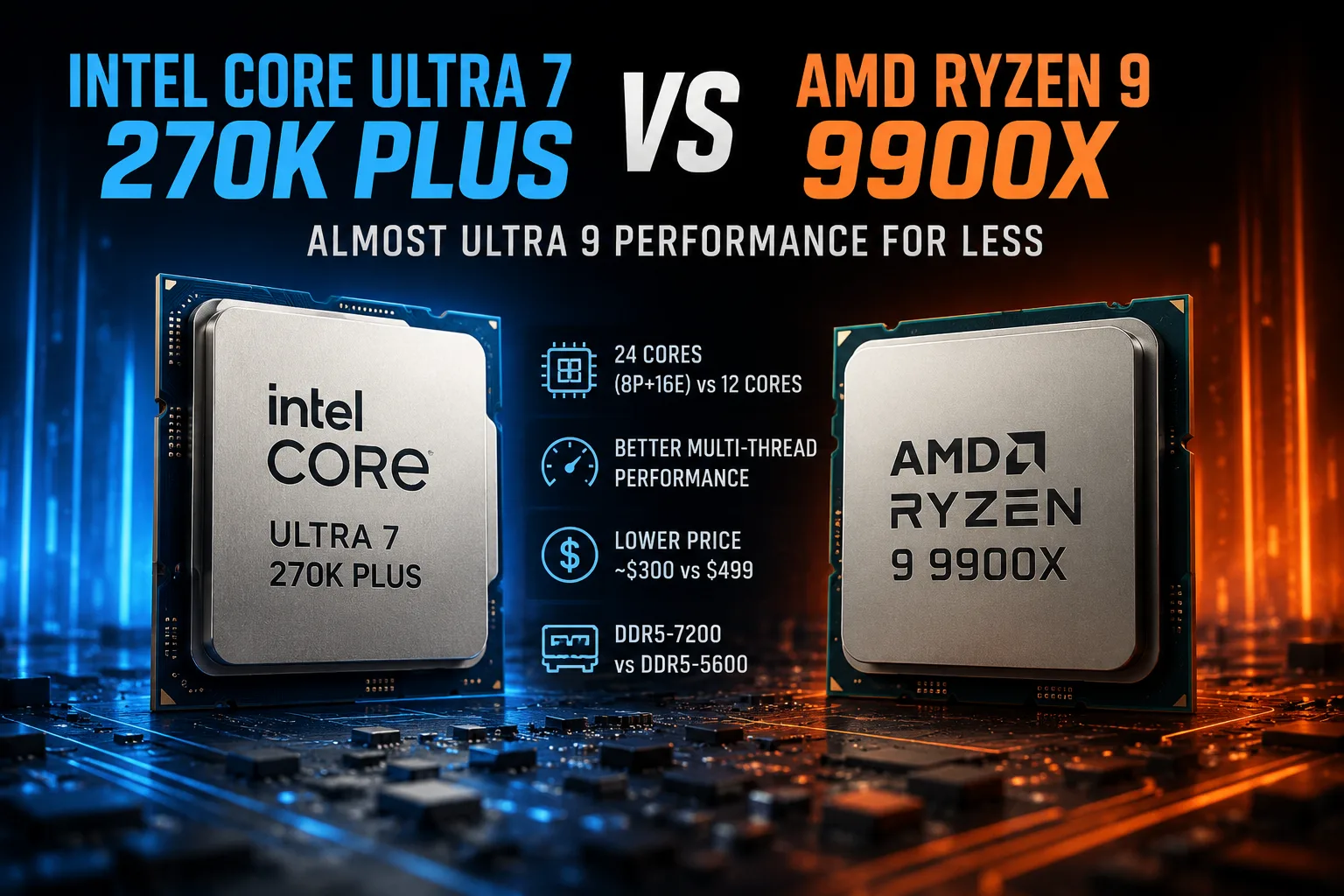
CPU Comparison Result
Intel Core Ultra 7 270K Plus vs Ryzen 9 9900X: Almost Ultra 9 for Less Money
Two years ago, the Ryzen 9 9900X sat significantly higher than the Core Ultra 7 in the model hierarchy. With the release of the 270K Plus, that boundary has almost vanished. The new Intel processor features the same 8 P-cores, 16 E-cores, and 36 MB of L3 cache as the previous flagship Core Ultra 9 285K, but starts at around $300. In terms of configuration, it is almost the previous Ultra 9 under the Ultra 7 name-cheaper than the Ryzen 9 9900X and significantly faster in well-parallelizable workloads.
Key Differences
| Specification | Intel Core Ultra 7 270K Plus | AMD Ryzen 9 9900X |
|---|---|---|
| Architecture | Arrow Lake-S Refresh | Zen 5, Granite Ridge |
| Launch | March 2026 | August 2024 |
| Cores / Threads | 24 / 24 | 12 / 24 |
| Configuration | 8P + 16E | 12 Zen 5 Cores |
| Max Frequency | 5.5 GHz | 5.6 GHz |
| L2 Cache | 40 MB | 12 MB |
| L3 Cache | 36 MB | 64 MB |
| Base Power / TDP | 125 W | 120 W |
| Max Turbo Power | 250 W | - |
| Memory | Up to DDR5-7200 | Up to DDR5-5600 |
| Socket | LGA1851 | AM5 |
| Launch Price | Around $299 | $499 |
| Integrated Graphics | Intel Graphics | Radeon Graphics |
| NPU | Intel AI Boost, 13 TOPS | None |
The same 24 threads here are achieved in different ways. Ryzen uses 12 Zen 5 cores with SMT, while Intel combines eight P-cores and sixteen E-cores without Hyper-Threading. Therefore, you cannot directly compare Intel's 24 cores to AMD's 12 cores.
What Changed in Core Ultra 7 270K Plus
The standard Core Ultra 7 265K had 20 cores in a 8P + 12E configuration and 30 MB of L3 cache. In the 270K Plus, Intel increased the number of E-cores from 12 to 16 while also expanding the L3 cache to 36 MB.
Simultaneously, the inter-die connection speed was increased, and official memory support was raised from DDR5-6400 to DDR5-7200. The architecture of the CPU cores remains unchanged-it is still Arrow Lake.
The main difference is revealed when comparing it with the Core Ultra 9 285K.
| Processor | P-cores | E-cores | Total Cores | L3 | Max Turbo |
|---|---|---|---|---|---|
| Core Ultra 7 265K | 8 | 12 | 20 | 30 MB | 5.5 GHz |
| Core Ultra 7 270K Plus | 8 | 16 | 24 | 36 MB | 5.5 GHz |
| Core Ultra 9 285K | 8 | 16 | 24 | 36 MB | 5.7 GHz |
The 270K Plus has the same number of P-cores, E-cores, and the same amount of L3 as the previous flagship Core Ultra 9 285K. Frequencies are lower, but in terms of cores and cache size, it is much closer to the 285K than to the 265K.
This is not just a cosmetic frequency update: Intel added four E-cores and 6 MB of L3. Essentially, the 24-core configuration of the previous Ultra 9 migrated to the Ultra 7 series.
Price: The Configuration of the Previous Ultra 9 is Significantly Cheaper
The Ryzen 9 9900X appeared in 2024 with a recommended price of $499. The Core Ultra 7 270K Plus launched for around $299.
Later, the official price range for Intel increased to about $339-349, but even after the increase, the 270K Plus remains cheaper than the Ryzen 9 9900X.
| Price | Core Ultra 7 270K Plus | Ryzen 9 9900X |
|---|---|---|
| At launch | Around $299 | $499 |
| Official price level in 2026 | Around $339-349 | Around $439 |
The previous Core Ultra 9 285K utilizes the same 8P + 16E and 36 MB of L3, but operates at higher frequencies and belongs to a more expensive segment.
Over two years, the performance level of the Ryzen 9 has effectively descended into a cheaper price class. The new Ultra 7 not only catches up with the old Ryzen 9: it is noticeably faster in multi-threaded tasks and comes at a lower price.
Performance
| Benchmark | Core Ultra 7 270K Plus | Ryzen 9 9900X | Difference |
|---|---|---|---|
| Geekbench 6 Single-Core | 3424 | 3401 | Intel +1% |
| Geekbench 6 Multi-Core | 23,783 | 19,756 | Intel +20% |
| PassMark Single Thread | 5093 | 4652 | Intel +9% |
| PassMark CPU Mark | 66,677 | 53,863 | Intel +24% |
| 3DMark CPU Profile 1 Thread | 1355 | 1284 | Intel +6% |
| 3DMark CPU Profile Max Threads | 19,323 | 13,832 | Intel +40% |
In single-threaded performance, the CPUs are close. Geekbench 6 shows nearly complete parity, while PassMark and 3DMark give Intel a slight edge.
In multi-threaded performance, the gap becomes noticeable. In Geekbench 6 Multi-Core, the 270K Plus is about 20% faster, while in PassMark CPU Mark, it is around 24% faster. In 3DMark CPU Profile Max Threads, the difference reaches about 40%.
This last result should not be generalized across all programs. It primarily demonstrates how effectively Intel utilizes all 24 cores under full load.
Geekbench 6 on Specific Systems
Testing specific systems shows how results depend on memory, motherboard, BIOS, and power limits.
| Processor | System / Motherboard | Memory | Geekbench 6 Single | Geekbench 6 Multi |
|---|---|---|---|---|
| Core Ultra 7 270K Plus | ASUS ROG STRIX Z890-E Gaming WiFi | 32 GB DDR5-7000 | 3382 | 24,101 |
| Core Ultra 7 270K Plus | ASRock Z890 Taichi | 32 GB DDR5 | 3337 | 23,535 |
| Core Ultra 7 270K Plus | MSI PRO B860M-P WiFi 6E | 16 GB DDR5-5200 | 3258 | 19,566 |
| Ryzen 9 9900X | ASUS ROG STRIX X870-A Gaming WiFi | 32 GB DDR5-6000 | 3473 | 20,968 |
| Ryzen 9 9900X | MSI PRO X870-P WiFi | 32 GB DDR5-6000 | 3416 | 20,214 |
| Ryzen 9 9900X | HP OMEN MAX 45L GT23 | 128 GB DDR5-5186 | 3209 | 17,483 |
This is not a direct comparison under identical conditions, so the differences between rows cannot solely be attributed to the CPU.
The Ryzen 9 9900X is capable of slightly outperforming in single-threaded tasks: the system on ROG STRIX X870-A scored 3473 points compared to 3382 for the 270K Plus on ROG STRIX Z890-E.
In multi-threaded testing, the advantage tilts to Intel. Good configurations with the 270K Plus score about 23,500 to 24,100 points, while fast systems with Ryzen 9 9900X hit around 20,000 to 21,000 points.
A system with the 270K Plus on MSI PRO B860M-P and DDR5-5200 only scored 19,600 points in Multi-Core. The difference compared to the system on Z890 exceeds 20%, so memory, motherboard, BIOS, and power mode significantly impact results.
Gaming
The multi-threaded advantage of Intel does not translate into the same advantage in gaming.
Games rarely load all 24 cores effectively enough to repeat the 20-40% gap seen in multi-threaded tests. Here, the speed of individual cores, memory latency, engine characteristics, and the graphics card are more important.
Intel claims a noticeable increase in gaming performance of the 270K Plus compared to the standard Core Ultra 7 265K. In some games, the Intel Binary Optimization Tool is also used, so the claimed improvement cannot be considered uniform across all projects.
There is currently insufficient independent testing of this pair for a confident conclusion regarding gaming performance. For a purely gaming PC, Intel's multi-threaded advantage of 20-40% should not dictate the choice.
Workloads
In workloads, the advantage of Intel is expressed much stronger.
The Ryzen 9 9900X features 12 Zen 5 cores, 24 threads, and 64 MB of L3 cache. High per-core performance helps AMD in tasks with a moderate number of threads.
Under full multi-threaded load, the 8P + 16E configuration from Intel is faster. This is confirmed by Geekbench Multi-Core, PassMark CPU Mark, and 3DMark CPU Profile.
For CPU rendering, compiling, video encoding, and heavy multitasking, the Core Ultra 7 270K Plus appears stronger than the Ryzen 9 9900X. Moreover, Intel achieves this at a lower CPU price.
Memory and Platform
The 270K Plus officially supports DDR5-7200, while for the Ryzen 9 9900X, AMD specifies DDR5-5600 when using two modules.
In practice, AM5 systems often utilize faster memory with EXPO, so the official DDR5 frequency alone says little about performance.
The total cost of the entire platform is far more important.
The Ryzen 9 9900X runs on AM5 and is compatible with a large number of motherboards across multiple generations. For an AM5 system owner, this is a significant advantage: you only need to replace the CPU.
The Core Ultra 7 270K Plus uses LGA1851 and motherboards on Intel's 800 series chipsets. Transitioning to it is also not difficult for an owner of a system on Arrow Lake, but moving from AM5 will require replacing the motherboard.
Thus, the price advantage of the 270K Plus is primarily evident when building a PC from scratch. For an AM5 owner, a simple upgrade to the 9900X may be cheaper.
Power Consumption and Cooling
The base power of the Core Ultra 7 270K Plus is 125 W, while the maximum Turbo Power is 250 W. The Ryzen 9 9900X has a stated TDP of 120 W.
These values cannot be directly compared due to different methodologies used by Intel and AMD, but both processors require adequate cooling.
The main advantage of the 270K Plus becomes evident under full multi-threaded load, so overly strict power limits or a weak cooler can significantly reduce its lead over the 9900X.
The variation in Geekbench results illustrates this in practice: the same model in different systems can yield significantly different performance.
NPU
The Core Ultra 7 270K Plus features Intel AI Boost with a performance of 13 TOPS, while the Ryzen 9 9900X does not have a separate NPU.
For a desktop PC of this level, this is currently a secondary advantage. The NPU can accelerate supported AI functions, but heavy local neural network tasks are much more efficiently performed on a powerful discrete graphics card.
Conclusion
The Core Ultra 7 270K Plus is much closer to the old Ultra 9 than to the regular 265K. Intel retained 8 P-cores, added 16 E-cores, and increased L3 to 36 MB-giving the Ultra 7 the same base configuration that the Core Ultra 9 285K had, but with slightly lower frequencies.
In single-threaded tasks, the Ryzen 9 9900X stays competitive, while under full multi-threaded load, Intel can achieve gains of 20% or more-doing so at a lower processor price.
The Ryzen 9 9900X still has a strong argument-AM5. For an owner of a compatible motherboard, the upgrade to the 9900X may be cheaper than switching to LGA1851. Additionally, the advantages of the 270K Plus from multi-threaded tests do not translate to the same degree in gaming.
However, when building a new system focused on rendering, compiling, encoding, and other multi-threaded workloads, the choice shifts towards Intel. In terms of price and multi-threaded performance, the Core Ultra 7 270K Plus is one of the strongest offerings among desktop processors in 2026.
Advantages
- More Total Cores: 24 (24 vs 12)
- Higher Technology: 3 nm (3 nm vs TSMC 4nm FinFET)
- Newer Launch Date: March 2026 (March 2026 vs August 2024)
- Larger L3 Cache: 64 MB (36 MB shared vs 64 MB)
Basic
CPU Specifications
Memory Specifications
GPU Specifications
Interfaces and Ports
Miscellaneous
Benchmarks
Related CPU Comparisons


Share in social media
Or Link To Us
<a href="https://cputronic.com/cpu/compare/intel-core-ultra-7-270k-plus-vs-amd-ryzen-9-9900x" target="_blank">Intel Core Ultra 7 270K Plus vs AMD Ryzen 9 9900X</a>