AMD Ryzen 7 9700X
vs
AMD Ryzen 7 7800X3D
CPU Comparison Result
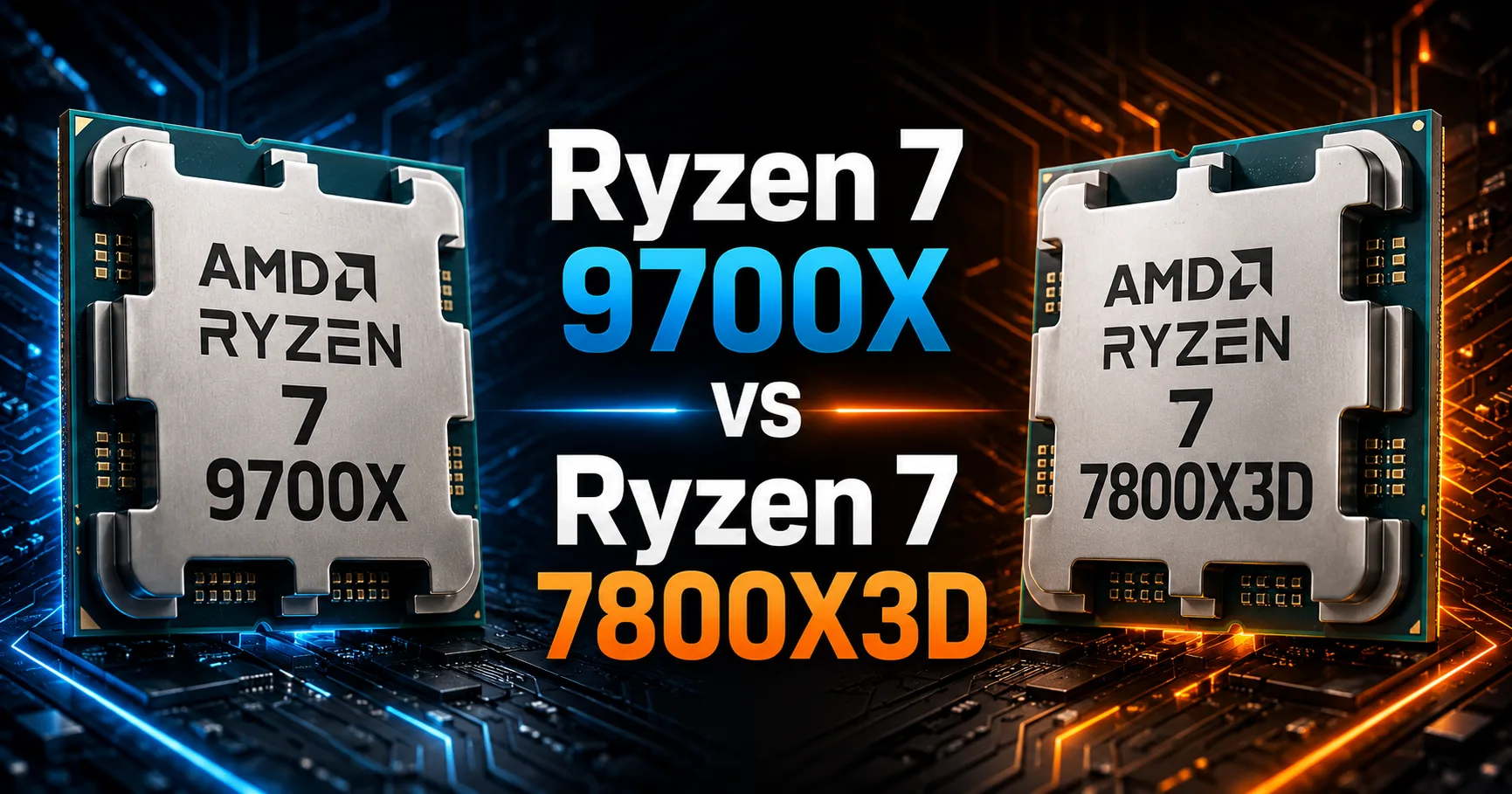
AMD Ryzen 7 9700X vs Ryzen 7 7800X3D: Zen 5 vs 3D V-Cache
AMD Ryzen 7 9700X and Ryzen 7 7800X3D are two 8-core processors for the AM5 platform, but they are designed for different tasks. The Ryzen 7 9700X focuses on the new Zen 5 architecture, low power consumption, and versatile performance. In contrast, the Ryzen 7 7800X3D is based on Zen 4 but gains a significant gaming advantage thanks to its 3D V-Cache and 96 MB of L3 cache.
This is not a comparison of “new vs old.” Rather, it’s a choice between a versatile modern processor and a specialized gaming chip.
Quick Summary
Ryzen 7 7800X3D is generally better for gaming builds. The large L3 cache aids in CPU-dependent games, enhancing FPS stability and performing particularly well at 1080p and 1440p with a powerful graphics card.
Ryzen 7 9700X is better suited for a general-purpose PC. It boasts a newer architecture, is more energy-efficient, simpler to cool, and excels in everyday tasks, single-threaded performance, and various workloads.
In short: for gaming - Ryzen 7 7800X3D; for a balanced and quiet system - Ryzen 7 9700X.
Key Differences
The Ryzen 7 9700X belongs to the Ryzen 9000 series and is built on the Zen 5 architecture. It features 8 cores, 16 threads, 32 MB of L3 cache, and a TDP of 65 W. This fast and efficient processor is ideal for those who want a modern CPU without excessive heat and complex cooling solutions.
The Ryzen 7 7800X3D is part of the Ryzen 7000 series and utilizes Zen 4 architecture. Its main feature is the 3D V-Cache technology. Thanks to the additional cache, the total L3 cache reaches 96 MB. In gaming scenarios, this often outweighs the benefits of a newer architecture or higher clock speeds.
The large cache is especially useful in strategy games, simulators, MMOs, competitive gaming, and certain AAA titles where the processor frequently accesses the same data.
Gaming Performance
In gaming, the Ryzen 7 7800X3D generally appears stronger. Its 96 MB of L3 cache helps reduce latency and lessens dependence on RAM. This can result in not only higher average FPS but also more stable 1% lows, less stutter, and micro-freezes.
The Ryzen 7 9700X remains a fast gaming processor. It is well-suited for modern games, but with a top-tier graphics card at 1080p and 1440p, it will usually lag behind the 7800X3D.
At 4K, the difference often diminishes: the load frequently hits the graphics card bottleneck. Therefore, for a 4K build, it’s more important to consider the CPU price, GPU level, and overall budget.
Work Tasks and Everyday Speed
For work tasks, the Ryzen 7 9700X looks like a more versatile choice. The Zen 5 architecture, high single-thread performance, and 65 W TDP make it an excellent option for programming, photo processing, office tasks, archiving, light video editing, and everyday multitasking.
The Ryzen 7 7800X3D is also fast, but its advantages don’t always manifest. The 3D V-Cache is great for gaming, but in general work applications, the large cache doesn’t always offer a performance boost. In some tasks, the 9700X may be faster due to its newer architecture and higher clock speeds.
For browsing, video, messaging apps, and office software, both processors are excessively powerful. The difference is more significant in gaming, heavy applications, and cooling considerations.
Power Consumption and Cooling
The Ryzen 7 9700X is easier to cool. With a TDP of 65 W, a good quality tower cooler is generally sufficient. This makes it a solid choice for quiet builds, compact cases, or PCs that need to run cool.
The Ryzen 7 7800X3D has a TDP of 120 W. It doesn’t require extreme cooling, but a good tower cooler or AIO (All-In-One) liquid cooler is advisable. Proper case airflow is also important.
If silence, low power consumption, and ease of assembly are priorities, the advantage goes to the Ryzen 7 9700X. If gaming FPS is more critical, the Ryzen 7 7800X3D justifies a more serious approach to cooling.
Integrated Graphics
Both processors come with basic AMD Radeon Graphics integrated. While this is not intended for serious gaming, it is useful for display output, diagnostics, office work, and temporarily running a PC without a discrete graphics card.
For a gaming build, a discrete graphics card is still essential. Without it, the value of the Ryzen 7 7800X3D is nearly lost.
What to Choose
| Scenario | Better Choice | Why |
|---|---|---|
| Gaming PC with a powerful GPU | Ryzen 7 7800X3D | 96 MB L3 and 3D V-Cache help in gaming |
| Versatile PC for gaming and work | Ryzen 7 9700X | Zen 5, low TDP, and good overall performance |
| Gaming at 1080p and 1440p | Ryzen 7 7800X3D | Processor significantly affects FPS |
| Gaming at 4K | Depends on price | Often the limiting factor is the graphics card |
| Quiet or compact build | Ryzen 7 9700X | 65 W TDP and easier cooling |
| Coding, photo, office, light editing | Ryzen 7 9700X | A more versatile and energy-efficient CPU |
| Maximum FPS in this pair | Ryzen 7 7800X3D | Large cache performs better in games |
Pros and Cons of Ryzen 7 9700X
Pros:
- Zen 5 architecture;
- Low TDP of 65 W;
- Good energy efficiency;
- High single-thread performance;
- Easier to cool;
- Suitable for quiet and compact builds;
- Comes with basic integrated graphics.
Cons:
- Often lags behind the Ryzen 7 7800X3D in games;
- 32 MB L3 versus 96 MB in the 7800X3D;
- Not always the most cost-effective choice for a purely gaming build.
Pros and Cons of Ryzen 7 7800X3D
Pros:
- Excellent gaming performance;
- 96 MB L3 cache;
- 3D V-Cache technology;
- Strong 1% lows in many games;
- A good choice for a powerful gaming build;
- Comes with basic integrated graphics.
Cons:
- Architecture is older than that of the Ryzen 7 9700X;
- TDP of 120 W;
- Not always faster than the 9700X in work tasks;
- Requires a more careful approach to cooling;
- Performs best with a good discrete graphics card.
Building Recommendations
Both processors use the AM5 platform and DDR5 memory. For most systems, a quality B650/B650E motherboard and a DDR5 kit with AMD EXPO profile will suffice.
For the Ryzen 7 9700X, a good tower cooler is sufficient. For the Ryzen 7 7800X3D, it’s better to get more efficient cooling and a case with good ventilation.
Conclusion
The Ryzen 7 9700X and Ryzen 7 7800X3D are robust 8-core processors, but they should be purchased for different tasks.
Ryzen 7 7800X3D is the better choice if the PC is primarily for gaming. It excels particularly at 1080p and 1440p with a powerful graphics card, where the 3D V-Cache helps achieve high FPS and smoother visuals.
Ryzen 7 9700X is better suited for a versatile computer. It runs cooler, is more energy-efficient, features a newer architecture, and performs well not only in gaming but also in work tasks.
The main guideline is simple: gaming maximum in this pair - Ryzen 7 7800X3D; versatility and efficiency - Ryzen 7 9700X.
Advantages
- Higher Max Turbo Frequency: Up to 5.5 GHz (Up to 5.5 GHz vs Up to 5 GHz)
- Higher Technology: TSMC 4nm FinFET (TSMC 4nm FinFET vs TSMC 5nm FinFET)
- Newer Launch Date: August 2024 (August 2024 vs April 2023)
- Larger L3 Cache: 96 MB (32 MB vs 96 MB)
Basic
CPU Specifications
Memory Specifications
GPU Specifications
Miscellaneous
Benchmarks
Related CPU Comparisons


Share in social media
Or Link To Us
<a href="https://cputronic.com/cpu/compare/amd-ryzen-7-9700x-vs-amd-ryzen-7-7800x3d" target="_blank">AMD Ryzen 7 9700X vs AMD Ryzen 7 7800X3D</a>