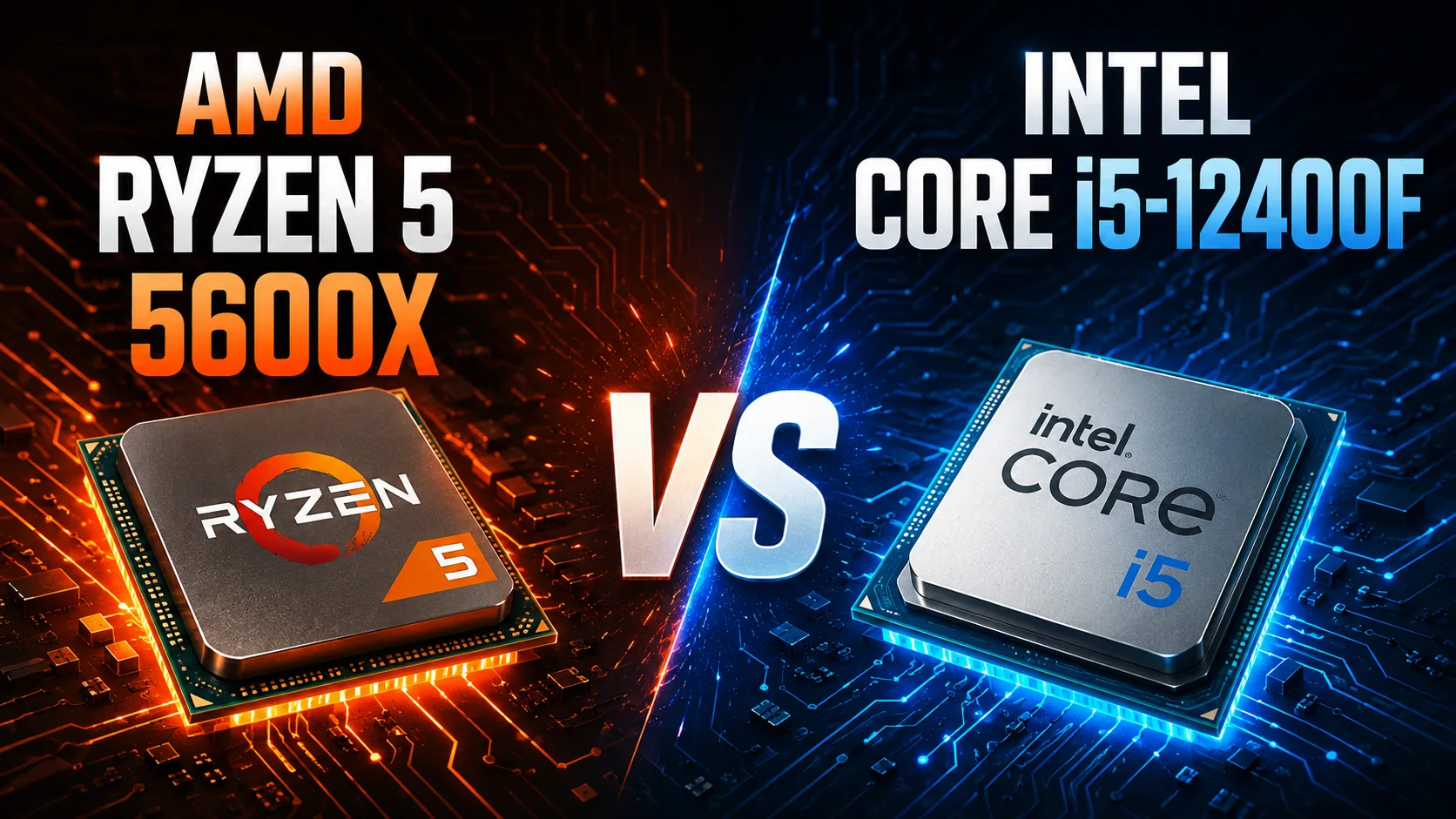
AMD Ryzen 5 5600X
vs
Intel Core i5-12400F
CPU Comparison Result
AMD Ryzen 5 5600X vs Intel Core i5-12400F - Which Processor to Choose
AMD Ryzen 5 5600X and Intel Core i5-12400F are similarly ranked 6-core processors for gaming and home PCs. Both have 6 cores and 12 threads, both require a discrete graphics card, and both are still suitable for an inexpensive build with a mid-range graphics card.
The main distinction is not in “pure speed”, but in the platform. Ryzen 5 5600X is more advantageous for AM4 upgrades, while Core i5-12400F is often more appealing for a new build, especially if the motherboard and memory bundle is reasonably priced.
Summary
Core i5-12400F is a good choice for a new budget or mid-range build. It is fast in games, supports DDR4 and DDR5, does not require overclocking, and works on the LGA1700 platform.
Ryzen 5 5600X is the better option if you already have an AM4 motherboard and DDR4 memory. In that case, you can simply replace the processor and significantly speed up an old system without buying a new platform.
If buying the processor separately, the difference between them is minor. If considering the entire setup, the winner depends on the cost of the motherboard, memory, and already owned components.
Key Specifications
| Specification | AMD Ryzen 5 5600X | Intel Core i5-12400F |
|---|---|---|
| Cores / Threads | 6 / 12 | 6 / 12 |
| Architecture | Zen 3 | Alder Lake |
| Frequencies | 3.7-4.6 GHz | 2.5-4.4 GHz |
| L3 Cache | 32 MB | 18 MB |
| Socket | AM4 | LGA1700 |
| Memory | DDR4-3200 | DDR4-3200 / DDR5-4800 |
| PCIe | PCIe 4.0 | PCIe 5.0 / 4.0 |
| Integrated Graphics | No | No |
| CPU Overclocking | Yes | No |
Ryzen 5 5600X stands out with its larger L3 cache, high base frequency, and overclocking capability. Core i5-12400F excels in strong single-core performance, DDR5 support, and more modern platform interfaces.
Gaming
In games, Ryzen 5 5600X and Core i5-12400F are very close. With graphics cards like the GeForce RTX 3060, RTX 4060, RTX 4060 Ti, Radeon RX 6600, RX 7600, or RX 7700 XT, the difference is often smaller than the difference between the GPUs themselves.
At 1080p on low settings, when the CPU load is heavier, Core i5-12400F is often a bit faster. But the lead is minor. Upgrading a complete AM4 system just for the i5-12400F usually does not make sense.
| Scenario | Best Choice |
|---|---|
| New build from scratch | Core i5-12400F |
| AM4-PC upgrade | Ryzen 5 5600X |
| Already have DDR4 and AM4 | Ryzen 5 5600X |
| LGA1700 bundle is cheaper | Core i5-12400F |
| Need max FPS on AM4 | Ryzen 7 5700X3D / 5800X3D |
Work Tasks
Both processors are suitable for browsing, office tasks, Photoshop, light editing, programming, gaming, and general multitasking.
Ryzen 5 5600X may be a bit more interesting in specific multithreaded tasks and cache-sensitive scenarios. Core i5-12400F is strong in single-thread performance and is well-suited for everyday tasks.
For heavy editing, 3D rendering, CPU streaming, or virtual machines, neither processor is the best choice. In such tasks, it's better to look at models with 8 cores and higher.
Platform Pricing
In this comparison, it’s not only the processor's price that matters. You need to consider the entire setup:
- processor;
- motherboard;
- RAM;
- cooler;
- potential future upgrades.
If you already have an AM4 motherboard and DDR4, Ryzen 5 5600X is almost always more cost-effective. This is a straightforward upgrade without extra expenses.
If it’s a new build, Core i5-12400F often looks stronger in terms of price-to-performance ratio. Especially with a budget B660/B760 motherboard and DDR4 memory. DDR5 isn't necessary for this processor: in a budget build, the extra cost is not always justified.
Platform and Upgrade
AM4 is an old but successful platform. Its main advantage is cheap upgrades. After Ryzen 5 5600X, you can upgrade to Ryzen 7 5700X3D or Ryzen 7 5800X3D if you need a more powerful gaming processor.
LGA1700 for Core i5-12400F is more modern in terms of interfaces: it supports DDR5 and PCIe 5.0. However, by 2026, it will no longer be a “future-proof” platform. Its advantage is the ability to upgrade to more powerful 13th or 14th generation Core processors with the right motherboard and BIOS.
PCIe 5.0 should not be overestimated. For mid-range graphics cards, it hardly affects FPS. In an actual build, the graphics card, memory, cooling, and the quality of the motherboard are more important.
Memory
Ryzen 5 5600X works with DDR4. The optimal option is a dual-channel kit of DDR4-3200 or DDR4-3600.
Core i5-12400F supports both DDR4 and DDR5, but the type of memory depends on the motherboard. For a budget build, it’s typically more sensible to choose DDR4. DDR5 makes sense if the price of the bundle is close to DDR4 or if further upgrades within LGA1700 are planned.
Integrated Graphics
Both processors lack integrated graphics. The Ryzen 5 5600X requires a discrete graphics card, while the F in Core i5-12400F indicates the absence of an integrated GPU.
If you need a PC without a separate graphics card, it’s better to look at the Core i5-12400 (without the F) or Ryzen 5 5600G. However, Ryzen 5 5600G is weaker in CPU performance and has less cache.
Power Consumption and Cooling
Both processors are quite energy-efficient. For a typical gaming build, a cheap 120 mm tower cooler will suffice. The stock cooler also handles it, but under prolonged load, it may be noisier.
Ryzen 5 5600X has a TDP of 65W. Core i5-12400F also has a base power of 65W, but it can consume more in turbo mode. With normal case ventilation, both processors are easily cooled.
What to Choose
Choose AMD Ryzen 5 5600X if you:
- already have an AM4 motherboard;
- are upgrading an old Ryzen;
- already have DDR4 memory;
- Ryzen 5 5600X is significantly cheaper;
- later potential upgrade to Ryzen 7 5700X3D or 5800X3D.
Choose Intel Core i5-12400F if you:
- are building a PC from scratch;
- the LGA1700 bundle is cheaper;
- need support for DDR5;
- do not need overclocking;
- plan an upgrade to 13th or 14th generation Core.
Conclusion
Core i5-12400F is better suited for a new build if the motherboard and memory bundle is reasonably priced. It is fast, cool, performs well in games, and supports more modern interfaces.
Ryzen 5 5600X is better suited for upgrading AM4. If you already have the motherboard and memory, this is one of the easiest ways to speed up an old PC without unnecessary expenses.
The choice is simple: for a new build, Core i5-12400F is often more advantageous; for an existing AM4 system, Ryzen 5 5600X.
Advantages
- Higher Max Turbo Frequency: Up to 4.6 GHz (Up to 4.6 GHz vs 4.40 GHz)
- Larger L3 Cache: 32 MB (32 MB vs 18 MB)
- Newer PCI Express Version: 5.0 and 4.0 (PCIe® 4.0 vs 5.0 and 4.0)
- Higher Memory Type: Up to DDR5 4800 MT/s Up to DDR4 3200 MT/s (DDR4 vs Up to DDR5 4800 MT/s Up to DDR4 3200 MT/s)
- Newer Launch Date: January 2022 (November 2020 vs January 2022)
Basic
CPU Specifications
Memory Specifications
GPU Specifications
AI Specifications
Interfaces and Ports
Miscellaneous
Benchmarks
Related CPU Comparisons


Share in social media
Or Link To Us
<a href="https://cputronic.com/cpu/compare/amd-ryzen-5-5600x-vs-intel-core-i5-12400f" target="_blank">AMD Ryzen 5 5600X vs Intel Core i5-12400F</a>