AMD Ryzen 9 PRO 9965

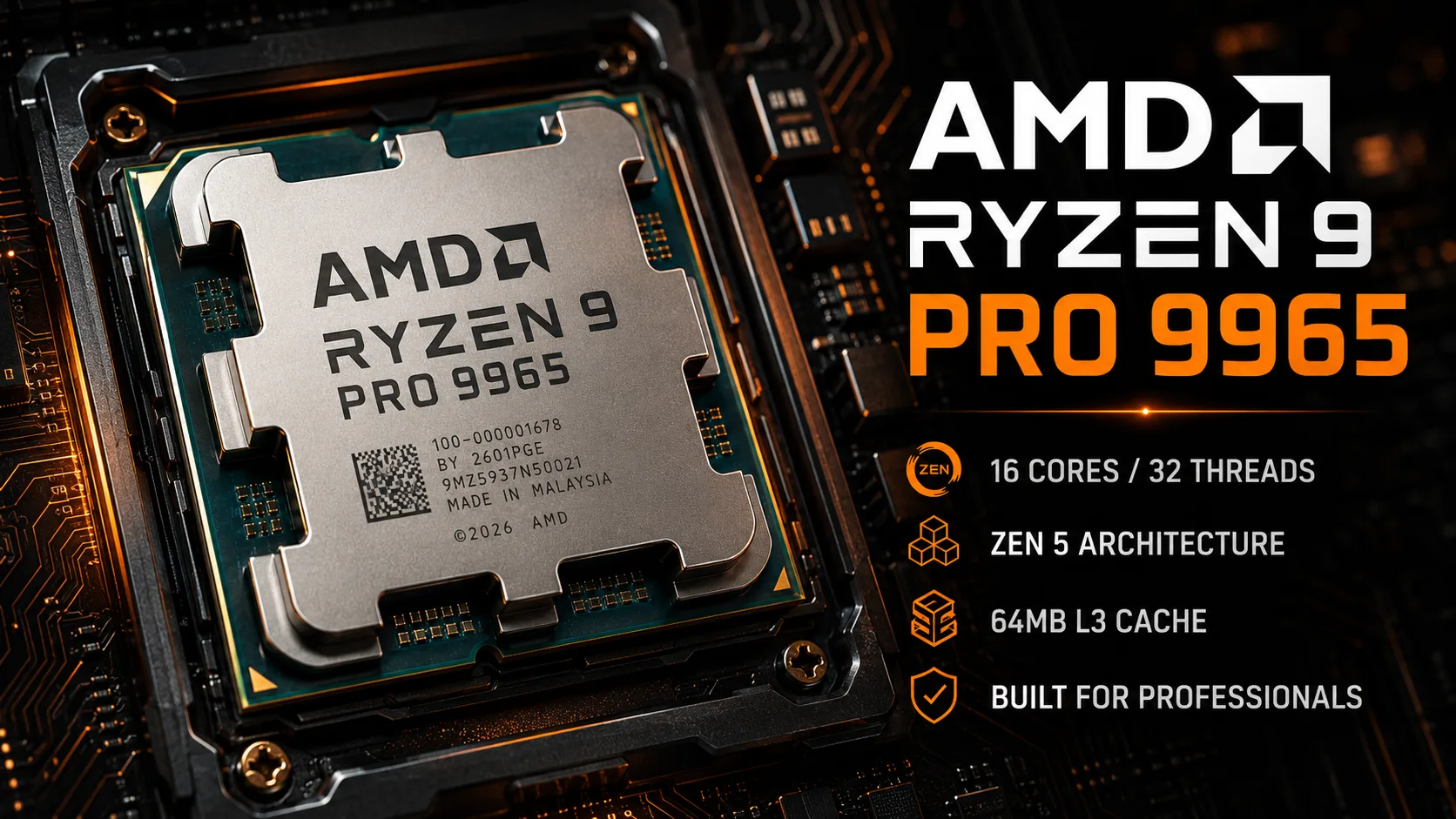
AMD Ryzen 9 PRO 9965: 16 Zen 5 Cores for Workstations
The AMD Ryzen 9 PRO 9965 is one of the higher-end processors in the Ryzen PRO 9000 lineup. Based on its specifications, it is similar to the Ryzen 9 9950X: 16 Zen 5 cores, 32 threads, clock speeds of 4.3-5.5 GHz, 64 MB of L3 cache, and a TDP of 170 W. However, it is not merely a "regular Ryzen 9 with a different name." This processor is designed for corporate desktop systems and workstations, where not only speed is crucial but also manageability, security, stable configurations, and long platform life cycle.
Unlike the Ryzen 9 PRO 9965X3D, this model does not feature 3D V-Cache. This is an important distinction: the Ryzen 9 PRO 9965 focuses not on increased cache but on a classic strong formula - 16 fast cores, high clock speeds, a modern AM5 platform, and a set of AMD PRO features.
Why This Processor Is Interesting
The main feature of the Ryzen 9 PRO 9965 is the combination of high multi-threaded performance and corporate positioning. It’s no longer a 12-core Ryzen PRO from the previous generation, but a full-fledged 16-core chip for workstations. For tasks such as compilation, rendering, engineering software, large project processing, virtual machines, and heavy multitasking, this configuration looks much more convincing.
Moreover, the Ryzen 9 PRO 9965 remains within the regular AM5 platform. It is not a Threadripper requiring a different motherboard, a different class of memory, and a significantly more expensive ecosystem. Therefore, it fits well in mid- to high-end workstations: more powerful than standard business PCs but simpler and cheaper than full-fledged Threadripper systems.
The essence of this model is not to achieve records at any cost. The Ryzen 9 PRO 9965 is appealing as a processor for ready-made professional systems, where performance must be combined with predictable behavior, remote management, and corporate support.
Performance and Benchmarks in PassMark
There is currently no direct stable PassMark result for the Ryzen 9 PRO 9965. Therefore, it is helpful to look at nearby models for reference: Ryzen 9 9950X as the retail equivalent without PRO, Ryzen 9 PRO 9965X3D as a neighboring PRO model with increased cache, Ryzen 9 9950X3D as an X3D benchmark, and Intel Core Ultra 9 285K as the relevant upper Intel competitor.
| Processor | CPU Mark | Single Thread | Comments |
|---|---|---|---|
| AMD Ryzen 9 9950X3D | 70 191 | 4 743 | Fast retail X3D benchmark |
| Intel Core Ultra 9 285K | 67 285 | 5 088 | Strong Intel benchmark, especially in single-thread |
| AMD Ryzen 9 9950X | 65 749 | 4 728 | Closest retail counterpart without X3D and without PRO |
| AMD Ryzen 9 PRO 9965X3D | 64 196 | 4 471 | PRO neighbor with 3D V-Cache, early result |
| Intel Core i9-14900K | 58 357 | 4 690 | Recognizable previous Intel flagship |
This table shows which processors can serve as a baseline when evaluating the Ryzen 9 PRO 9965. On one hand, there’s the Ryzen 9 9950X - almost the same 16-core logic without the corporate PRO designation. On the other hand, there’s the Ryzen 9 PRO 9965X3D, which is class-closer but uses 3D V-Cache and therefore behaves differently in cache-sensitive tasks.
It is logical to expect the Ryzen 9 PRO 9965 to perform on the level of the Ryzen 9 9950X, but with some allowances for the configurations of ready-made systems, BIOS, power limits, and corporate configurations. This is not a processor for manual overclocking and experimentation; rather, it is a model for workstations where stability and repeatability of behavior are more important.
The Intel Core Ultra 9 285K serves not as a direct PRO processor analog but as a benchmark for the upper desktop segment. It excels in single-thread performance and has a hybrid architecture with a larger number of cores, but it's a different platform and a different system logic.
How Ryzen 9 PRO 9965 Differs from Ryzen 9 9950X
The Ryzen 9 PRO 9965 and Ryzen 9 9950X are very close in basic concept: both have 16 cores, 32 threads, Zen 5 architecture, 64 MB of L3 cache, a TDP of 170 W, and support the AM5 platform. However, the difference between them is not just in the name.
The Ryzen 9 9950X is a retail processor for enthusiasts and DIY builds. It has a higher maximum boost clock and more freedom in tuning memory, power, and processor behavior. It’s a good option for those building their own PCs and looking to get the most out of cooling, BIOS, and memory.
The Ryzen 9 PRO 9965 is designed for a different scenario. It disables overclocking, AMD EXPO, Precision Boost Overdrive, and Curve Optimizer. For a home user, this may seem like a drawback, but for a corporate workstation, this logic is understandable. For the system manufacturer and IT department, a stable configuration, predictable parameters, and fewer variables for maintenance are more important.
How It Differs from Ryzen 9 PRO 9965X3D
The main difference from the Ryzen 9 PRO 9965X3D is the cache. The Ryzen 9 PRO 9965 has the standard 64 MB L3, while the X3D version has 128 MB L3 thanks to 3D V-Cache. In workloads sensitive to memory latency and data reuse, the X3D version may be more interesting. This applies to simulations, some engineering calculations, real-time visualization, certain gaming scenarios, and parts of workloads.
However, the regular Ryzen 9 PRO 9965 does not appear “inferior in terms.” It has the same 16-core foundation, the same 32 threads, the same TDP of 170 W, and the same frequency formula of 4.3-5.5 GHz. If an application is more focused on clock speeds, threads, and stable multi-threaded performance than on a large L3 cache, the difference from the X3D version may not be as dramatic.
In simpler terms: the Ryzen 9 PRO 9965X3D is more interesting for cache-sensitive tasks, while the Ryzen 9 PRO 9965 is a more classic and straightforward 16-core option for a versatile workstation.
PRO Features: Why Are They Needed
The PRO suffix is significant here. The Ryzen 9 PRO 9965 supports AMD PRO Technologies, remote management, security, and maintenance features. For a home PC, this almost doesn’t matter, but for a company, such capabilities may be more vital than a few percentage points difference in synthetic benchmarks.
A corporate system should not only perform quickly; it needs to be deployed, updated, inventoried, secured, remotely maintained, and kept in a stable configuration. That is why PRO processors are interesting not just to enthusiasts, but to manufacturers of ready-made workstations and IT departments.
Where It Excels
The Ryzen 9 PRO 9965 is best suited for tasks that require 16 powerful cores and high performance during extended workloads. This includes compiling large projects, CPU rendering, media processing, CAD/CAM, engineering applications, local computing, virtual machines, and heavy multitasking.
For a pure gaming PC, it is excessive and not the most logical choice. Here, it is simpler to consider Ryzen 7 9800X3D, Ryzen 7 9850X3D, or Ryzen 9 9950X3D. For tasks where a large L3 cache is critical, the Ryzen 9 PRO 9965X3D might be more interesting. And if extreme multi-threaded performance is necessary, then the Threadripper line should be considered.
The Ryzen 9 PRO 9965 occupies a space between these worlds. It is more powerful than a standard business processor, simpler and more affordable than Threadripper platforms, and better suited for corporate environments than the retail Ryzen 9 9950X.
Platform and Integrated Graphics
The processor uses the AM5 socket and supports DDR5, PCIe 5.0, up to 256 GB of memory, and ECC if supported by the motherboard. This is an important set for a workstation: performance often depends not only on the CPU but also on RAM size, storage speeds, platform reliability, and discrete graphics capabilities.
There is also integrated graphics - AMD Radeon Graphics with 2 graphic cores and a frequency of 2200 MHz. This is sufficient for outputting images, diagnostics, and basic office work, but not for professional 3D graphics. In a real workstation, the Ryzen 9 PRO 9965 will almost certainly be used alongside a discrete graphics card.
Conclusion
The AMD Ryzen 9 PRO 9965 is a classic 16-core Zen 5 processor for workstations: without 3D V-Cache, without overclocking, and without enthusiast freedom, but with a strong multi-threaded foundation, an AM5 platform, and the corporate capabilities of AMD PRO.
It should not be seen as the brightest processor in the lineup. That role is likely taken by the Ryzen 9 PRO 9965X3D with increased cache. However, the Ryzen 9 PRO 9965 might be an even clearer choice for a versatile workstation: 16 cores, 32 threads, 64 MB L3, 170 W, and predictable operation in ready-made professional systems.
If a home gaming PC is needed, it’s better to look at the X3D models. If maximum multi-threaded power is required, Threadripper is the more logical choice. But if a powerful, manageable, and relatively versatile AM5 workstation for business is needed, the Ryzen 9 PRO 9965 presents a very reasonable option.
CPU Comparison
Compare Ryzen 9 PRO 9965 with other CPUs
Basic
CPU Specifications
Memory Specifications
GPU Specifications
Miscellaneous
Benchmarks
Compared to Other CPU
Share in social media
Or Link To Us
<a href="https://cputronic.com/cpu/amd-ryzen-9-pro-9965" target="_blank">AMD Ryzen 9 PRO 9965</a>