AMD Ryzen 7 156
AMD Ryzen 7 156: Six Cores Instead of Eight
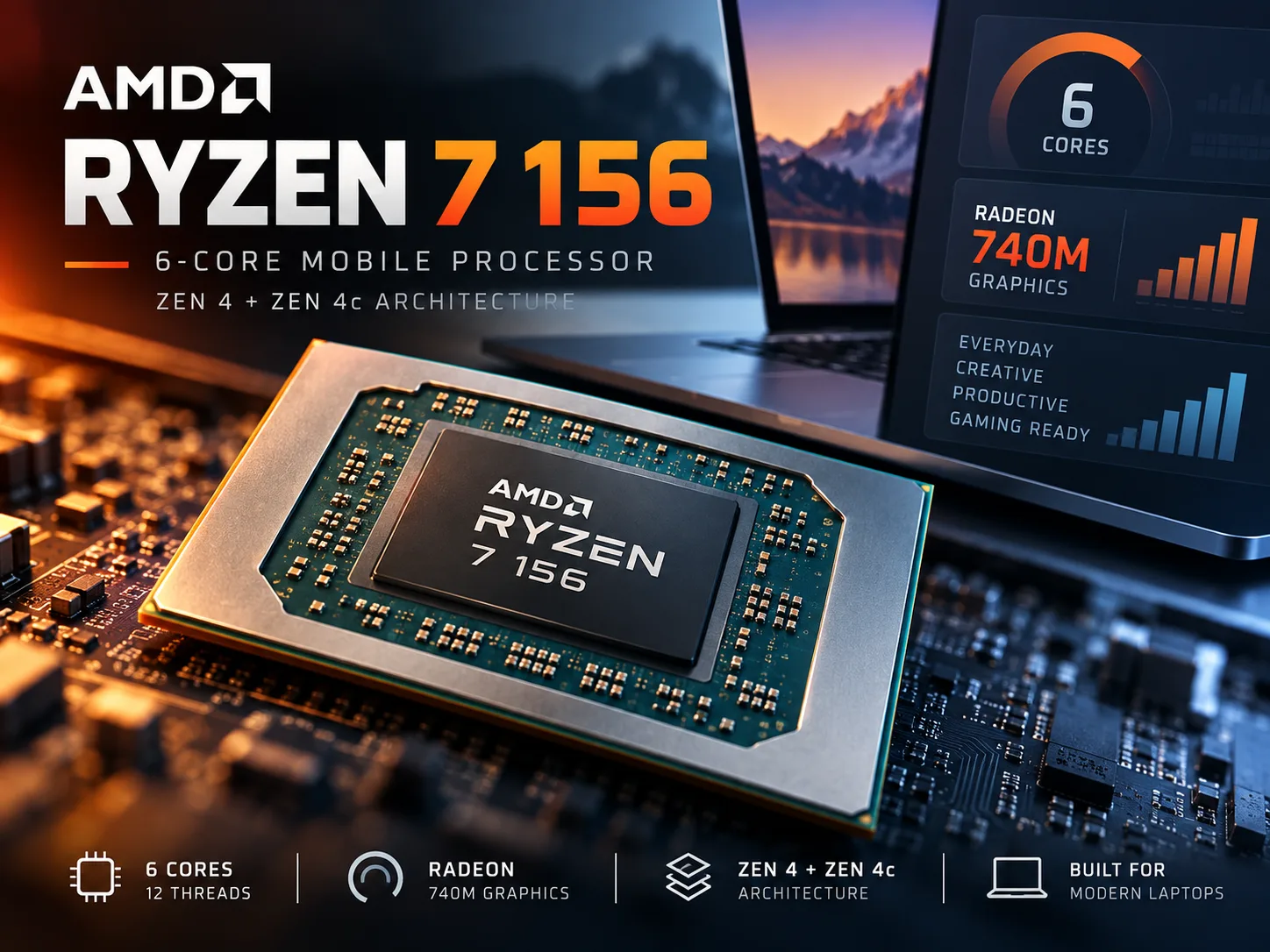
The AMD Ryzen 7 156 has six cores, although most modern mobile Ryzen 7 processors have eight. Two cores are based on Zen 4, while the other four use the compact Zen 4c variant. Its integrated Radeon 740M has just four compute units. In terms of configuration, the processor is closer to the Ryzen 5 8540U, which even has a higher maximum clock speed: 4.9 versus 4.7 GHz.
Ryzen 7 156 Compared with Ryzen 5 and Ryzen 7
The Ryzen 7 156 belongs to the Ryzen 100 series and the Hawk Point family. The processor is manufactured using TSMC’s 4 nm process, supports 12 threads, and boosts up to 4.7 GHz. It has 16 MB of L3 cache and a nominal TDP of 28 W.
| Processor | Cores / Threads | Boost | Graphics | TDP |
|---|---|---|---|---|
| Ryzen 7 156 | 2 Zen 4 + 4 Zen 4c / 12 | 4.7 GHz | Radeon 740M | 28 W |
| Ryzen 7 155 | 6 Zen 4 / 12 | 4.7 GHz | Radeon 740M | 35 W |
| Ryzen 5 8540U | 2 Zen 4 + 4 Zen 4c / 12 | 4.9 GHz | Radeon 740M | 28 W |
| Ryzen 5 8640U | 6 Zen 4 / 12 | 4.9 GHz | Radeon 760M | 28 W |
| Ryzen 7 250 | 8 Zen 4 / 16 | 5.1 GHz | Radeon 780M | 28 W |
The similarity to the Ryzen 5 8540U is not limited to the core count. Both processors have the same amount of L3 cache and the same integrated Radeon 740M graphics. The Ryzen 5 8640U has six Zen 4 cores and a more powerful Radeon 760M with eight compute units.
Zen 4c cores should not be equated with Intel’s energy-efficient E-cores. They support the same instructions and SMT multithreading as Zen 4, but take up less space on the die and are designed for lower clock speeds.
The Ryzen 7 156 supports DDR5-5600 and LPDDR5X memory, PCIe 4.0, and USB4 interfaces. Laptop manufacturers can configure the power limit within a range of 15-40 W. This model does not have a dedicated NPU.
CPU Performance: Comparison with the Ryzen 5 8540U
There are no confirmed independent Ryzen 7 156 results for a direct comparison yet. For an approximate estimate, tests of the Ryzen 5 8540U with a similar core configuration can be used.
The table contains Geekbench 6 results for five laptop models.
| Laptop and Processor | Single-Core | Multi-Core |
|---|---|---|
| Acer TravelMate P4 14, Ryzen 5 8540U | 2474 | 8221 |
| HP Pavilion 16, Ryzen 5 8540U | 2504 | 9280 |
| Acer Swift Edge 16, Ryzen 5 8640U | 2464 | 9903 |
| Lenovo ThinkPad E14 Gen 7, Ryzen 7 250 | 2499 | 10123 |
| HP EliteBook 8 G1a, Ryzen 7 250 | 2623 | 11206 |
The results of the two laptops with the Ryzen 5 8540U differ by nearly 13% in the multithreaded test. Performance is affected by power settings, cooling, and other laptop-specific characteristics. As a result, the same processor can produce noticeably different results in different devices.
The HP Pavilion 16 with the Ryzen 5 8540U scores 9280 points, while the HP EliteBook 8 G1a with the eight-core Ryzen 7 250 scores 11206. The latter laptop’s advantage is about 21%. Cooling and power settings may account for part of this difference, but the Ryzen 7 250’s two additional cores give it an advantage in multithreaded workloads.
Based on the specifications, there is no reason to expect a significant advantage for the Ryzen 7 156 over the Ryzen 5 8540U. Six cores are sufficient for office work, programming, and photo editing. The eight-core Ryzen 7 250 is better suited to compiling large projects and lengthy rendering workloads.
Radeon 740M: The Ryzen 7 156’s Weak Point
The Radeon 740M is based on the RDNA 3 architecture and operates at up to 2500 MHz. The Radeon 760M has twice as many compute units, while the Radeon 780M has three times as many. The difference is especially noticeable in games.
The results below come from testing the Radeon 740M in the HP Pavilion 16 with the Ryzen 5 8540U.
| Test | Result |
|---|---|
| 3DMark Time Spy Graphics | 1600 points |
| Dota 2, 1080p, high settings | 63 FPS |
| GTA V, 1080p, high settings | 41.4 FPS |
| Cyberpunk 2077, 1080p, low settings, without FSR | 21.5 FPS |
In Dota 2, the integrated graphics delivers 63 FPS, while in GTA V it produces around 41 FPS. However, in Cyberpunk 2077, the frame rate is just 21.5 FPS even at low settings. For demanding games, the resolution and graphics settings will have to be lowered, and a stable 30 FPS is not guaranteed.
The Ryzen 7 156 uses the same Radeon 740M, but results may differ because of the GPU clock speed, memory bandwidth, and power limits.
The Radeon 740M is sufficient for everyday work, video playback, and undemanding games. However, if modern gaming is also a consideration when buying a laptop, it is better to choose the Radeon 760M or 780M.
Is the Ryzen 7 156 Worth Buying?
The Ryzen 7 156 delivers sufficient performance for office work, studying, programming, and most home tasks. However, when buying a laptop, it should be compared not only with other Ryzen 7 processors but also with six-core Ryzen 5 models.
- Ryzen 5 8540U. If the laptops are equipped similarly, there is no reason to pay more for the Ryzen 7 156. Their processor configurations are virtually identical.
- Ryzen 5 8640U. If the price is comparable, it is the better choice: all six cores are Zen 4, and the Radeon 760M is more powerful than the Radeon 740M.
- Ryzen 7 250. Its eight cores and Radeon 780M are better suited to rendering, compiling large projects, and gaming. If the price difference is small, the Ryzen 7 250 is preferable.
Bottom line: The Ryzen 7 156 should primarily be considered as an alternative to the Ryzen 5 8540U. It offers no significant advantages over that processor in terms of specifications, and its higher model number does not justify paying extra. Choosing the Ryzen 7 156 may make sense if a laptop equipped with it is cheaper than competing models or offers better specifications for the same price.
CPU Comparison
Compare Ryzen 7 156 with other CPUs
Basic
CPU Specifications
Memory Specifications
GPU Specifications
Miscellaneous
Share in social media
Or Link To Us
<a href="https://cputronic.com/cpu/amd-ryzen-7-156" target="_blank">AMD Ryzen 7 156</a>