AMD Ryzen 5 126
AMD Ryzen 5 126: Four Cores and Lower Clock Speeds Than the Ryzen 3 8440U
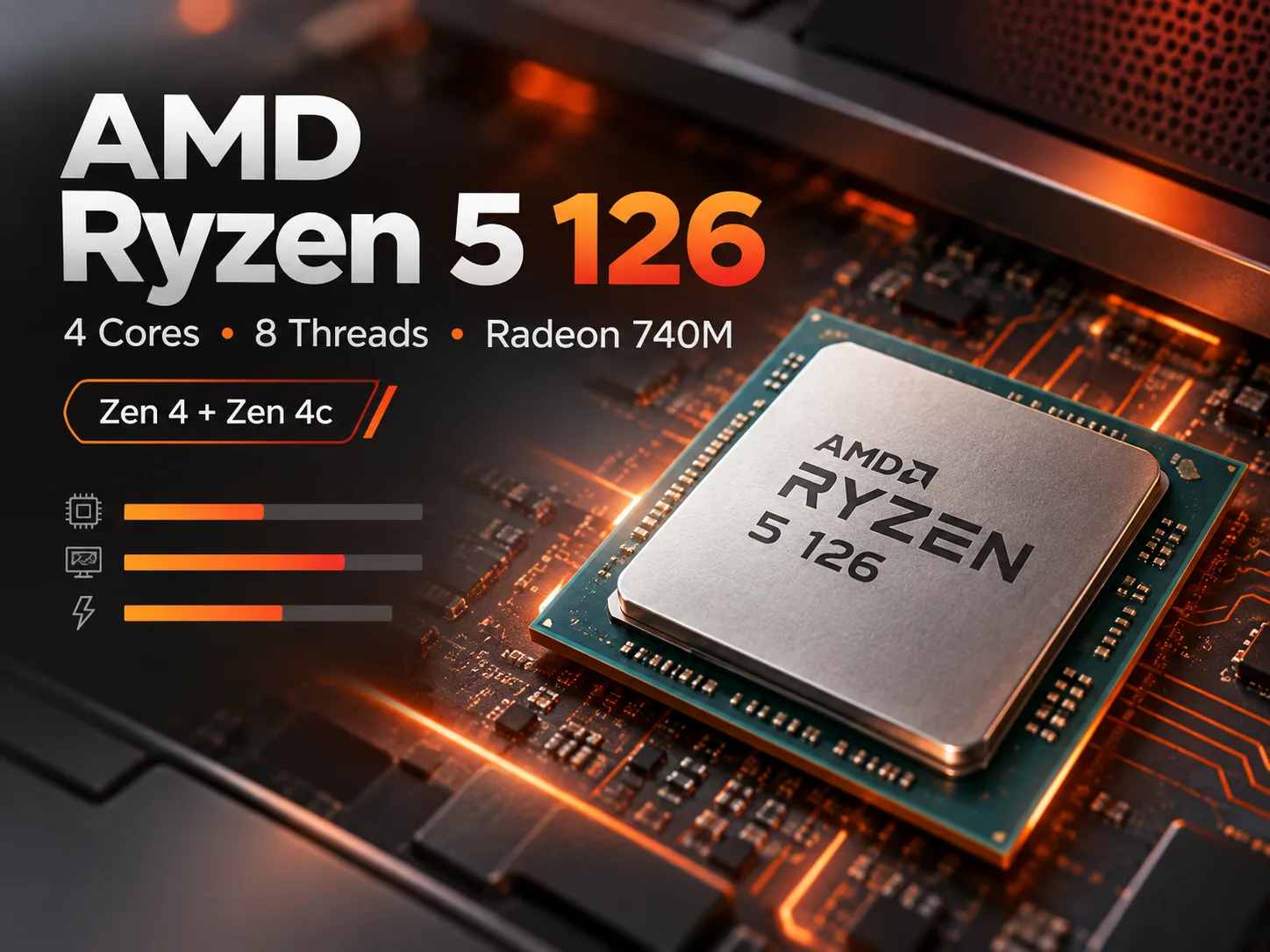
The AMD Ryzen 5 126 has the same core configuration as the earlier Ryzen 3 8440U: one Zen 4 core and three Zen 4c cores. Both processors support eight threads and feature Radeon 740M graphics. However, the Ryzen 3 8440U has higher rated maximum CPU and integrated graphics clock speeds. The Ryzen 5 126 uses the FP8 platform, but there are no direct benchmark results yet.
| Specification | Ryzen 5 126 | Ryzen 5 125 | Ryzen 3 8440U | Ryzen 5 8540U |
|---|---|---|---|---|
| Cores / threads | 4/8 | 4/8 | 4/8 | 6/12 |
| Architecture | 1 Zen 4 + 3 Zen 4c | Zen 4 | 1 Zen 4 + 3 Zen 4c | 2 Zen 4 + 4 Zen 4c |
| Max. CPU clock speed | 4.6 GHz | 4.5 GHz | 4.7 GHz | 4.9 GHz |
| L3 cache | 8 MB | 8 MB | 8 MB | 16 MB |
| Radeon 740M clock speed | 2300 MHz | 2300 MHz | 2500 MHz | 2800 MHz |
| DDR5 speed | Up to 5600 MT/s | Up to 4800 MT/s | Up to 5600 MT/s | Up to 5600 MT/s |
| Platform | FP8 | FP7r2 | FP7/FP7r2 | FP7/FP7r2 |
All four processors are manufactured using TSMC’s 4 nm process. Each has a nominal TDP of 28 W. The Ryzen 5 126 has a specified TDP range of 15-40 W. Performance under sustained load depends on the computer’s power settings and cooling.
How the Ryzen 5 126 Differs From the Ryzen 3 8440U
Zen 4c supports the same instruction set as Zen 4, but takes up less die area and is designed for lower operating frequencies. The single Zen 4 core allows the processor to reach higher clock speeds in single-threaded workloads, while the three compact Zen 4c cores save die area.
In multithreaded workloads, the Ryzen 5 126’s main limitation remains its four physical cores. Even with SMT support, it has fewer compute resources than six-core models, especially under sustained load.
The Ryzen 5 126’s rated maximum CPU clock speed is 100 MHz lower, while its Radeon 740M clock speed is 200 MHz lower. Both models have the same cache configuration: 4 MB of L2 and 8 MB of L3 cache.
The Ryzen 5 126 uses the FP8 platform and supports DDR5-5600, LPDDR5X, PCIe 4.0, and USB4. The Ryzen 3 8440U also supports DDR5-5600, so there is no advantage in this respect.
In terms of core configuration, the Ryzen 5 126 is closer to the Ryzen 3 8440U than to the six-core members of the Ryzen 5 series. Independent tests of the new model will show how much their real-world performance differs.
Geekbench 6 Performance
The article contains no confirmed Geekbench 6 results specifically for the Ryzen 5 126. For comparison, it includes the Ryzen 3 8440U with the same core configuration, the Ryzen 3 7440U, and two six-core AMD processors.
| Processor and device | Single-core | All cores |
|---|---|---|
| Ryzen 5 126 | No data | No data |
| Ryzen 3 7440U, HP EliteBook 845 G10 | 1,938 | 5,834 |
| Ryzen 3 8440U, test system with 16 GB of RAM | 2,218 | 6,005 |
| Ryzen 5 8540U, HP Pavilion 16-ag0057ng | 2,504 | 9,280 |
| Ryzen 5 8640U, Acer Swift Edge 16 SFE16-44 | 2,464 | 9,903 |
In the multithreaded test, the Ryzen 5 8540U outperformed the Ryzen 3 8440U by 55%, while the Ryzen 5 8640U was 65% faster. The results were obtained on different systems, but the difference clearly demonstrates the advantage of six physical cores over four.
These results do not represent the performance of the Ryzen 5 126 itself. Since it and the Ryzen 3 8440U have the same core configuration, similar results can be expected. Clock speeds, power settings, and cooling will affect the difference.
The Ryzen 5 126 is suitable for browsing, office applications, and small projects. Six-core models usually handle compiling large programs, rendering, and batch image processing faster.
Radeon 740M: Four RDNA 3 Compute Units and Gaming Limitations
The Radeon 740M is based on the RDNA 3 architecture and contains four compute units (256 stream processors). Its maximum clock speed in the Ryzen 5 126 is 2300 MHz.
There are no direct tests of the Ryzen 5 126 yet, but the capabilities of the Radeon 740M can be assessed using results from other laptops with this graphics solution.
| Device | Test | Result |
|---|---|---|
| Acer TravelMate P4, Ryzen 5 8540U | 3DMark Time Spy Graphics | 1,136 |
| HP Pavilion 16, Ryzen 5 8540U | 3DMark Time Spy Graphics | 1,600 |
| Lenovo Yoga Slim 6, Ryzen 5 7540U | 3DMark Time Spy Graphics | 1,699 |
| Lenovo Yoga Slim 6, Ryzen 5 7540U | Counter-Strike 2, 1080p Low | 72.7 FPS |
| Lenovo Yoga Slim 6, Ryzen 5 7540U | Cyberpunk 2077, 1080p Low, without FSR | 20.5 FPS |
In the two laptops with the Ryzen 5 8540U, Radeon 740M results in Time Spy differ by approximately 41%. Performance is affected by RAM, power settings, and cooling.
On the Lenovo Yoga Slim 6, Counter-Strike 2 delivers around 73 FPS at low settings in 1080p. The result in Cyberpunk 2077 is only around 20 FPS, so the Radeon 740M is poorly suited to demanding games.
The Ryzen 5 126 has a lower rated maximum Radeon 740M clock speed than the Ryzen 5 7540U used in the gaming test. Therefore, the same FPS cannot be expected.
The Radeon 760M is better suited to gaming: it has eight compute units instead of four and is faster than the Radeon 740M in most games.
Is the Ryzen 5 126 Worth Buying?
The Ryzen 5 126 is suitable for an inexpensive laptop if the main tasks are browsing, working with documents, and uncomplicated development. Four cores are already insufficient for heavy workloads, while the Radeon 740M limits gaming capabilities.
When choosing a computer, three points should be considered:
- For everyday work, the Ryzen 5 126 is sufficient, especially in a laptop with 16 GB of RAM and dual-channel memory.
- For multithreaded workloads, the Ryzen 5 8540U with six cores and twelve threads is preferable.
- For gaming, it is better to choose the Ryzen 5 8640U with Radeon 760M if the price difference is acceptable.
There are not yet enough retail offerings with the Ryzen 5 126 to determine a reasonable price for such a computer. At similar prices and with comparable configurations, the Ryzen 5 8540U is the better choice: it has two additional cores and significantly higher multithreaded benchmark results.
The Ryzen 5 126 makes sense primarily in cheaper laptops for everyday work. There is no reason to pay extra for the Ryzen 5 branding: in terms of core configuration, it is closer to the Ryzen 3 8440U than to the six-core Ryzen 5 models.
CPU Comparison
Compare Ryzen 5 126 with other CPUs
Basic
CPU Specifications
Memory Specifications
GPU Specifications
Miscellaneous
Share in social media
Or Link To Us
<a href="https://cputronic.com/cpu/amd-ryzen-5-126" target="_blank">AMD Ryzen 5 126</a>