AMD EPYC 8435P
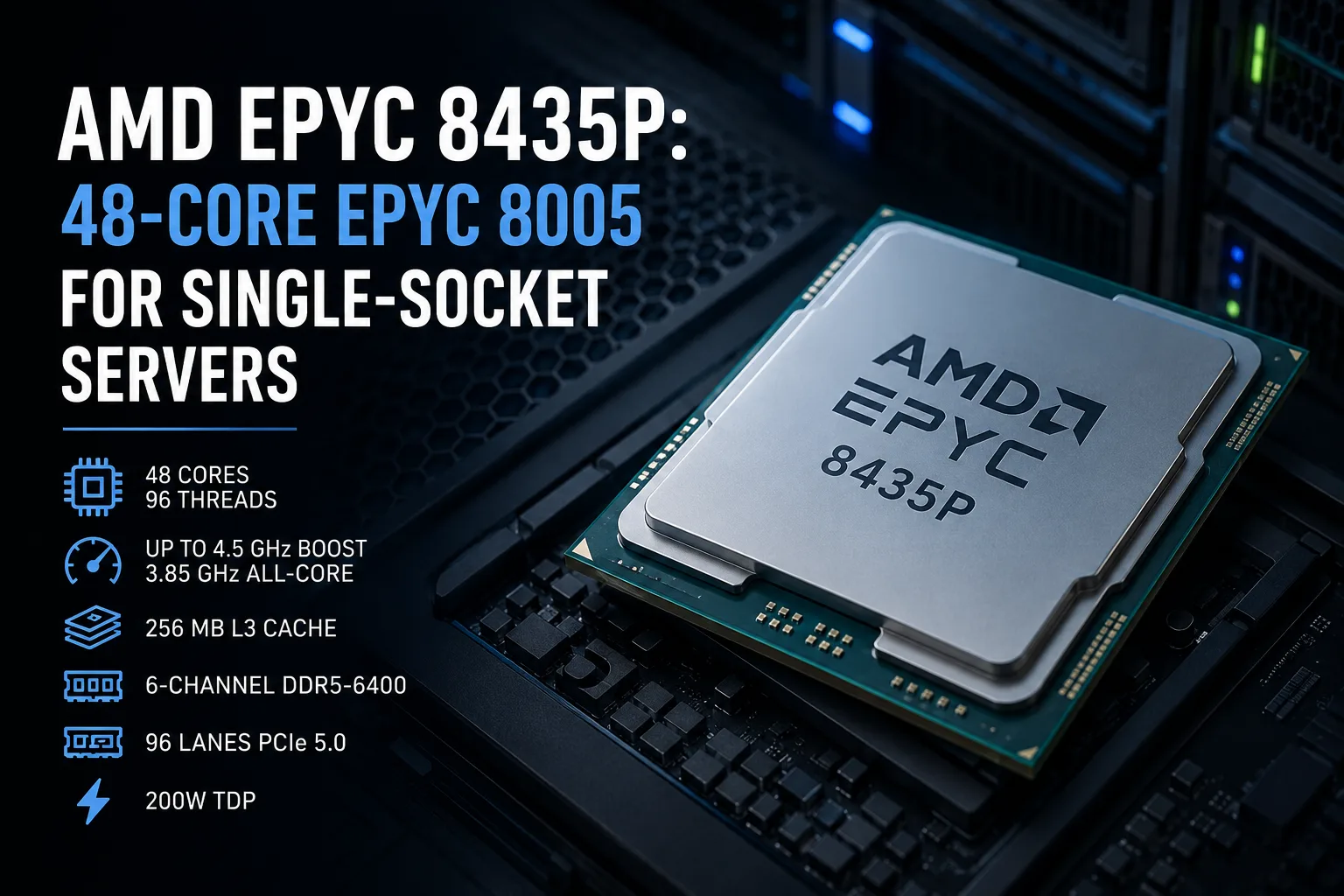
AMD EPYC 8435P: 48-core EPYC 8005 for Single-Socket Servers
The AMD EPYC 8435P is a 48-core server processor in the EPYC 8005 series designed for the SP6 platform and single-processor systems. It sits between the 32-core EPYC 8325P and the higher-end models with 64 and 84 cores. The model is interesting not for its maximum core count, but for its combination of price, frequencies, cache, and SP6 capabilities.
The processor features 48 cores, 96 threads, Zen 5 architecture, 256 MB of L3 cache, a TDP of 200W, 6-channel DDR5-6400 memory, and 96 PCIe 5.0 lanes. The EPYC 8435P does not replace the higher-end EPYC 9005s: they offer more memory channels, broader scaling capabilities, and higher limits for large server configurations. The role of the 8435P is different-providing 48 Zen 5 cores in a more compact SP6 platform.
What Changed Compared to the EPYC 8434P
The closest comparison point is the EPYC 8434P. Both models have 48 cores, 96 threads, SP6 socket, 1P configuration, and a TDP of 200W. However, the EPYC 8435P has transitioned to Zen 5, featured higher frequencies, double the L3 cache, and support for DDR5-6400.
| Parameter | EPYC 8434P | EPYC 8435P | Difference |
|---|---|---|---|
| Architecture | Zen 4c | Zen 5 | new core |
| Cores / Threads | 48 / 96 | 48 / 96 | unchanged |
| Base Frequency | 2.5 GHz | 2.45 GHz | nearly unchanged |
| Boost | up to 3.1 GHz | up to 4.5 GHz | 45% higher |
| All-core boost | 3.1 GHz | 3.85 GHz | about 24% higher |
| L3 Cache | 128 MB | 256 MB | 2 times larger |
| Memory | DDR5-4800 | DDR5-6400 | faster |
| Memory Bandwidth | 230.4 GB/s | 307 GB/s | about 33% higher |
| TDP | 200 W | 200 W | unchanged |
| Price 1KU | $2700 | $3099 | about 15% higher |
The update is significant: while the core count and TDP remained the same, frequencies, cache, and memory bandwidth increased. For virtualization, databases, storage servers, and mixed workloads, this is more important than merely retaining the same 48-core position in the lineup.
A standout feature is the L3 cache. The EPYC 8434P had 128 MB, while the EPYC 8435P has 256 MB. For server workloads, this is crucial beyond a simple cache size comparison: more working data stays closer to the cores, reducing memory access times, and the processor operates more stably with a larger number of parallel tasks.
Position in the EPYC 8005 Lineup
The EPYC 8435P is situated between the 32-core 8325P and the 64-core 8535P. It has a better price-per-core ratio than its closest neighbors.
| Model | Cores / Threads | L3 | TDP | Price 1KU | Price per Core |
|---|---|---|---|---|---|
| EPYC 8325P | 32 / 64 | 256 MB | 175 W | $2299 | ~$71.8 |
| EPYC 8435P | 48 / 96 | 256 MB | 200 W | $3099 | ~$64.6 |
| EPYC 8535P | 64 / 128 | 256 MB | 210 W | $5499 | ~$85.9 |
| EPYC 8635P | 84 / 168 | 384 MB | 225 W | $5799 | ~$69.0 |
The EPYC 8325P is cheaper but has a third fewer cores. The EPYC 8535P offers 64 cores, but it's significantly more expensive, and the L3 cache remains the same-256 MB. Thus, upgrading to the 8535P is justifiable only where 64 cores will be actively utilized.
In this context, the EPYC 8435P occupies a sensible middle ground: it is significantly more powerful than the 32-core model yet much cheaper than the 64-core option.
Expected Performance
Without independent tests, it is prudent not to specify a precise percentage increase. It’s better to evaluate the EPYC 8435P based on architectural changes: frequencies, L3 cache size, memory speed, and its placement within the lineup.
The technical advantages over the EPYC 8434P are evident in four areas: higher boost, higher all-core boost, double the L3, and faster memory. The most noticeable differences will be in mixed server workloads: virtualization, containers, databases, storage servers, hosting, and network services. In these tasks, cores, cache, memory, I/O, and stable frequency under long loads are all critical.
Where the AMD EPYC 8435P Fits
The EPYC 8435P is suitable for servers where a single powerful processor is needed without moving to the higher EPYC 9005 platform.
Appropriate scenarios include:
- Virtualization and containers;
- Medium-sized databases;
- Software-defined storage;
- Servers with numerous NVMe drives;
- Hosting and private cloud solutions;
- Edge systems;
- Telecom nodes and network services.
The primary use case is where 32 cores are already insufficient, and purchasing a 64- or 84-core model does not provide a performance or workload density return. In such configurations, the EPYC 8435P occupies a middle position without a steep cost increase.
Limitations
The main limitation of the EPYC 8435P is the SP6 platform. The processor is limited to a 1P configuration, has 6 memory channels, and 96 PCIe 5.0 lanes. This is sufficient for storage servers, edge systems, and hosting, but it is not AMD's high-end server platform.
For those needing 12 memory channels, dual-processor configurations, or maximum core density, it is better to consider the EPYC 9005. The EPYC 8435P is tailored for a different class of systems: a single processor, moderate power consumption, modern I/O, and 96 threads for parallel tasks.
Moreover, the 8435P may not always be more cost-effective than lower models. If a workload does not utilize more than 32 cores, the EPYC 8325P may be more rational. Likewise, if a task scales well to 64 cores and beyond, it’s worth comparing the cost and performance of the EPYC 8535P or 8635P.
Conclusion
The AMD EPYC 8435P is one of the most logical models in the EPYC 8005 series. It is not a flagship, but it stands out for its balance of characteristics: 48 Zen 5 cores, 256 MB of L3 cache, high frequencies, DDR5-6400, and PCIe 5.0 in the SP6 platform.
Compared to the EPYC 8434P, it represents a noticeable step forward: more cache, higher frequencies, and faster memory with the same core count and TDP. Within the EPYC 8005 lineup, it maintains a favorable position: it is more powerful than the 8325P and significantly cheaper than the 8535P.
Choose the EPYC 8435P for servers requiring a single processor where 32 cores are no longer sufficient, and transitioning to 64 or 84 cores is not justified. This is not the maximum server platform from AMD, but a balanced solution for virtualization, storage servers, hosting, and mixed workloads.
CPU Comparison
Compare EPYC 8435P with other CPUs
Basic
CPU Specifications
Memory Specifications
Interfaces and Ports
Miscellaneous
Share in social media
Or Link To Us
<a href="https://cputronic.com/cpu/amd-epyc-8435p" target="_blank">AMD EPYC 8435P</a>