AMD EPYC 8125P
AMD EPYC 8125P: 16 Zen 5 Cores for Single-Socket SP6 Servers
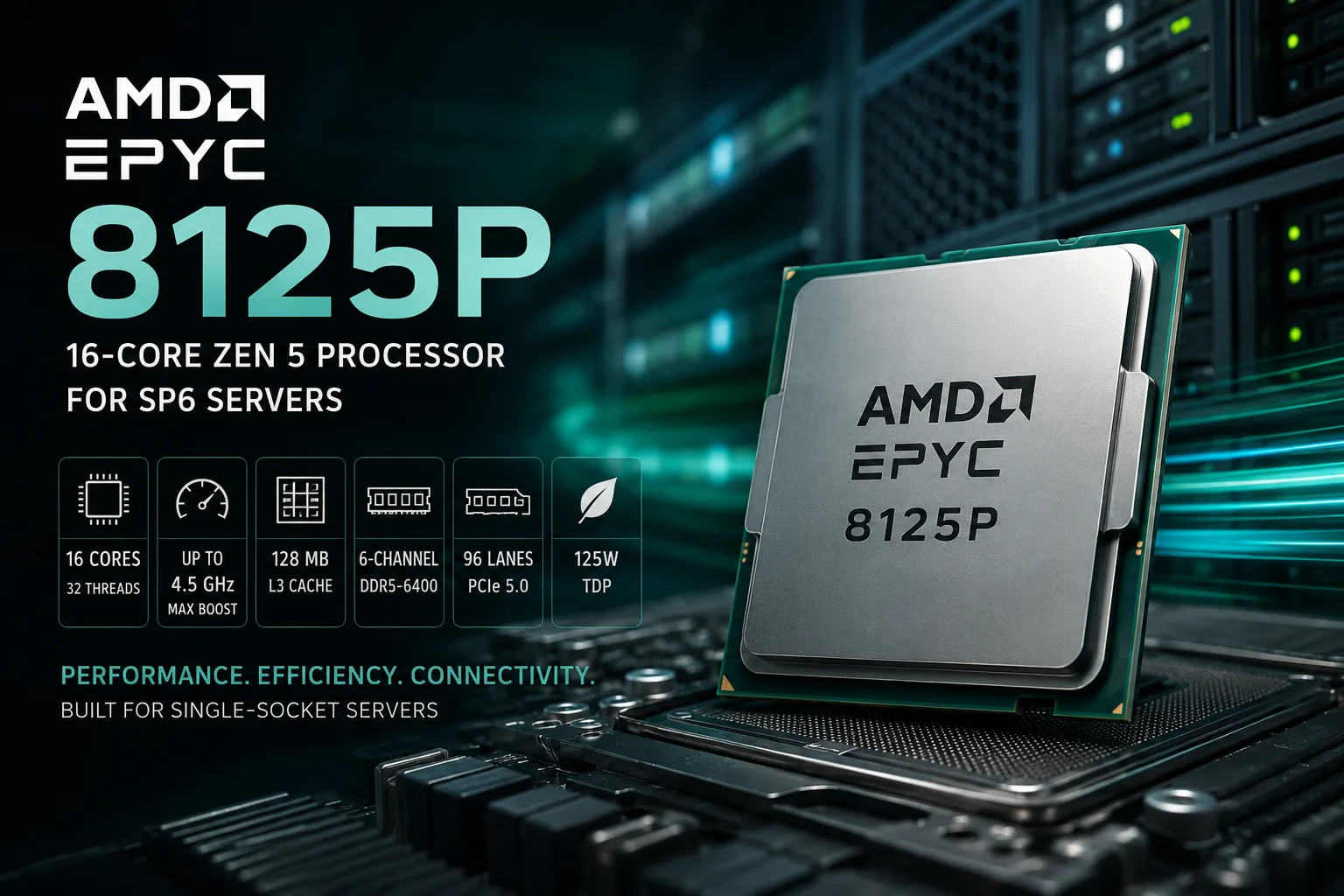
The AMD EPYC 8125P is a server processor from the EPYC 8005 line designed for single-socket systems on the SP6 platform. It is not a model aimed at maximizing the number of virtual machines nor a replacement for the higher-end EPYC 9005. Its purpose is to provide 16 Zen 5 cores, 128 MB of L3 cache, DDR5-6400 support, and 96 PCIe 5.0 lanes with a TDP of 125W.
The value of the EPYC 8125P does not lie in the number of cores. While 16 cores represent the lower configuration for EPYC 8005, the processor retains the strengths of the SP6 platform: six memory channels, a large L3 cache, and numerous PCIe 5.0 lanes. Therefore, the EPYC 8125P should be considered not as a general-purpose entry-level EPYC but as a processor for systems where frequency, memory, NVMe storage, and network adapters are crucial.
EPYC 8125P vs. EPYC 8124P: What Has Changed
The EPYC 8124P was a 16-core SP6 processor based on Zen 4c. Its limitations are evident in key specifications: boost up to 3.0 GHz, 64 MB of L3 cache, and support for DDR5-4800. The EPYC 8125P retains 16 cores and TDP of 125W but moves to the Zen 5 architecture, achieving a maximum boost of up to 4.5 GHz, 128 MB of L3 cache, and support for DDR5-6400.
| Parameter | EPYC 8124P | EPYC 8125P |
|---|---|---|
| Architecture | Zen 4c | Zen 5 |
| Cores / Threads | 16 / 32 | 16 / 32 |
| Maximum Boost | up to 3.0 GHz | up to 4.5 GHz |
| L3 Cache | 64 MB | 128 MB |
| Memory | DDR5-4800 | DDR5-6400 |
| Memory Bandwidth | 230.4 GB/s | 307 GB/s |
| TDP | 125W | 125W |
Thus, the EPYC 8125P is not a cosmetic update. The strong suit of the EPYC 8124P was the SP6 platform: six memory channels, 96 PCIe 5.0 lanes, and a single-processor configuration. However, low boost and 64 MB of L3 cache limited it in mixed workloads and tasks sensitive to single-core performance. The EPYC 8125P changes this ratio: with higher frequencies, double the cache, and faster memory.
Suitable Servers for EPYC 8125P
The EPYC 8125P is well-suited for servers where not only cores are important but also PCIe lanes, memory, and network interfaces. Typical scenarios include dedicated hosting for entry-level and mid-range applications, edge nodes, network services, small databases, caches, CDN, software-defined storage, and servers with a high number of NVMe drives.
An important part of the SP6 platform is the 96 PCIe 5.0 lanes. For a 16-core processor, this is a significant advantage: a single-processor server can be built with a fast network adapter, several NVMe drives, and additional controllers without having to move to the higher-end SP5 platform or a dual-processor configuration.
In hosting, the EPYC 8125P is suitable for moderate virtualization and network services. The 32 threads are sufficient for such loads, while the 128 MB of L3 cache is beneficial in mixed server scenarios. It is particularly well-suited for tasks where performance relies on frequency, latency, memory, or the speed of NVMe drives.
EPYC 8125P vs. Neighboring Models
In the EPYC 8005 line, this model sits between the 8-core EPYC 8025P and the 24-core EPYC 8225P. The EPYC 8025P is a lower-tier option: 8 cores and 64 MB of L3. The EPYC 8225P offers 24 cores and 48 threads but has a TDP of 160W and is priced higher. The EPYC 8125P fills the gap between 8 and 24 cores: 16 cores, 128 MB of L3, and the same 96 PCIe 5.0 lanes of the SP6 platform.
If the server requires basic networking functions, lightweight services, or a cost-effective node with a high number of PCIe lanes, the EPYC 8025P could be considered. If the workload scales well on 24 cores, it is more logical to look at the EPYC 8225P. The EPYC 8125P is needed in intermediate scenarios: when 8 cores are already insufficient but 24 cores are not yet necessary.
Who Does Not Need EPYC 8125P
The EPYC 8125P should not be chosen for dense virtualization, a large number of containers, or heavy multi-threaded tasks. In such scenarios, it is better to consider the EPYC 8225P, 8325P, or higher models in the EPYC 8005 line. They provide more cores and are better suited for workloads that truly leverage additional threads.
It is also not suitable for dual-processor systems. The EPYC 8125P is a 1P processor for SP6, meaning it is designed for servers with a single CPU. If two processors, more memory channels, or a higher-end platform are needed for heavy data center workloads, it is advisable to look towards the EPYC 9005 on SP5.
Conclusion
The AMD EPYC 8125P is not a model for maximizing thread count; rather, it is a 16-core server processor with a strong platform surrounding it. Its main advantage lies in the combination of Zen 5 architecture, 128 MB of L3 cache, DDR5-6400 memory support, and 96 PCIe 5.0 lanes at a TDP of 125W.
Compared to the EPYC 8124P, the new model significantly gains in terms of frequency, cache, and memory. The maximum boost has increased from 3.0 to 4.5 GHz, L3 has grown from 64 to 128 MB, and memory support has improved from DDR5-4800 to DDR5-6400. Therefore, the EPYC 8125P is better suited for edge servers, storage, network services, and moderate virtualization.
Transitioning to the EPYC 8225P or higher models is justified only if the workload truly utilizes more than 16 cores. If a single-socket SP6 server with high boost, large cache, 96 PCIe 5.0 lanes, and without transitioning to a 24-core model is needed, the EPYC 8125P is better for this role than the EPYC 8124P.
CPU Comparison
Compare EPYC 8125P with other CPUs
Basic
CPU Specifications
Memory Specifications
Interfaces and Ports
Miscellaneous
Related CPU Comparisons


Share in social media
Or Link To Us
<a href="https://cputronic.com/cpu/amd-epyc-8125p" target="_blank">AMD EPYC 8125P</a>