AMD EPYC 8025P
AMD EPYC 8025P: 8 Zen 5 cores for single-processor SP6 servers
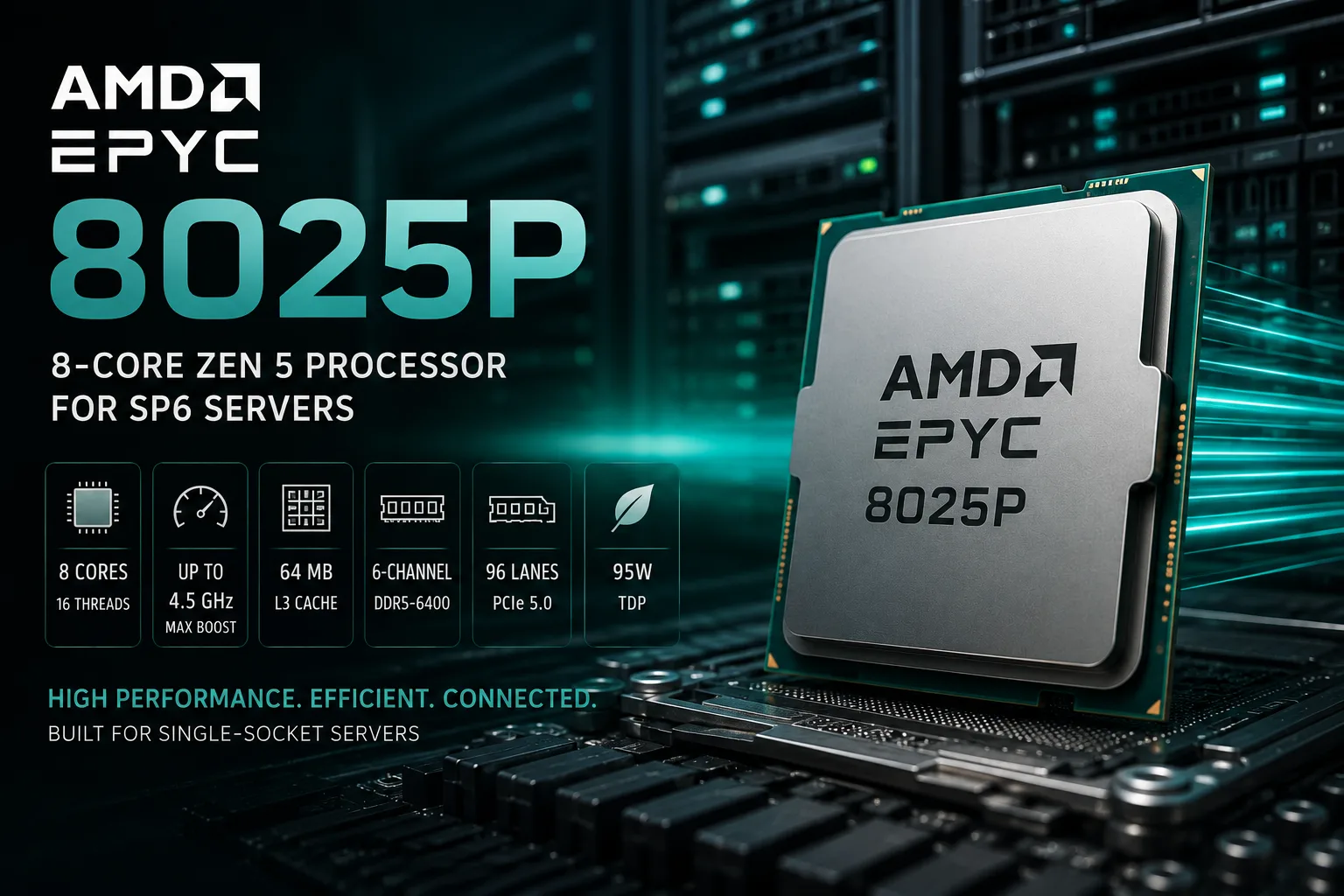
The AMD EPYC 8025P is an 8-core entry-level model of the EPYC 8005 line for single-processor servers on the SP6 platform. It is not a processor for dense virtualization or heavy multi-threaded tasks. Its purpose is to offer Zen 5, high boost speeds, 64 MB L3 cache, DDR5-6400 memory, and 96 PCIe 5.0 lanes with a TDP of 95 watts.
The EPYC 8025P combines 8 cores with the capabilities of the SP6 server platform. For an 8-core processor, this is a rare configuration: 96 PCIe 5.0 lanes, six channels of DDR5-6400 memory, and a memory bandwidth of 307 GB/s. Therefore, the EPYC 8025P should be viewed not as a general-purpose entry-level server processor but as a processor for systems where frequency, memory, NVMe storage, and network adapters are critical.
EPYC 8025P vs. EPYC 8024P: What's Different
The EPYC 8024P was the entry-level 8-core model of the EPYC 8004 on the SP6 platform. It had 8 cores, 16 threads, a boost frequency of up to 3.0 GHz, 32 MB of L3 cache, DDR5-4800 memory, and a TDP of 90 watts. The EPYC 8025P maintains the same position in the lineup-8 cores for the single-processor SP6 platform-but uses the Zen 5 architecture, achieves boost speeds up to 4.5 GHz, includes 64 MB of L3 cache, and supports DDR5-6400 memory. Memory bandwidth has increased from 230.4 to 307 GB/s.
| Parameter | EPYC 8024P | EPYC 8025P |
|---|---|---|
| Architecture | Zen 4c | Zen 5 |
| Cores / Threads | 8 / 16 | 8 / 16 |
| Maximum Boost | up to 3.0 GHz | up to 4.5 GHz |
| L3 Cache | 32 MB | 64 MB |
| Memory | DDR5-4800 | DDR5-6400 |
| Memory Bandwidth | 230.4 GB/s | 307 GB/s |
| TDP | 90 W | 95 W |
Thus, the EPYC 8025P is not a formal upgrade in the lineup. The number of cores has not changed, but frequencies are higher, the L3 cache has doubled, and memory is faster. Meanwhile, the TDP has only increased from 90 to 95 watts. If 8 cores are sufficient, the gains come from frequency, cache, memory, and NVMe storage. The difference from the EPYC 8024P will be significant in such scenarios.
Suitable Servers for the EPYC 8025P
The EPYC 8025P is suitable for servers where high thread counts are not required, but six memory channels and 96 PCIe 5.0 lanes are needed. Typical scenarios include edge nodes, network services, small databases, caches, CDN nodes, network gateways and routers, entry-level dedicated hosting, storage servers with multiple NVMe drives, and infrastructure services.
The key argument for the EPYC 8025P is the 96 PCIe 5.0 lanes. For an 8-core processor, this is a strong advantage: a server can be built with a fast network adapter, multiple NVMe drives, and additional controllers without moving to a more expensive SP5 platform.
Another scenario includes services with moderate parallelism, where frequency is more critical than the number of threads. The all-core boost of 4.25 GHz is suitable for networking applications, management services, small databases, and servers where the processor often serves storage and network needs rather than performs heavy computations.
EPYC 8025P vs. Neighboring Models
In the EPYC 8005 lineup, this is the entry-level model: 8 cores, 16 threads, 64 MB L3, and 95 W TDP. The next step up is the EPYC 8125P with 16 cores, 32 threads, 128 MB L3, and 125 W TDP. Above that is the EPYC 8225P with 24 cores, 48 threads, 128 MB L3, and 160 W TDP. All of these models share the same platform: SP6, DDR5-6400, six memory channels, and 96 PCIe 5.0 lanes.
If a server needs basic networking functions, NVMe storage, and several infrastructure services, the EPYC 8025P is sufficient. If the workload includes more virtual machines, containers, or databases, it makes more sense to consider the EPYC 8125P. If tasks scale well with 24 cores, it's better to switch to the EPYC 8225P.
Who Doesn't Need the EPYC 8025P
The EPYC 8025P should not be used for dense virtualization, a large number of containers, or heavy multi-threaded tasks. 8 cores and 16 threads will quickly become a limitation if the server needs to handle many independent workloads. In such scenarios, it's better to choose the EPYC 8125P, and for more dense virtualization, the EPYC 8225P or higher models from the EPYC 8005 line.
It is also not suitable for dual-processor systems. The EPYC 8025P is a 1P processor for SP6, meaning it is designed for servers with a single CPU. If two processors, more memory channels, or a higher-end data center platform are needed, it's better to consider the EPYC 9005 on the SP5 platform.
Conclusion
The AMD EPYC 8025P is not a processor for maximum thread counts. It is the entry-level EPYC 8005 model for single-processor servers where high frequency, memory, 96 PCIe 5.0 lanes, and low TDP are important. The main value of this model lies not in the number of cores but in the combination of Zen 5, boost speeds up to 4.5 GHz, 64 MB L3, DDR5-6400, and 96 PCIe 5.0 lanes.
The EPYC 8025P outperforms the EPYC 8024P in terms of frequency, cache, and memory. Boost speeds have increased from 3.0 GHz to 4.5 GHz, L3 has grown from 32 MB to 64 MB, and memory support has upgraded from DDR5-4800 to DDR5-6400. Meanwhile, the TDP has only risen by 5 watts. For edge servers, network nodes, small storage solutions, and entry-level hosting, this is a faster option within the same 8-core SP6 model.
Moving to the EPYC 8125P or EPYC 8225P is justified if the workload utilizes more than 8 cores. If an affordable single-processor SP6 server with high frequency, NVMe storage, and network cards is needed without transitioning to a 16 or 24-core model, the EPYC 8025P occupies the entry position in the EPYC 8005 lineup.
CPU Comparison
Compare EPYC 8025P with other CPUs
Basic
CPU Specifications
Memory Specifications
Interfaces and Ports
Miscellaneous
Share in social media
Or Link To Us
<a href="https://cputronic.com/cpu/amd-epyc-8025p" target="_blank">AMD EPYC 8025P</a>